It was a very cold night and we woke to find ice on the top of our roof vent. However we were snug and warm and so were the boys in their swags.
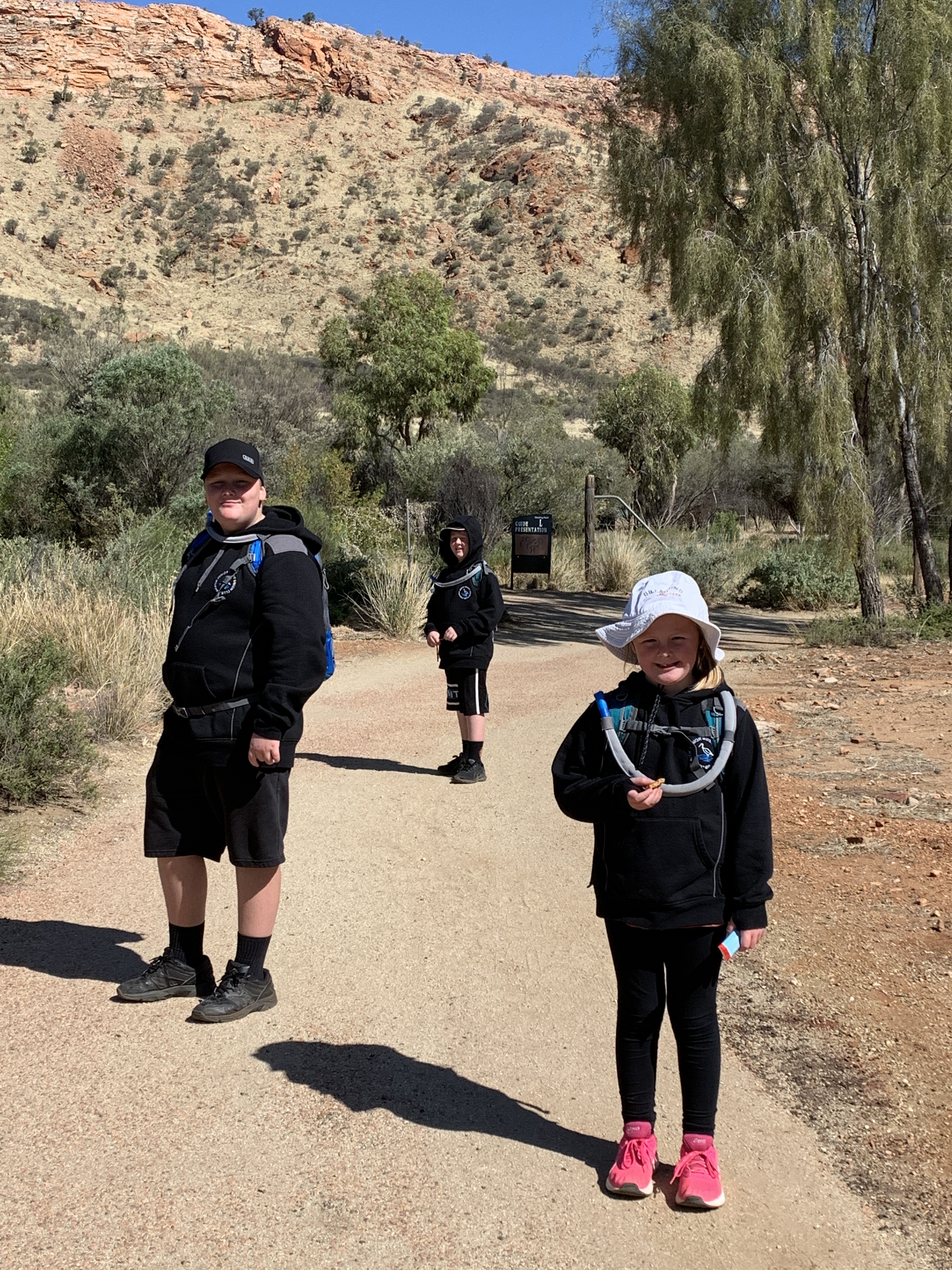
We packed our backpacks and set off westwards to explore Redbank Gorge. There’s a 5km unsealed, rocky and corrugated road to the carpark and two camping areas. From Redbank Gorge carpark you can do the walk to the summit of Mt Sondor, the highest point in the West McDonells.
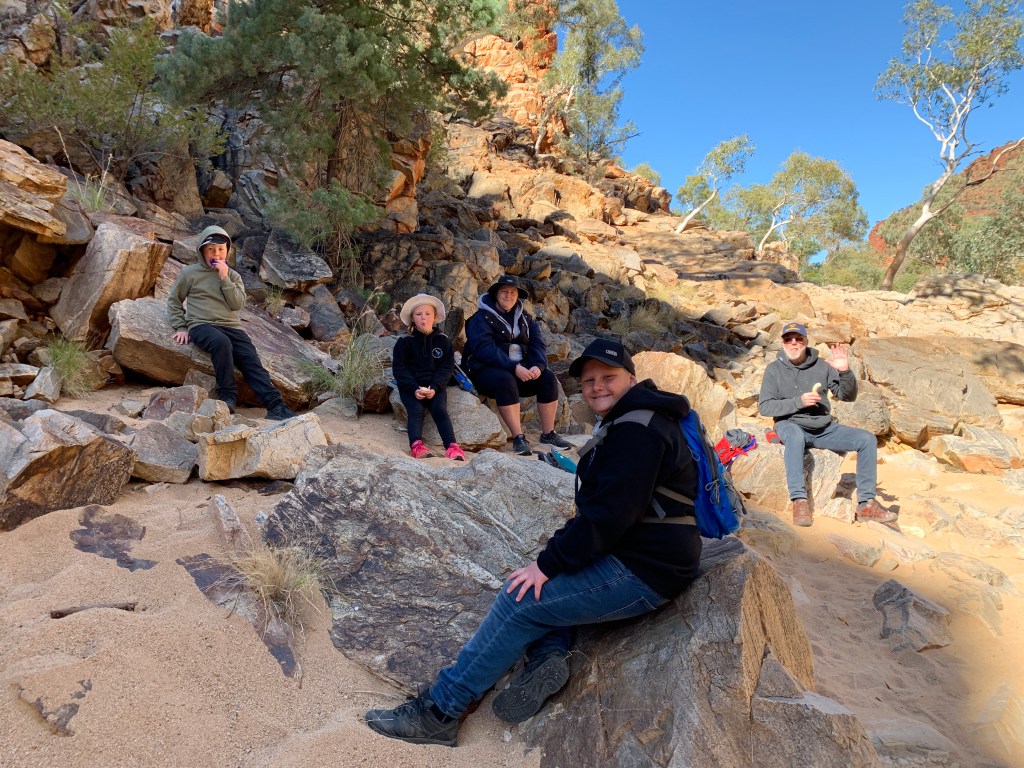
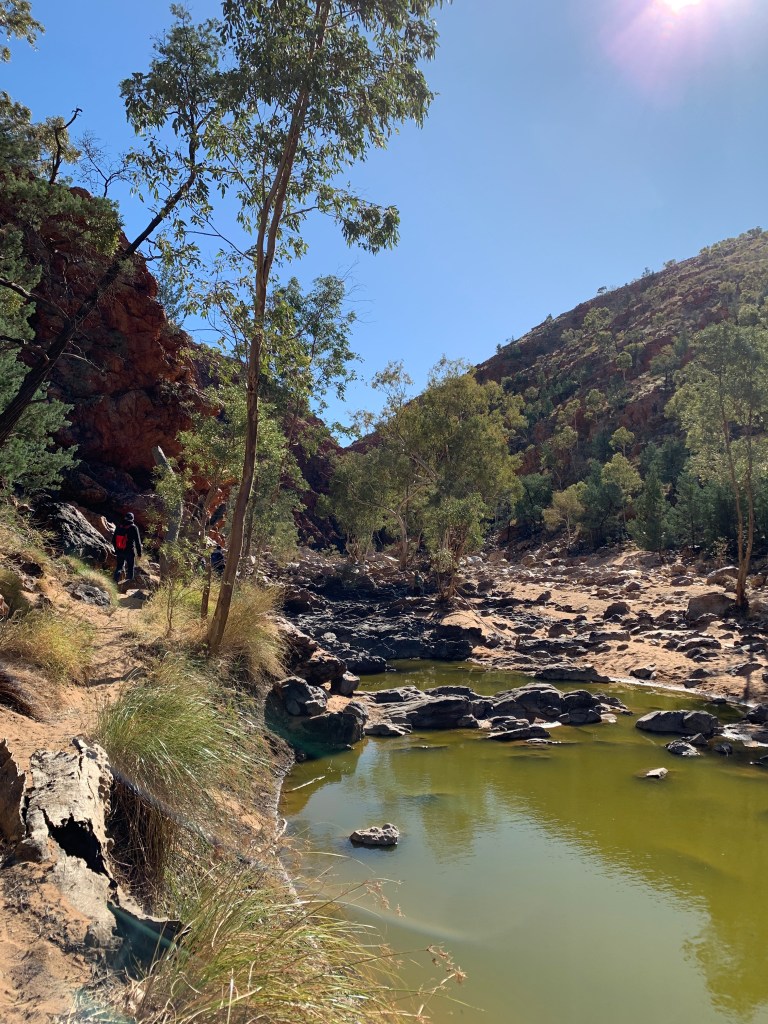
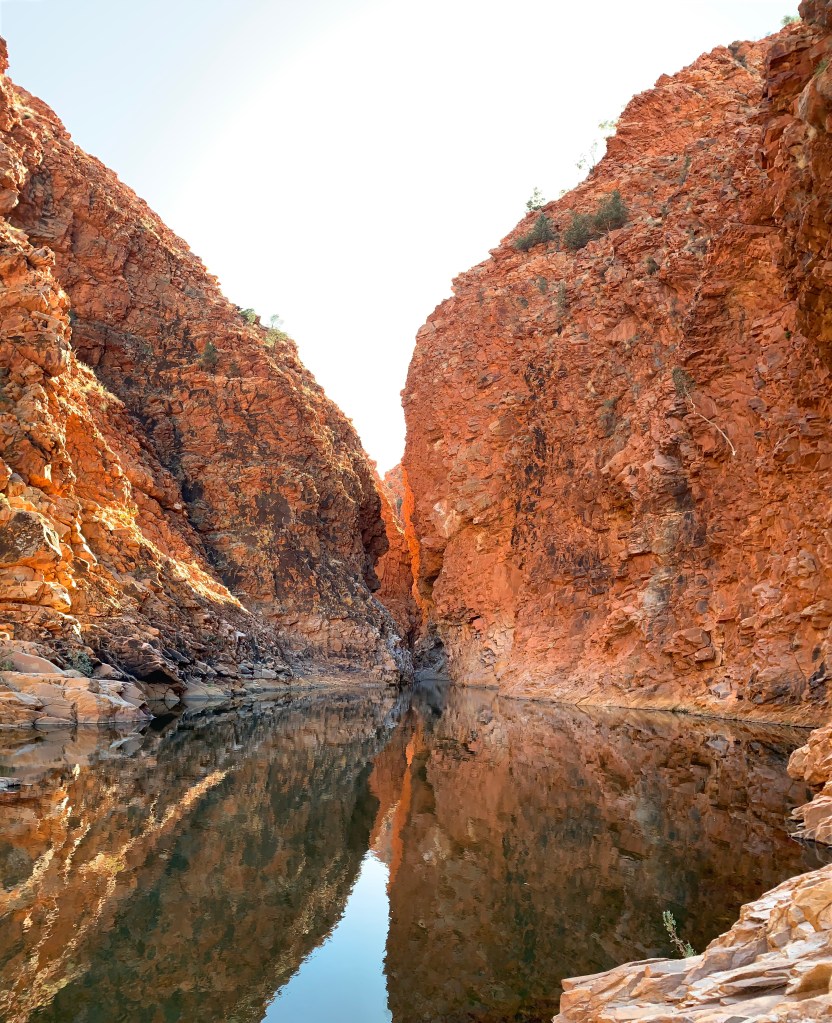
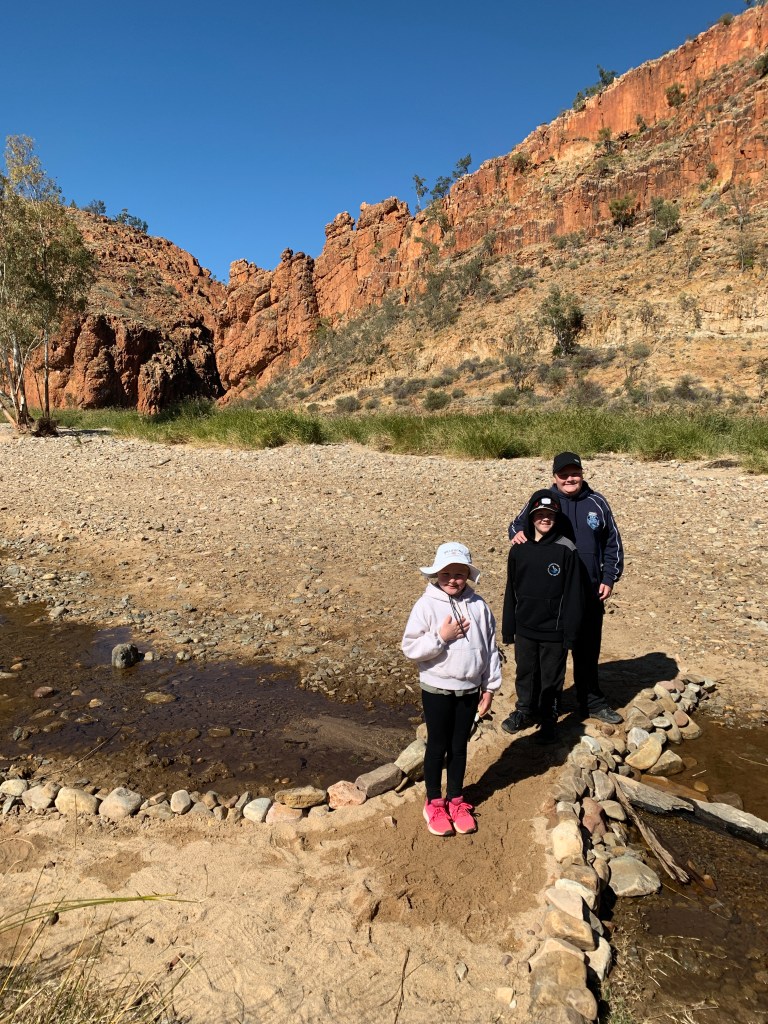
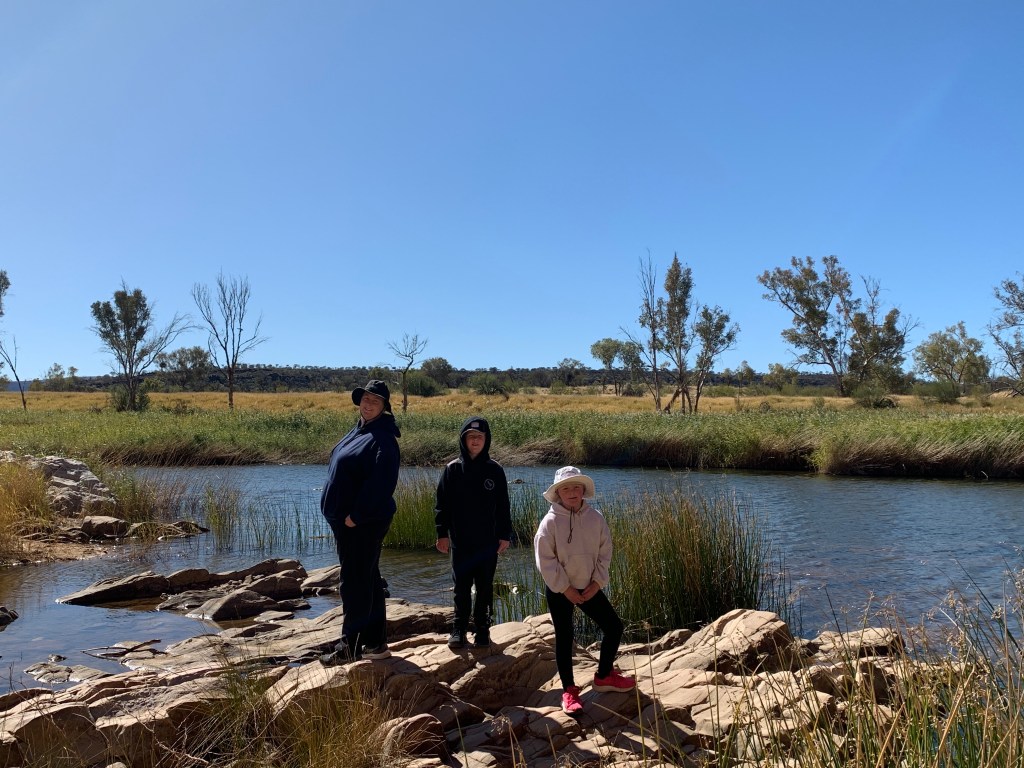
We followed the path to the gorge and it quickly became a scramble over rocks instead of a path. We reached the gorge at the end after negotiating the rocky waterway and were rewarded with the sight of another beautiful waterhole surrounded by towering red sandstone cliffs. Stunning! You can swim through the gorge however as the water is extremely cold a floatation device is recommended. None of us had any desire to get into that cold water. It would be great to do in warmer weather though.
We stopped at the gorge for lunch before making out way back across the rocks until we finally reached the path. It had taken us 2 hours to walk in and back out. We all felt this was the hardest walk we’d been on so far due to having to pick your way carefully over the rocky river bed without falling or twisting an ankle.
Redbank Gorge
Back at camp the afternoon was spent reading, playing games, blogging and watching a couple of movies in the motorhome. Pa had a couple of little visitors for a movie session.
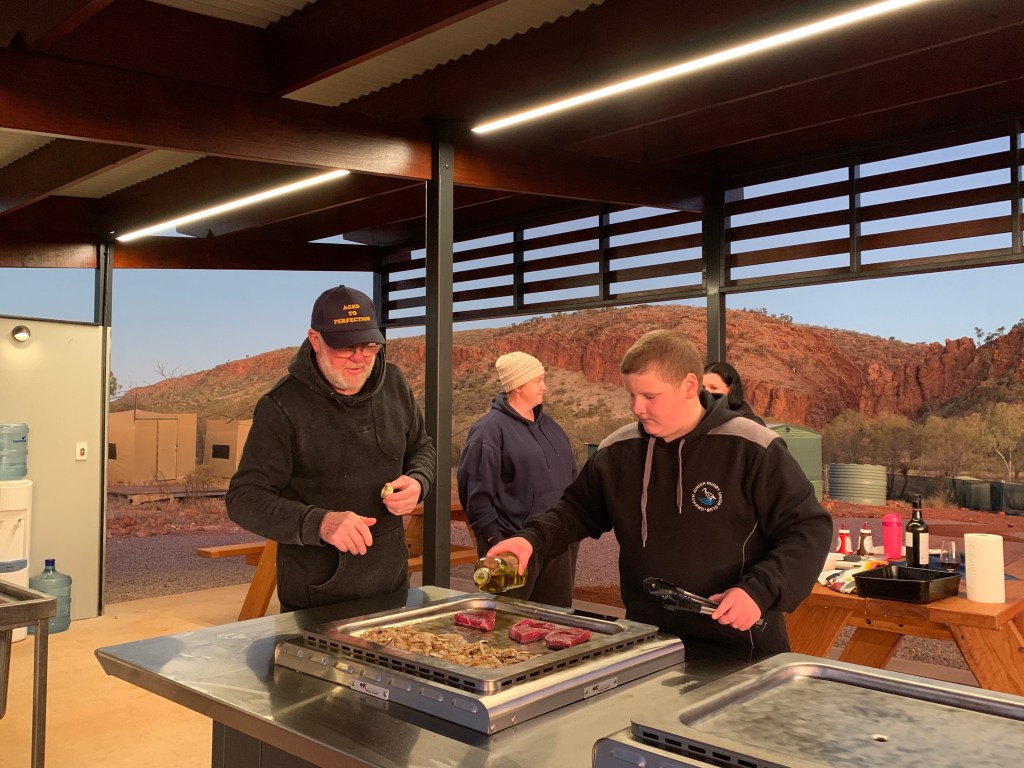
Pa and Riley were in charge of cooking our steaks on the camp kitchen BBQ and quite some time was spent discussing the difference between cooking a rare steak and a well-done one. Riley cooked the onions and steaks under Pa’s instructions and did a fabulous job of ensuring there was steak to meet each persons tastes. My steak was a perfect medium.
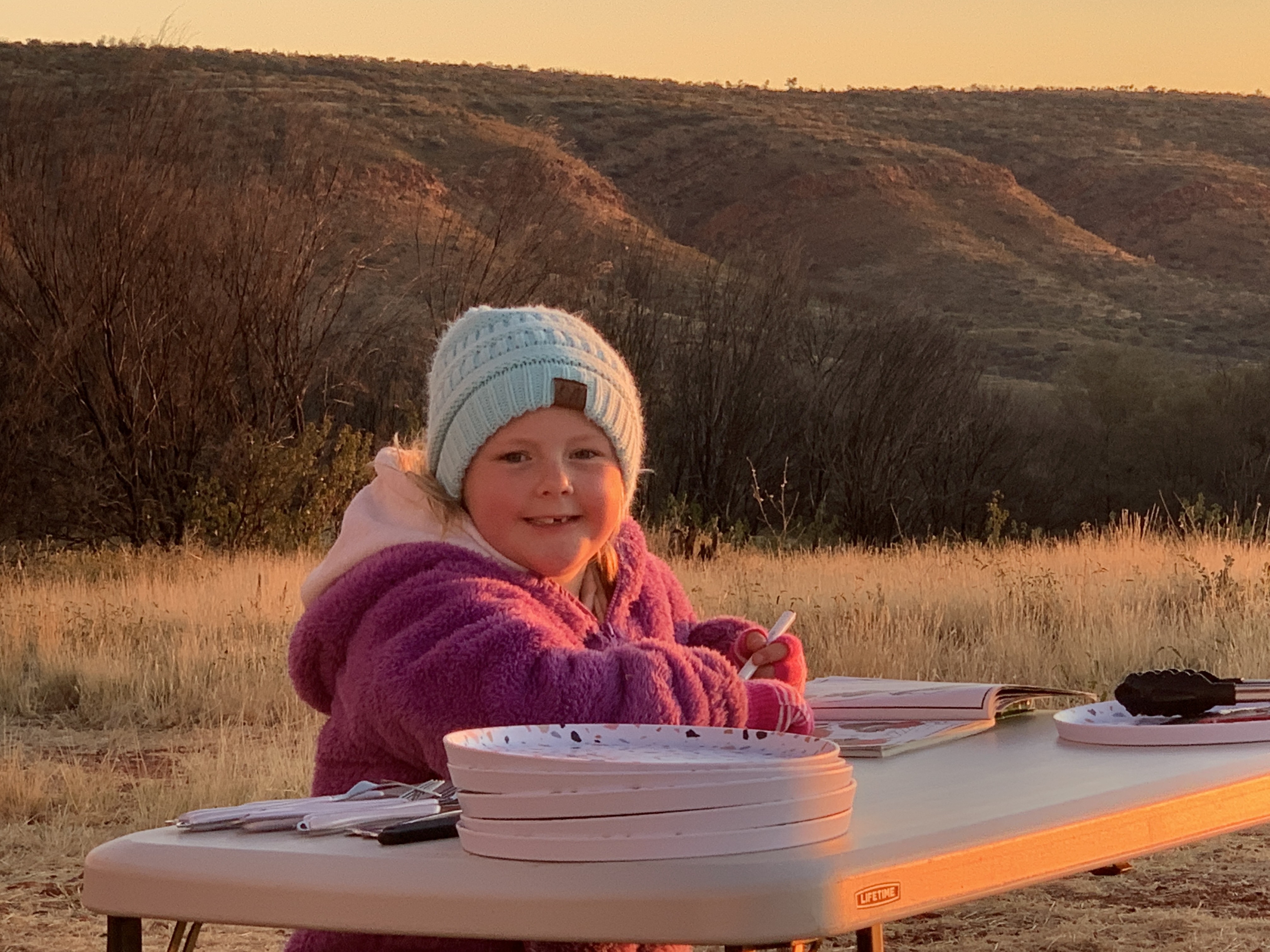
We had boiled potato with sour cream and corn on the cob to go with our steaks. There was lots of happy chatter around the dinner table.
Everyone had enjoyed our stay at Glen Helen but was now ready to move on. Everyone pitched in and packed up the outside chairs, tables, mat etc so we didn’t have to do that in the cold morning.
We had another stunning sunset for our last night at Glen Helen
We had a relaxing day at Glen Helen. Reading, playing cards and games and lazing about.
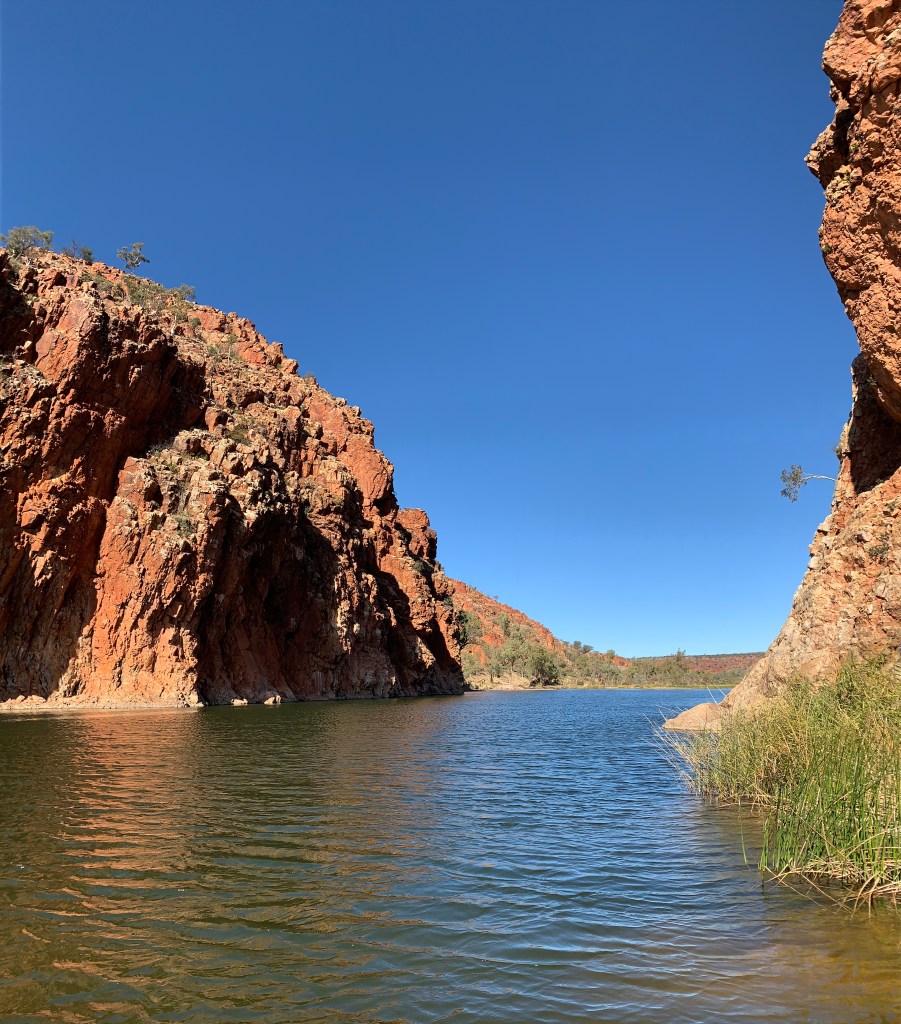
We did do the short walk to Glen Helen Gorge and it is another spectacular place. The gorge was formed by the Finke River and due to the recent rains the river was running and the huge waterhole at the base of the gorge was very full.
It would have been a perfect spot for a kayak if I’d brought it on this trip. However it was left at home to make way for more wood and we’ve needed that more. It’s been freezing cold at night. A little camp fire has been lovely to sit around.
There are a couple of natural features of Glen Helen Gorge called the Organ Pipes and the Stone Window however to get there involves a swim through the icy waters of the waterhole and a further walk along the river. None of us were too keen to swim!
The traditional owners of the land will not swim in the permanent waterhole at Glen Helen as they believe it is home of an ancient and powerful Rainbow Serpent.
The Finke River starts in the West MacDonnells and travels some 700km across plains and through rugged ranges before it disappears altogether in the desert sands towards Lake Eyre. The permanent waterholes were lifelines for the Arrernte people especially during times of drought. The Finke River was a major trade route for Aboriginal people for thousands of years.
John McDouall Stuart and his party were the first non-Aboriginal people to visit Central Australia and they saw the river in 1860. By the 1870’s the river had become a major trade route for early settlers.
The Finke River is often described as the world’s oldest river. It has been following the same general course for approximately 100 million years and is home to nine species of fish.
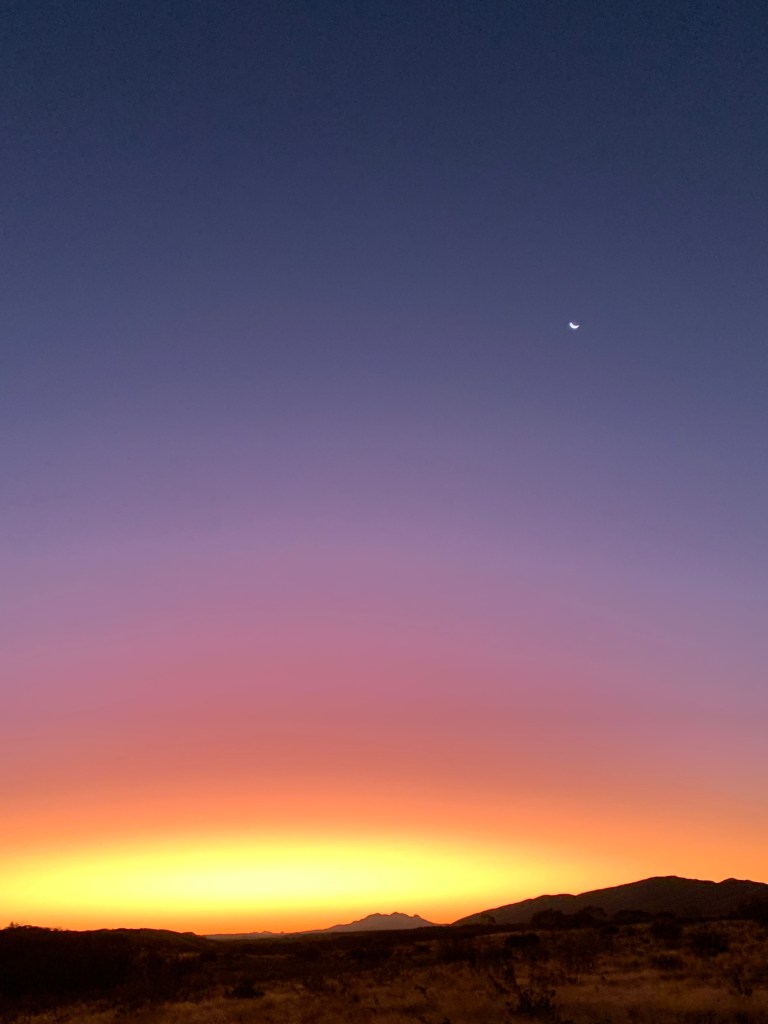
We decided to stay one more night at Glen Helen and there was plenty of room in the unpowered section. We had another gorgeous sunset. There wasn’t a cloud in the sky and the whole of the western skyline glowed red, orange and pink as the sun dipped below the horizon. It was really beautiful.
In the morning we said a sad farewell to our new friends as they left in their van to go eastwards to Alice Springs. We continued heading further west to Ormiston Gorge.
It’s a sealed road to Ormiston Gorge. There was plenty of parking as well as a kiosk, information centre, picnic tables, toilets and an amenities block including showers for the Larapinta Trail walkers. Ormiston Gorge is the Trail Head for Sections 9 & 10 of the Trail.
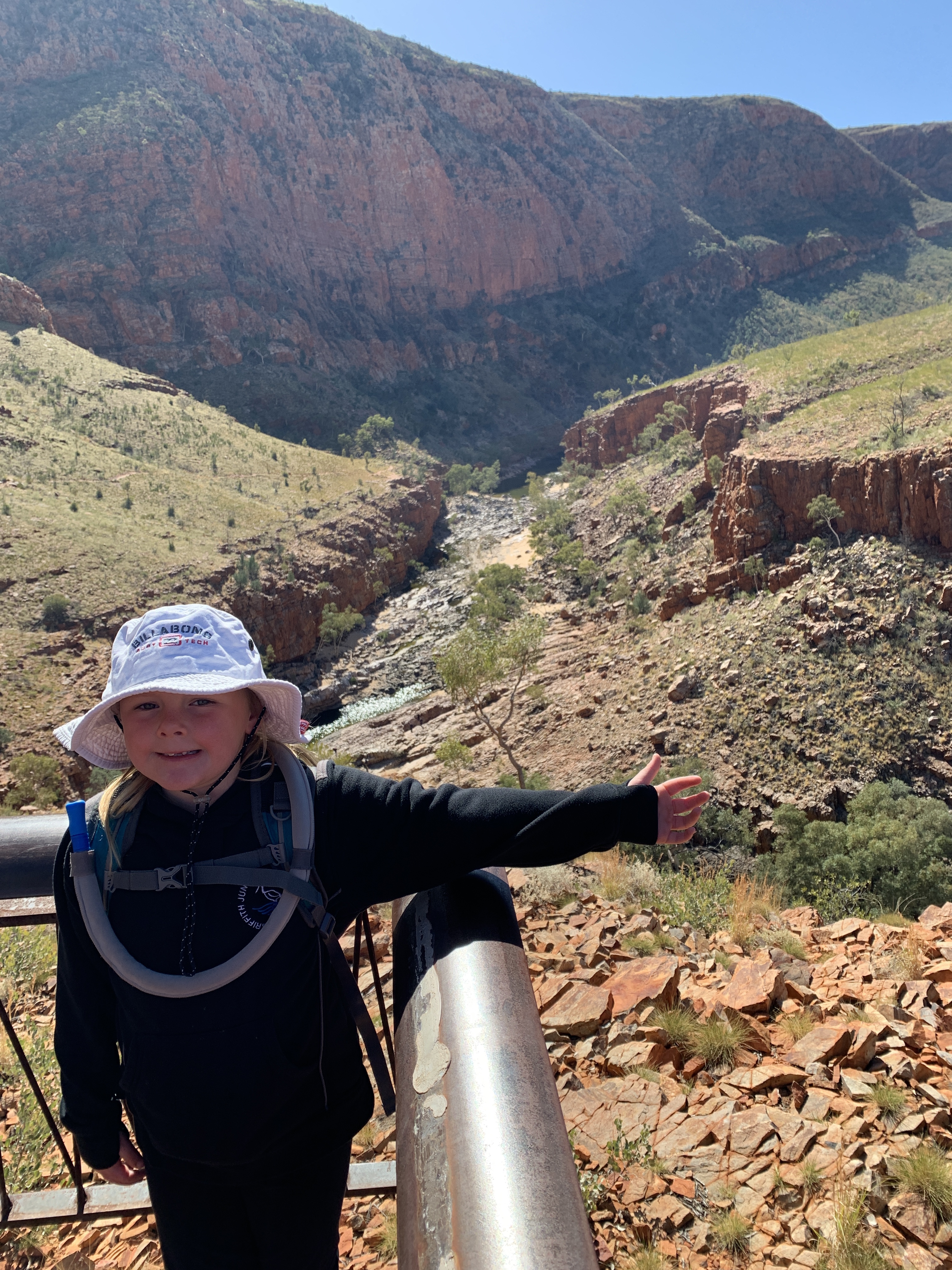
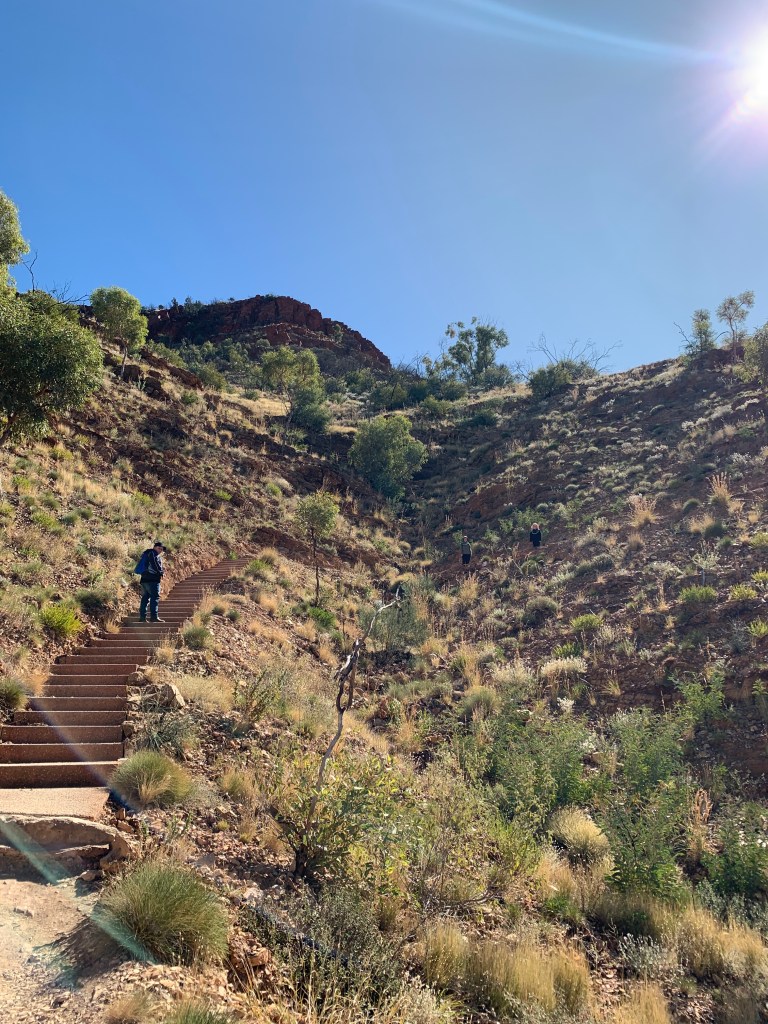
We packed our backpacks for this walk as it was going to take an hour and a half return. We set off on the Ghost Gum Loop and it started out going up the steep hillside. There were many steps. However the view at the lookout when you arrive at the top was worth it.
Wow, wow, wow!!
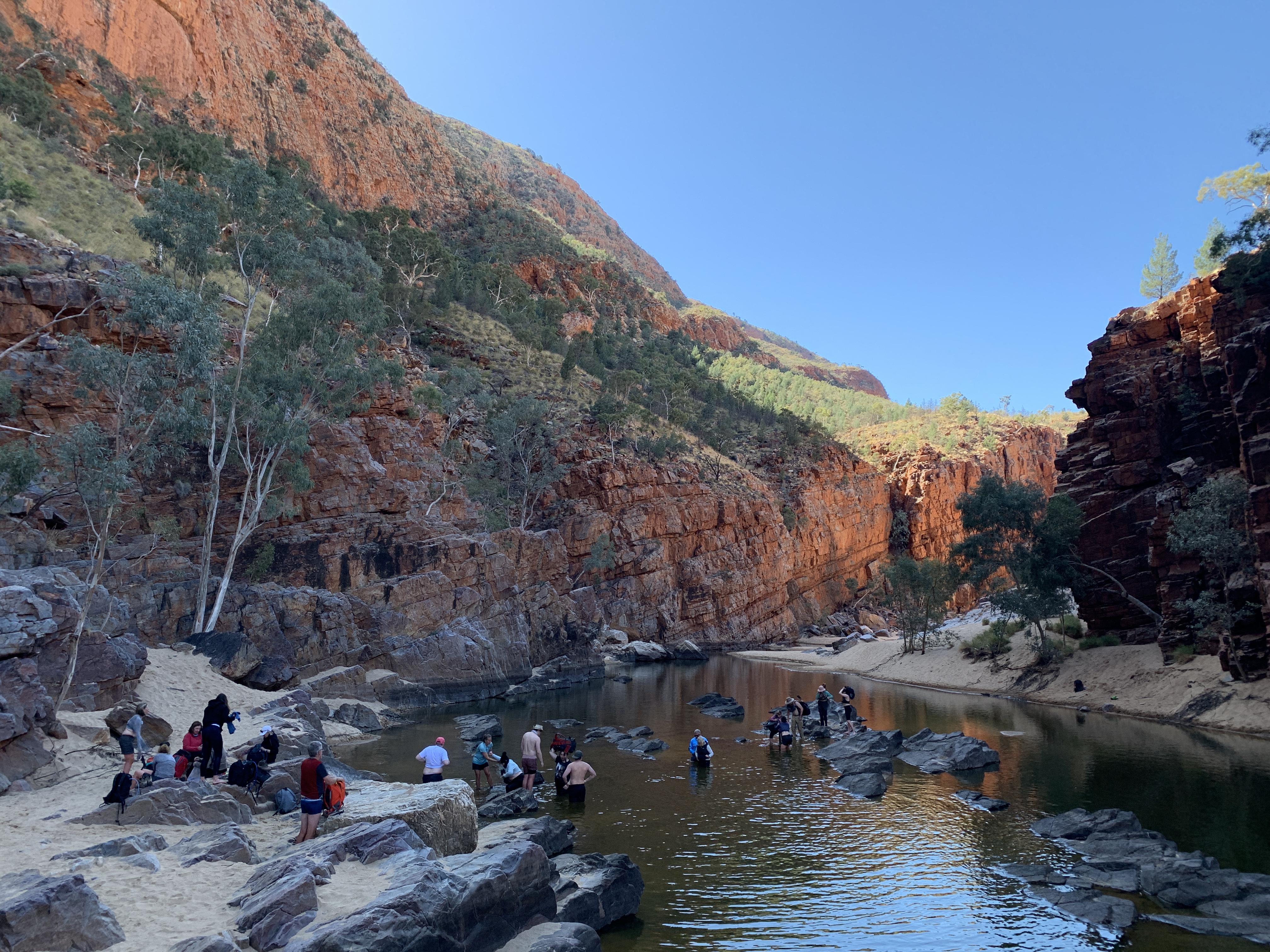
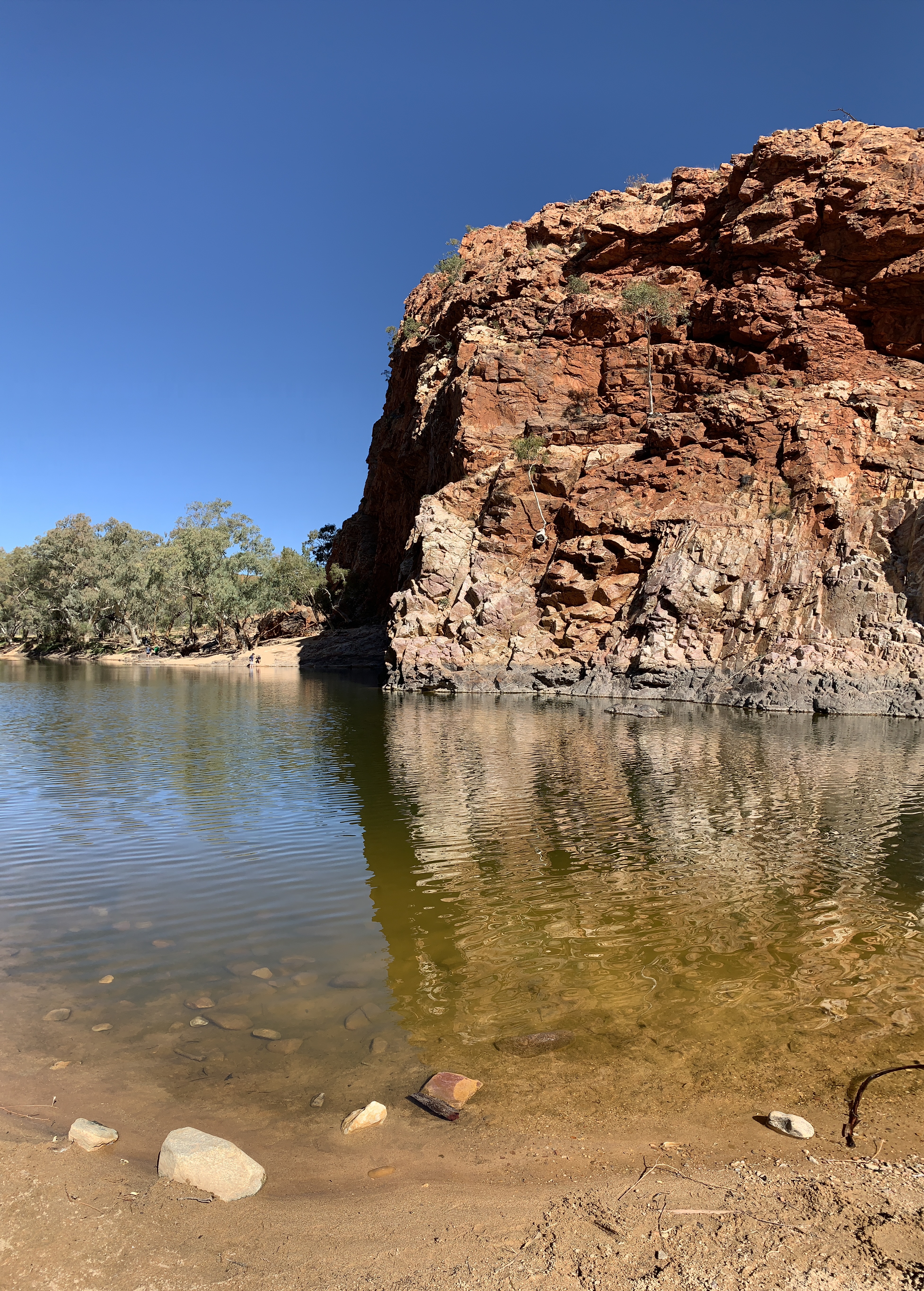
Ormiston Gorge
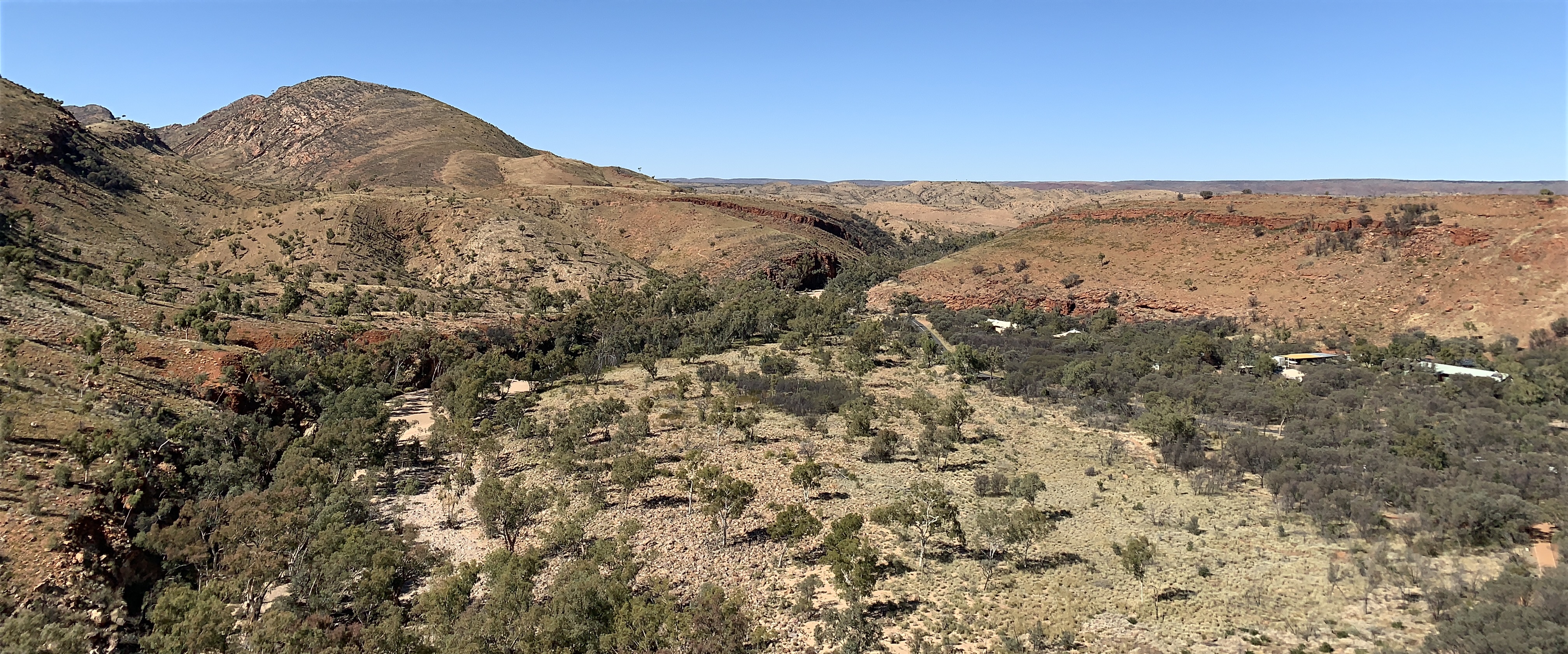
From the lookout you have a fantastic view up into the Gorge and down to the riverbed below. If you look back you can see all the way to the carpark and we could make out where the motorhome was parked. What a view!
The trail continues on and is a narrow, very rocky pathway. You really have to watch where you are going. It would be very easy to turn an ankle.
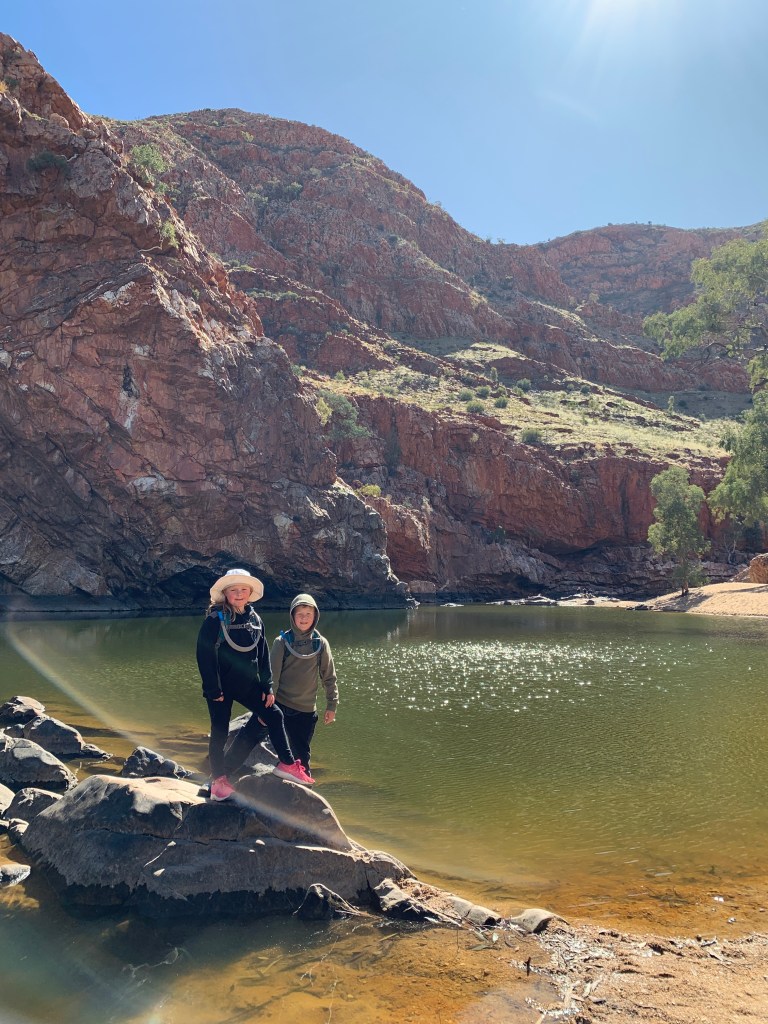
At the end of the trail you come to a stop as the waterhole was so full of water that we couldn’t cross over to be able to come back along the waterholes. We watched some Larapinta Trail walkers having to wade across the freezing cold water to get to the other side. Their legs were very red when they came out of the water!
We backtracked a bit and found a rocky gully that we thought we’d be able to use to get down to the river bed and we all made it carefully down the steep gully. The kids thought this was great fun.
Once at the bottom we found a good spot to stop for a snack and a rest before continuing on following the waterholes back to where we started our walk. It had taken us 2 hours to do the round trip.
It is so hard to stop taking photos as you walk along. Each corner you go around shows more stunning scenery. I’m sure you’ll all get sick of photos of beautiful gorges and waterholes!
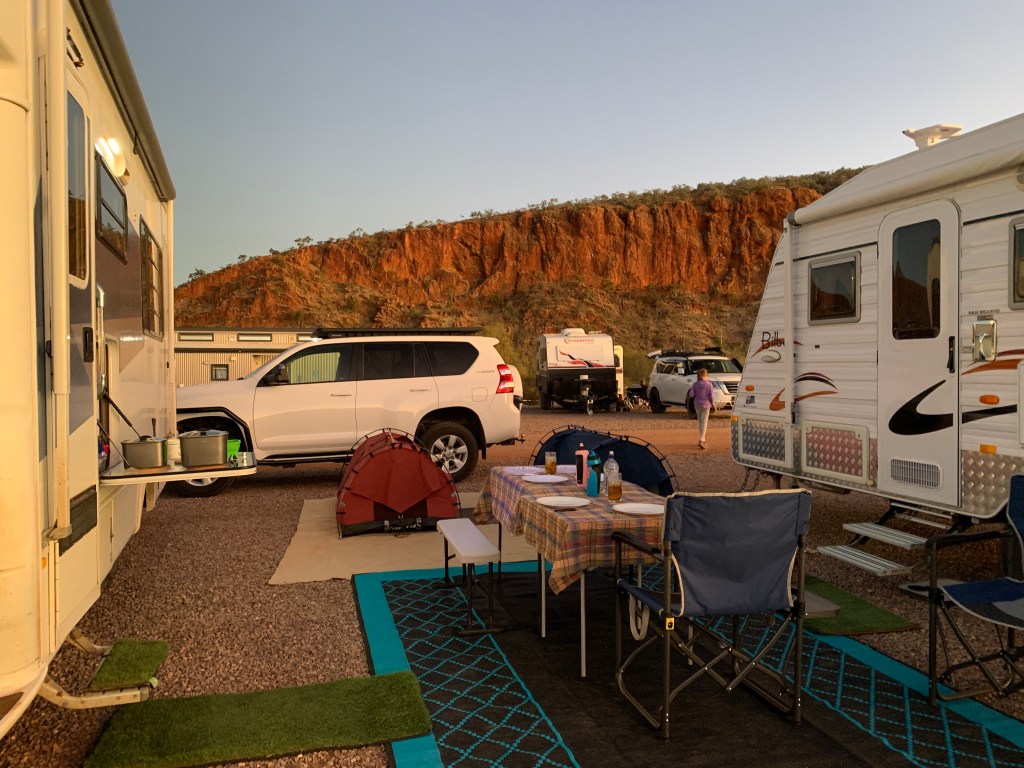
We continued further west to the Discovery Parks – Glen Helen. The park is 132 km from Alice Springs. Here we had a couple of unpowered sites booked. We checked in for two nights, used their dump point, then drove up onto the newly gravelled unpowered section of the park. There was a brand new amenities block including a laundry and next to that was a brand new camp kitchen. A water tap is available at the back of the camp kitchen so we both filled up with water prior to parking up and setting up our camp with our doors facing each other.
New fuel station going inNew amenities and camp kitchen
We are all impressed with the new amenities block at Glen Helen. The Laundry is impressive too with a bank of 5 stacked washer dyers. It’s 4 x $1 a load for a wash and $4 a load to dry. The camp kitchen is also great and has a fridge, microwave, kettle & toaster, stainless steel benches, sinks, and gas BBQs.
The park was purchased by Discovery Parks and is slowly being upgraded to their standard. A brand new fuel facility is under construction and there’s evidence that lots of earthworks had been done recently to terrace the camping area.
The view from our camp is a red cliff that looked amazing as the sun sets. The red sandstone just seems to glow in the sun.
After a great nights sleep at our free camp at Point Howard Lookout we continued heading west and our first stop was Ellery Creek Big Hole. There is 2km of unsealed road to get to the carpark and from there it’s only a short walk to Ellery Creek Big Hole and a big hole is exactly what is there. A huge waterhole in between towering cliffs. It is a popular swimming spot when the weather is warmer.
The kids had fun crossing over the creek on a fallen log testing their balancing skills. We just hoped none of them would fall off into the very cold water. Luckily no one fell.
Ellery Creek Big Hole
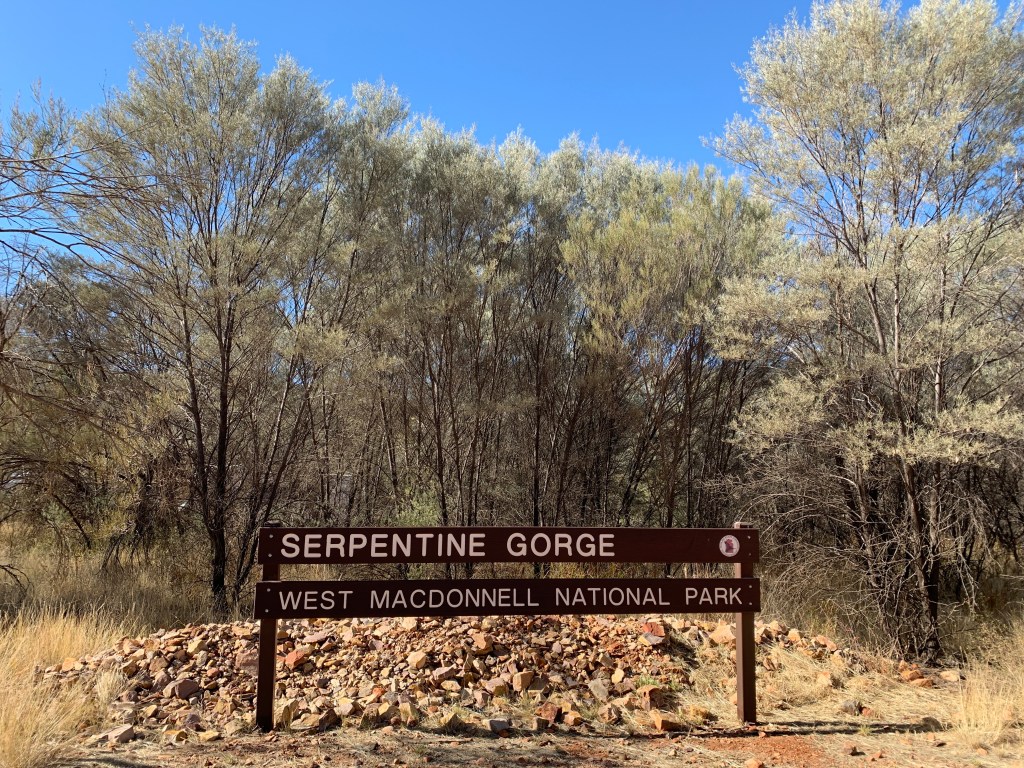
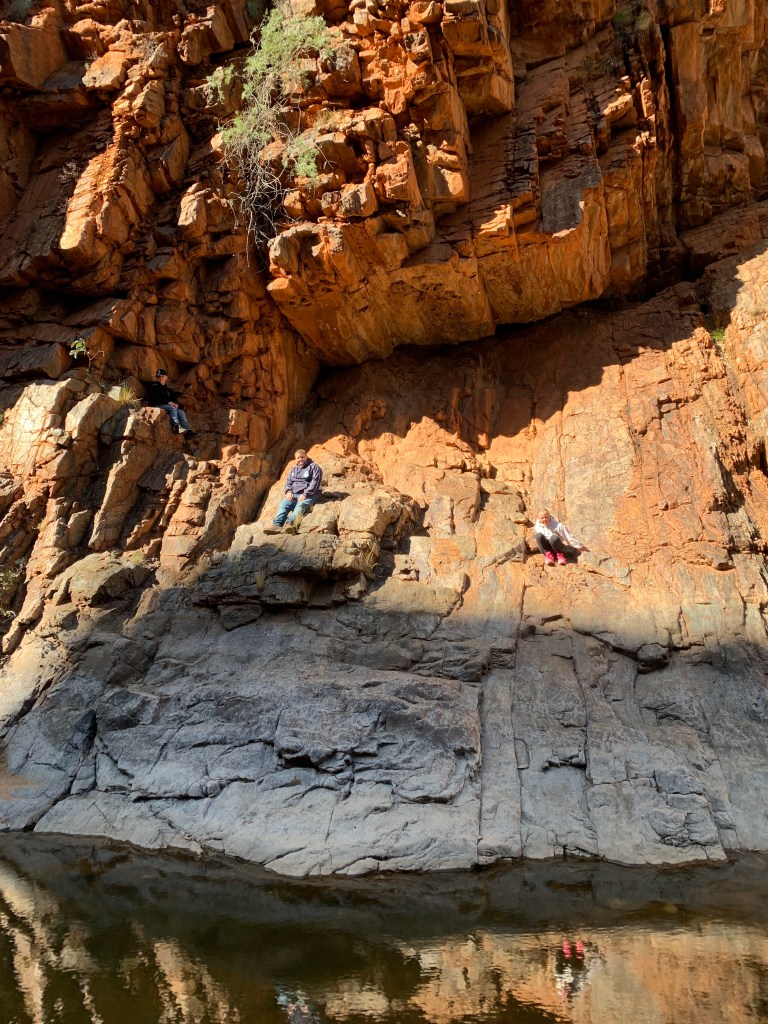
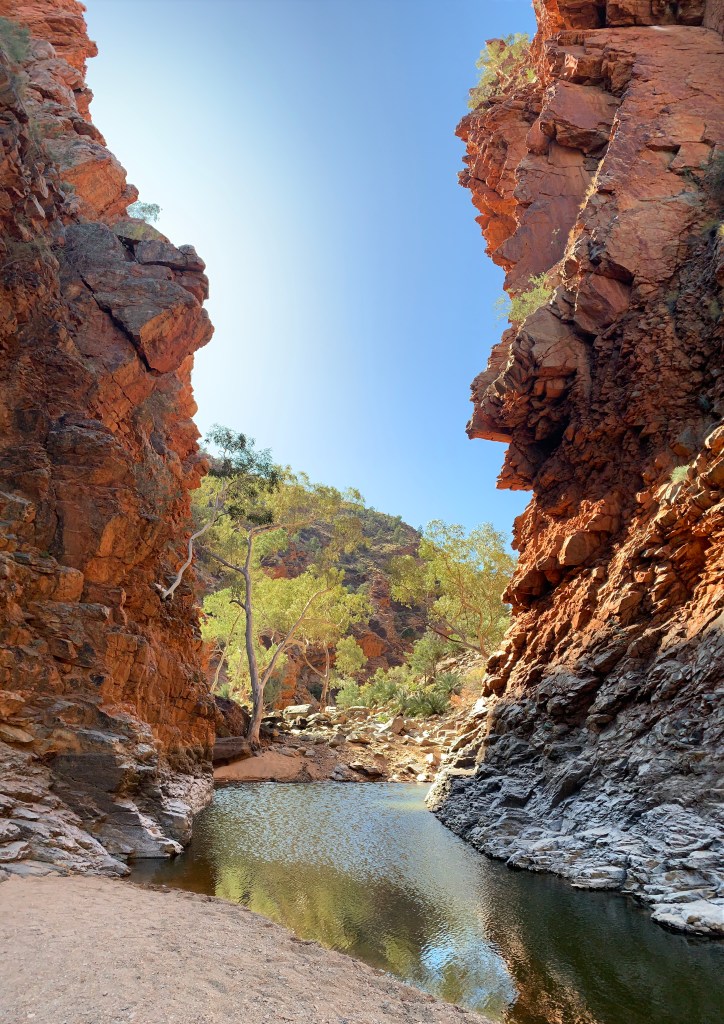
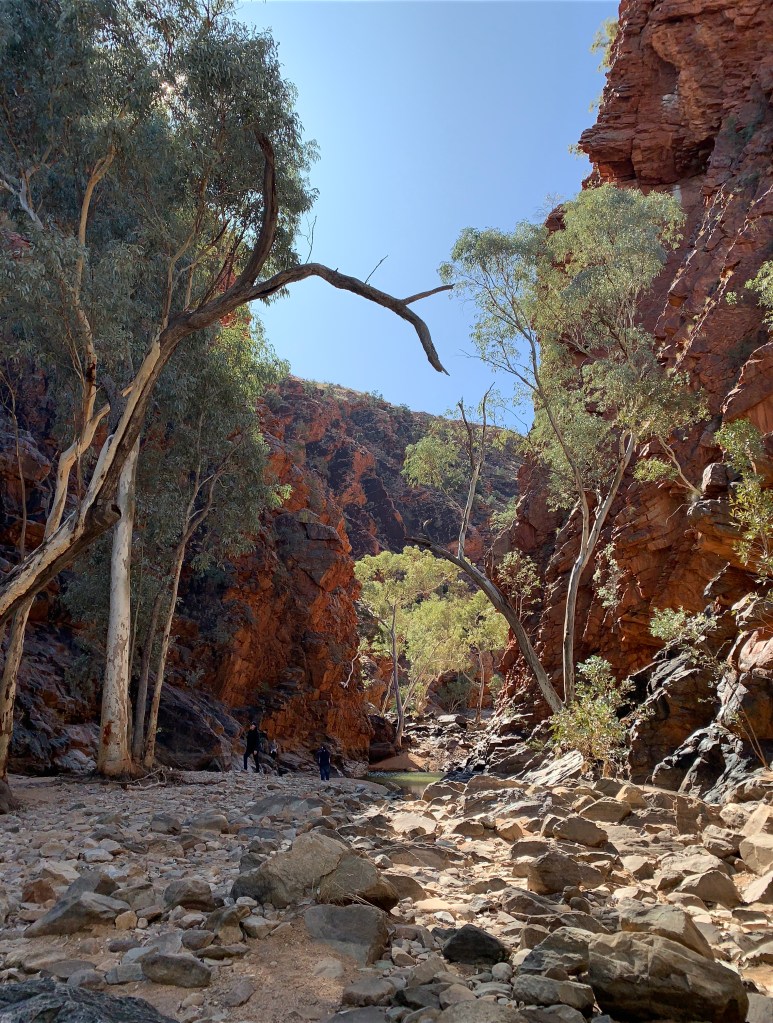
Our second stop was Serpentine Gorge. I had thought surely the gorges couldn’t get better each time but I was wrong. Serpentine Gorge is beautiful. There is an unsealed road that leads to the carpark. Serpentine Gorge is the Trail Head for sections 7 & 8 of the Larapinta Trail. There are toilets and picnic benches but no camping is allowed.
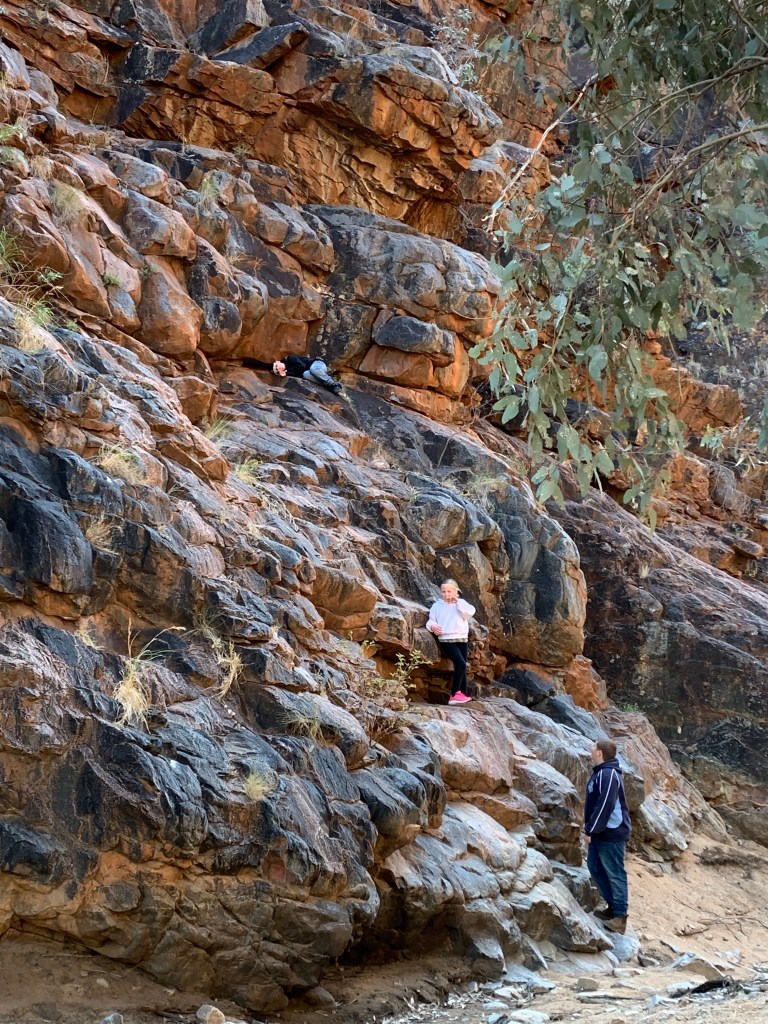
The rocks on either side of the gorge just lent themselves for climbing and the children really tested their skills. I couldn’t watch! They had a great time climbing up and down like goats. That is until Ben fell. Oh no! Not another broken arm I thought. Thankfully he was Ok just had a bit of a bruised knee. Luckily he only fell about a metre but his knee collected a rock on the way down. After a few minutes he was able to get up and walked back to the vehicles. No more rock climbing!
Serpentine Gorge
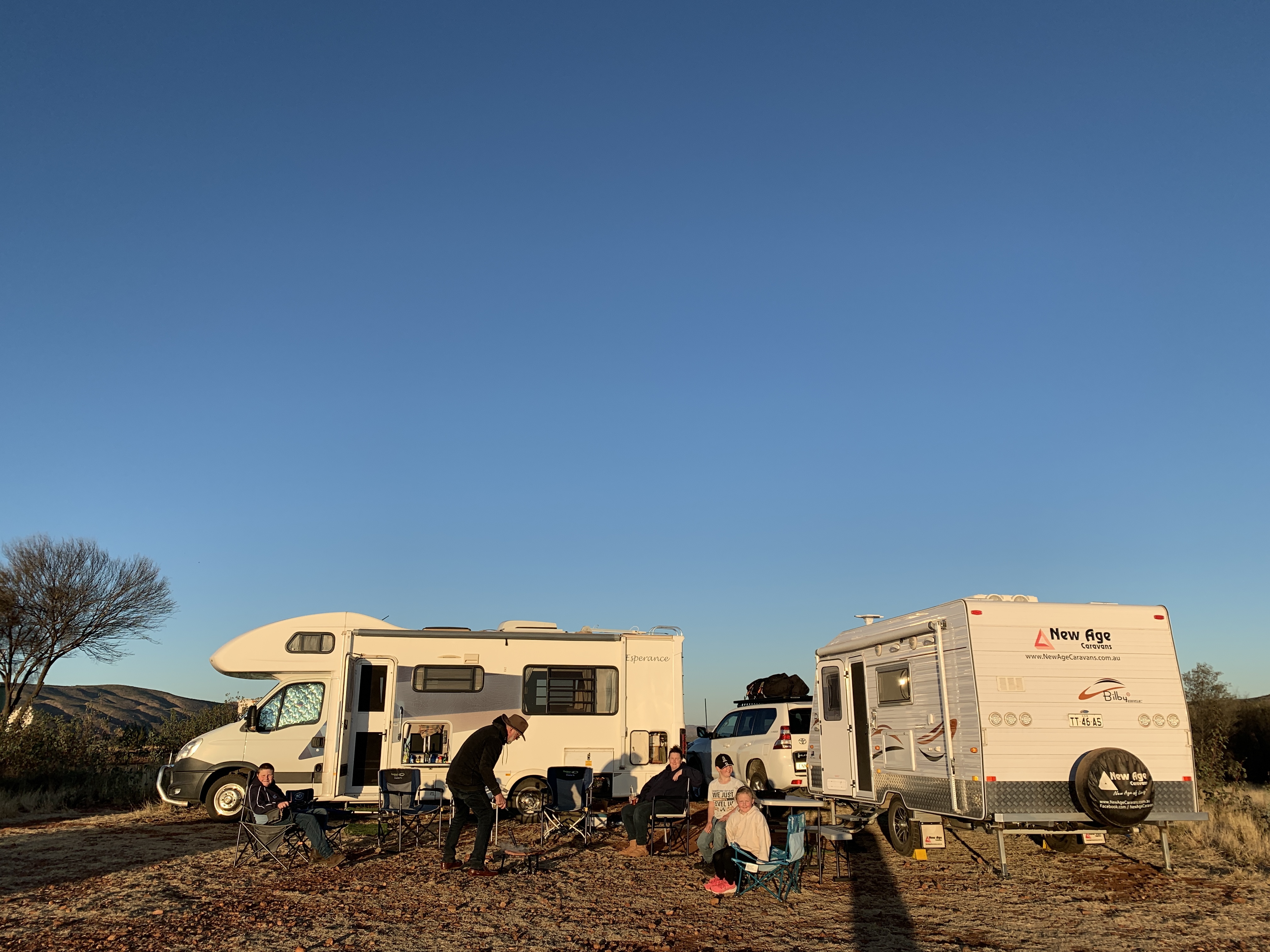
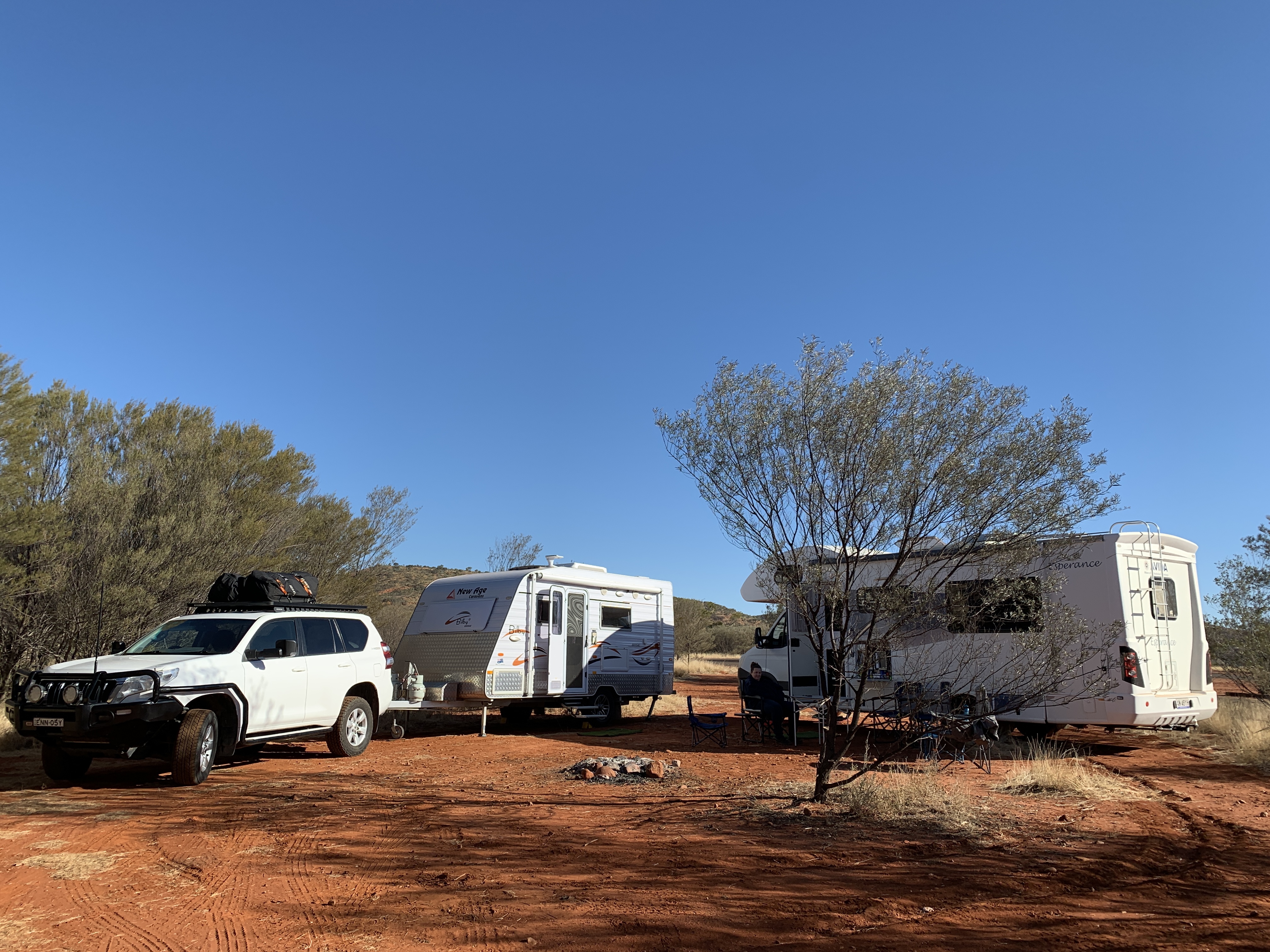
We continued westwards and found a camp spot at Neil Hargrave Lookout. There was one van set up there already and we found a spot to set up our RV’s not far away. This spot was a bit more exposed than our previous camp and the cold wind was blowing. We set up the motorhome and van so they blocked most of the wind.
We’d only just parked up and the fellow from the other van came over for a chat. They are a family with two boys, Hugo and Archie.
Hugo and Archie have a set of Battle Blocks and invited our kids to play a game. Lots of fun was had by all the kids playing that.
Free camp at Neil Hargrave Lookout
One of the things I enjoy most about this RV lifestyle is meeting people. We’ve met the most amazing people since we started meandering around our beautiful country. Archie & Hugo and their parents Luke & Liz have been added to our list. What a lovely family.
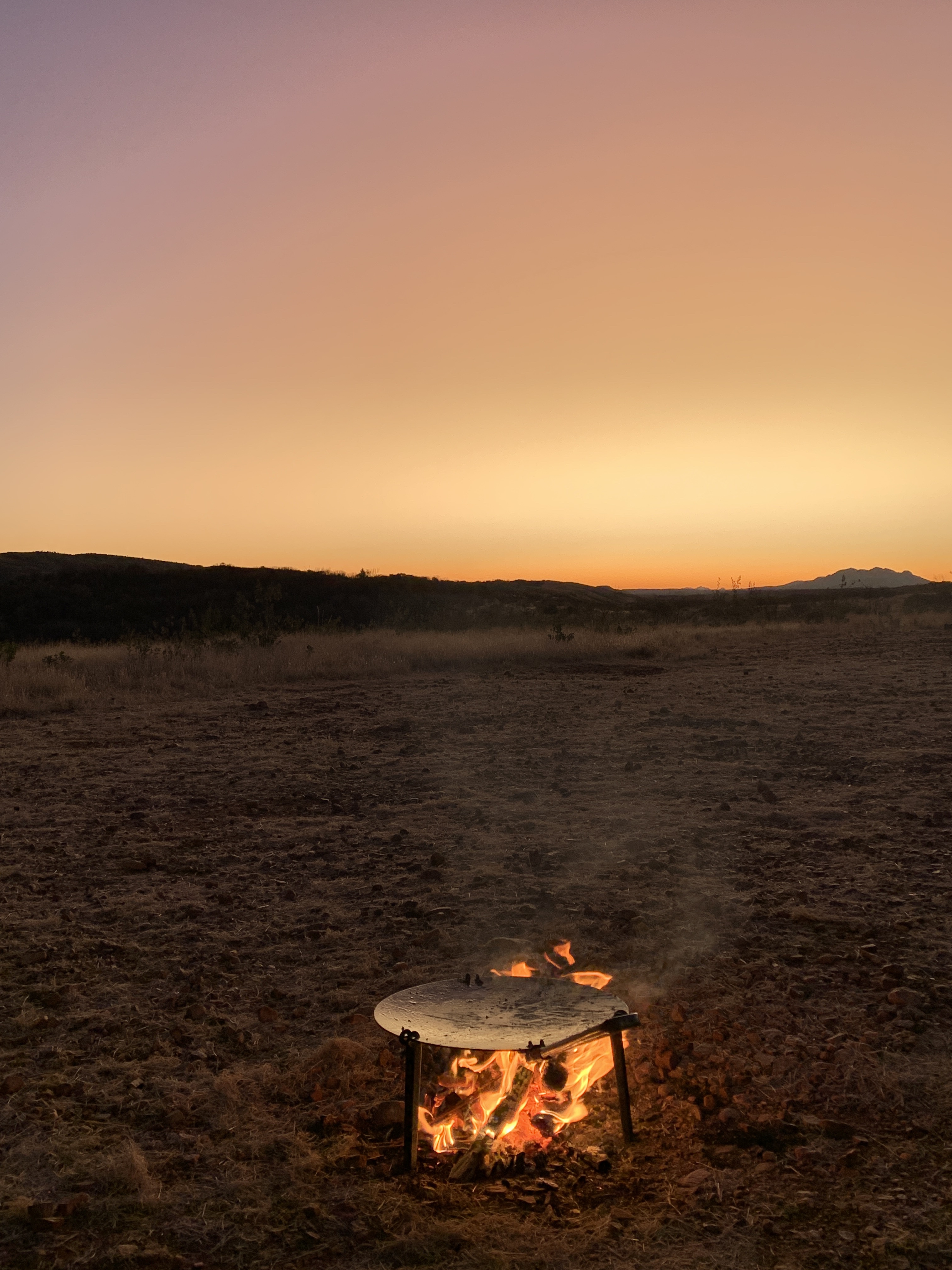
We invited them over to share our fire after we’d had our dinner and they came. Best thing is, they brought some wood so our campfire was even bigger!
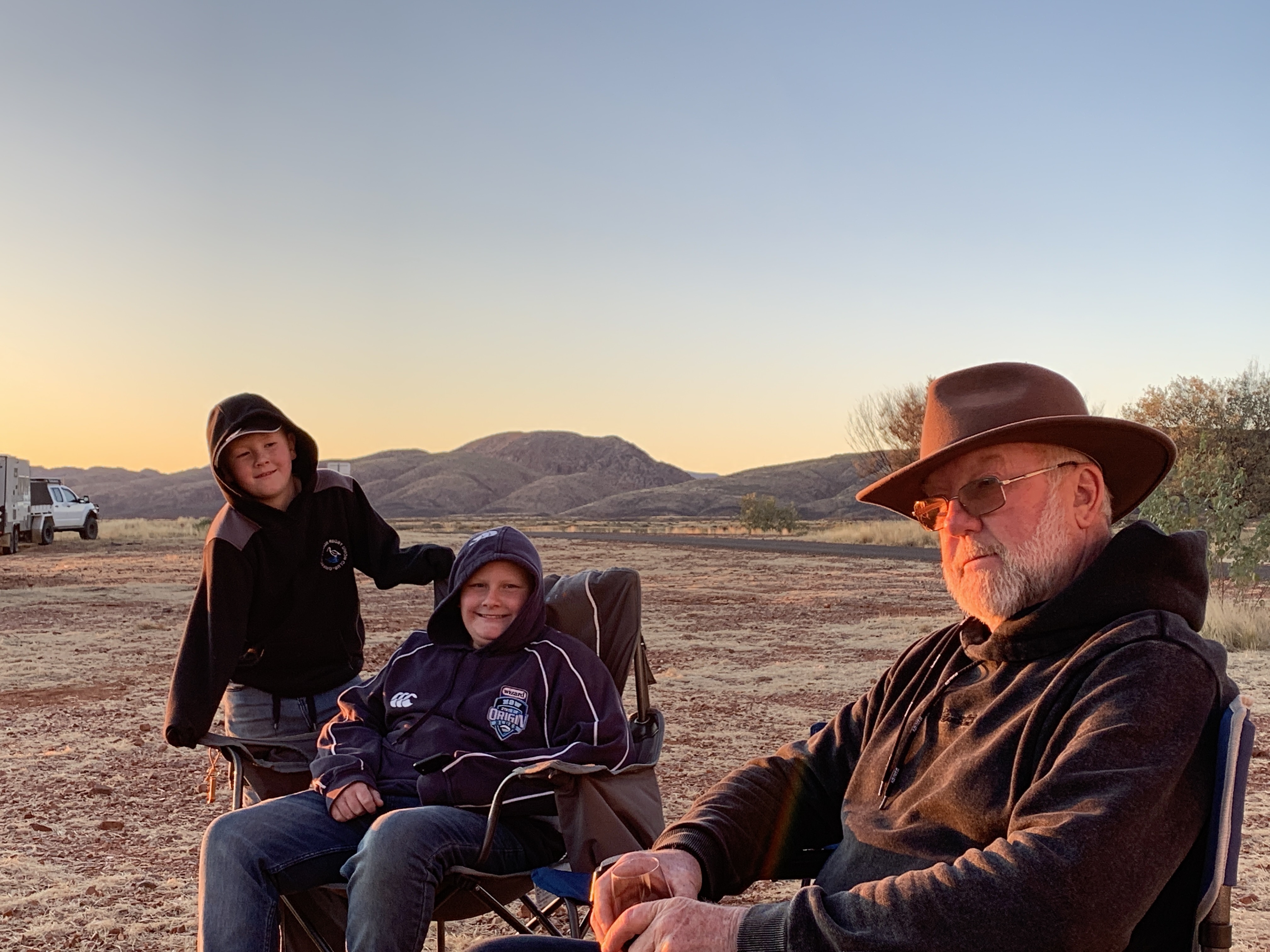
We had a lovely evening watching the sun set and getting to know each other. The kids had a lot of fun toasting marshmallows (yuk) and playing hide and seek in the dark.
We also had some tiny mice visit camp. They were similar to the Spinifex Hopping Mouse that we’d seen earlier on our trip.
Maddie had a turn sleeping in the motorhome and she happily snuggled up in the Luton bed (the bed above the cab) with the safety net up.
You might be wondering what’s happened to us. Where did we go? No posts for a while and I usually post so regularly whilst on a trip. Simple truth is, there is little to no mobile service in the West MacDonnell Ranges and, if you manage to get a signal, there is no internet. However, I have been writing every day so here’s a few posts in rapid succession. Enjoy the read!
We left our comfortable camps at the Discovery Park – Alice Springs and, after a quick fuel stop, headed west into the Tjoritja/ West MacDonnell National Park.
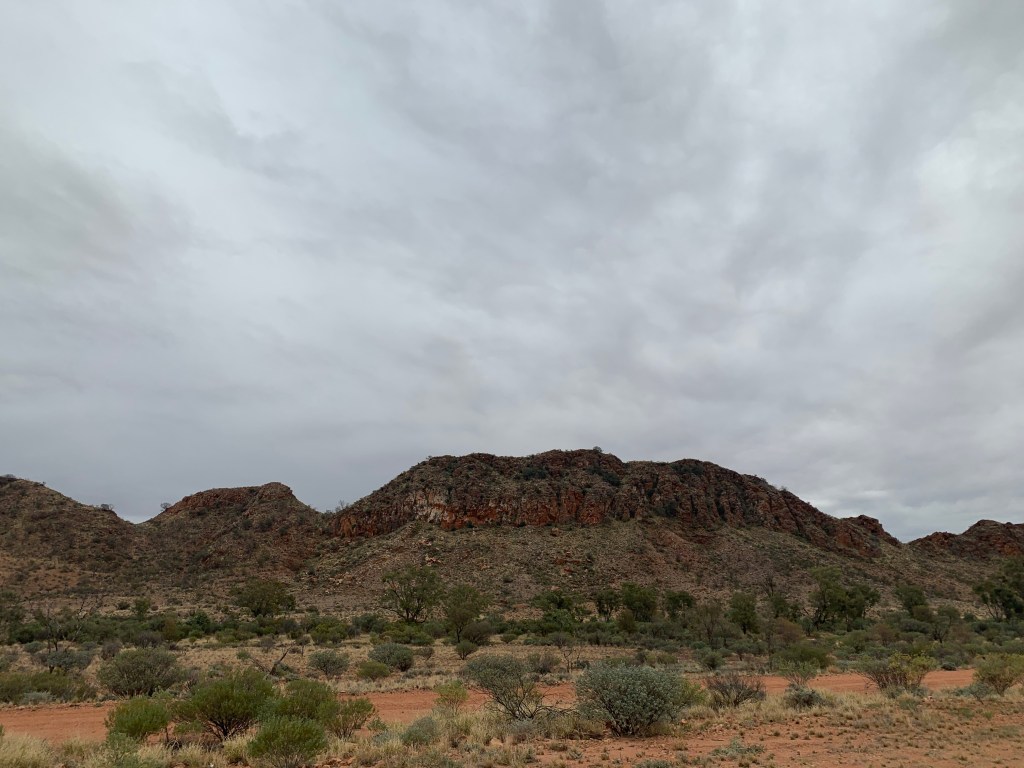
Aboriginal people have lived in the ranges for thousands of years and call the place Tjoritja (pronounced Choor-it-ja). The ranges as they are now are just a shadow of their former selves. They were once as high as the Himalayas. Can you believe that?
Approximately 850 million years ago most of the southern half of the Northern Territory and much of Central Australia was covered by a shallow sea. During this time sediment layers built up on the sea floor. The sea receded approximately 460 million years ago leaving behind layers and layers of built up sediment.
Between 340 and 310 million years ago massive movements in the earth’s crust pushed the mountains up over 10,000 metres high. Those movements pushed and folded the rock layers and caused great slabs to slide up and over each other.
Over the last 300 million years water and wind have eroded and shaped the ranges to produce the spectacular landscape we have now.
Our first stop for the day was Simpsons Gap. No one knows why it is called Simpsons Gap. It was originally called Simsons Gap and the name was changed to Simpsons Gap but there is no one left who knows the reason why. Who was Simpson or Simson? It’s a mystery!
We called in at the Information Centre however they’d run out of maps. We took photos of the maps of each place on the wall and we would have to use those as our guides.
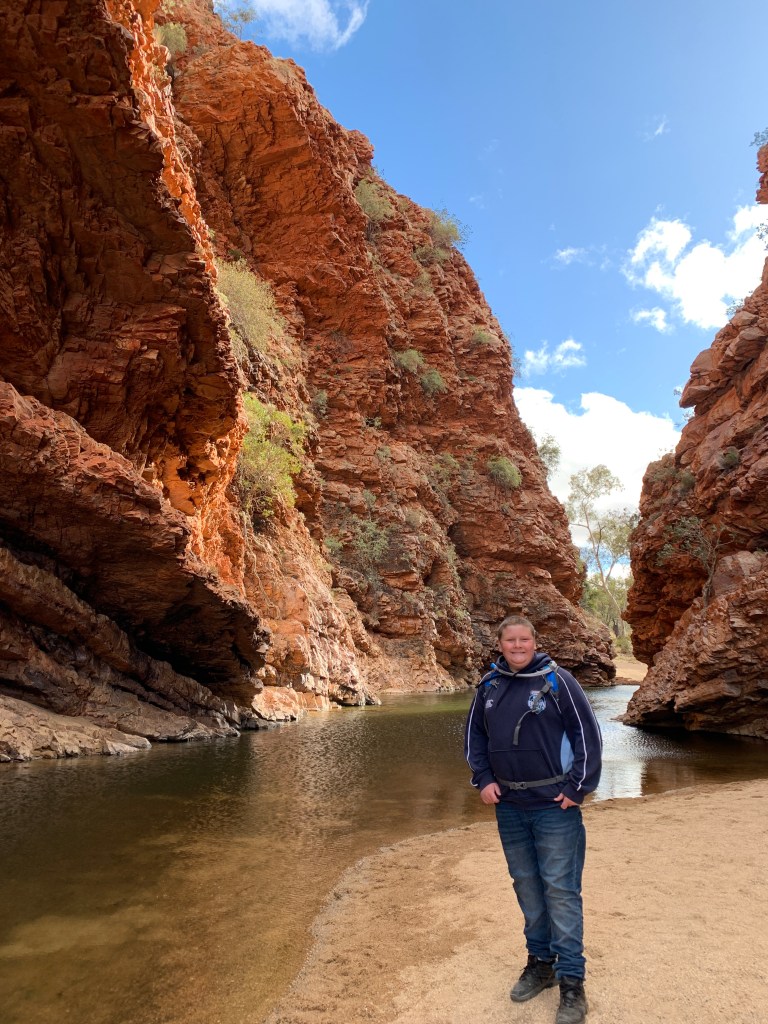
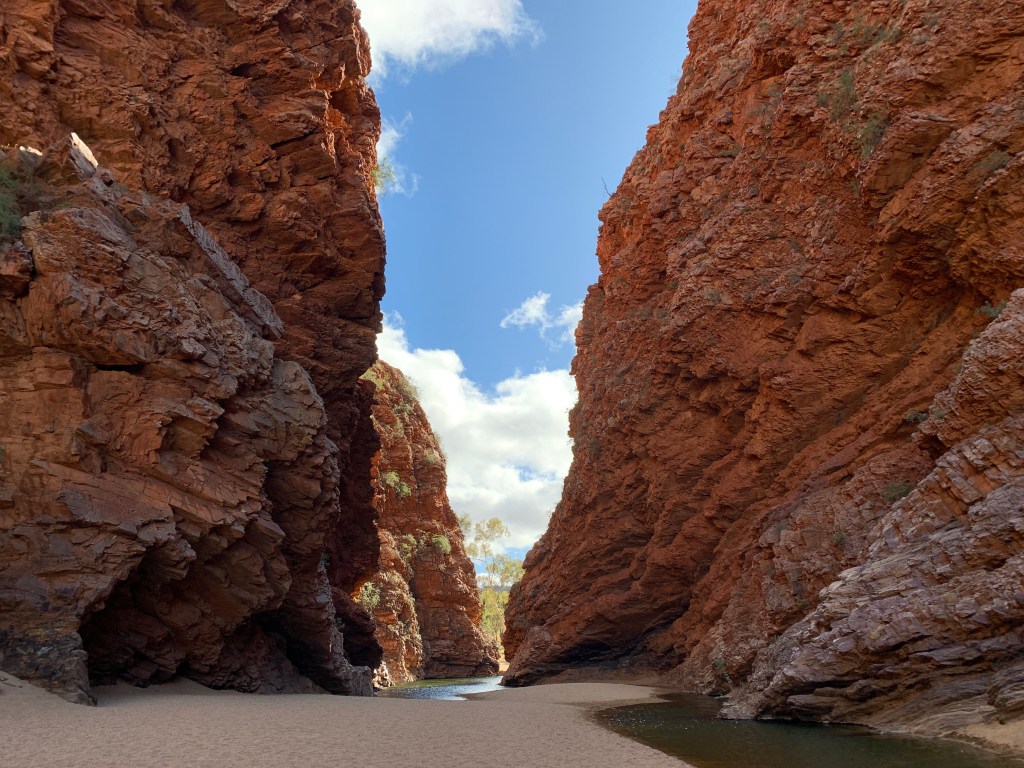
The road into Simpsons Gap is a short one and the carpark was large enough for many vehicles and we had no problem finding a park. It was a short 20 minute return walk from the carpark to the gap along a well made gravel pathway alongside a dry riverbed. The gap did not disappoint. At the end of the walk you are between towering red cliffs with sandy waterholes at the bottom. Just stunning.
The gap is home to over 40 rare and relict plants and is also home to the Black-Footed Rock Wallaby. We didn’t see any though.
Back in the vehicles we continued westwards and took the turn off into Standley Chasm. Standley Chasm is a bit different to the other places along our route as it is privately owned and run by the Arunda people. They receive no government funding so an entry fee is charged and they have a great little cafe serving hot food and drinks as well as a gift shop. You can also camp in their carpark after the gates close at 5pm and they have powered sites for about 6 vans. There is an amenities block and a grassy area for tents. Standley Chasm is a popular spot for walkers on the Larapinta Trail as they can rest up, have showers and recharge before continuing their walk.
The Larapinta Trail is a world renowned walking trail though the West McDonnell ranges. It is 230km long and is broken into 12 stages. You can do one, many or all of the stages. I got chatting to one of the walkers and their group was walking the entire trail and it was going to take them 15 days including a couple of rest days.
The carpark at Standley Chasm is very small and tight and, while we were able to park the motorhome, Katie had to do a five point turn to go back out and park further down the road as there was no room for a van. We did feel that this could be better signposted as we later saw quite a few large vans pull in and have to do the same thing.
Standley Chasm is a very popular tourist destination and bus loads of tourists arrive daily. Once you’ve purchased your entry ticket you enter through a gate and follow the well worn path into the chasm. The path is wheelchair friendly. The chasm is a marvellous sight. The sandstone cliffs tower some 80m above you and there is a small waterhole at the bottom. The best time of the day to view the chasm is an hour either side of noon when the sun is directly overhead. The sun shines down on both walls of the chasm making them glow. We’d timed our walk perfectly. Unfortunately, so had the hoard of other tourists. It is impossible to get that perfect photo as there are always other people in the way. Oh well. It was still a stunning sight.
When we returned to the entry we decided to give the cafe a go and all ordered our lunch. It was good lunch food and served pretty quickly considering how busy they were.
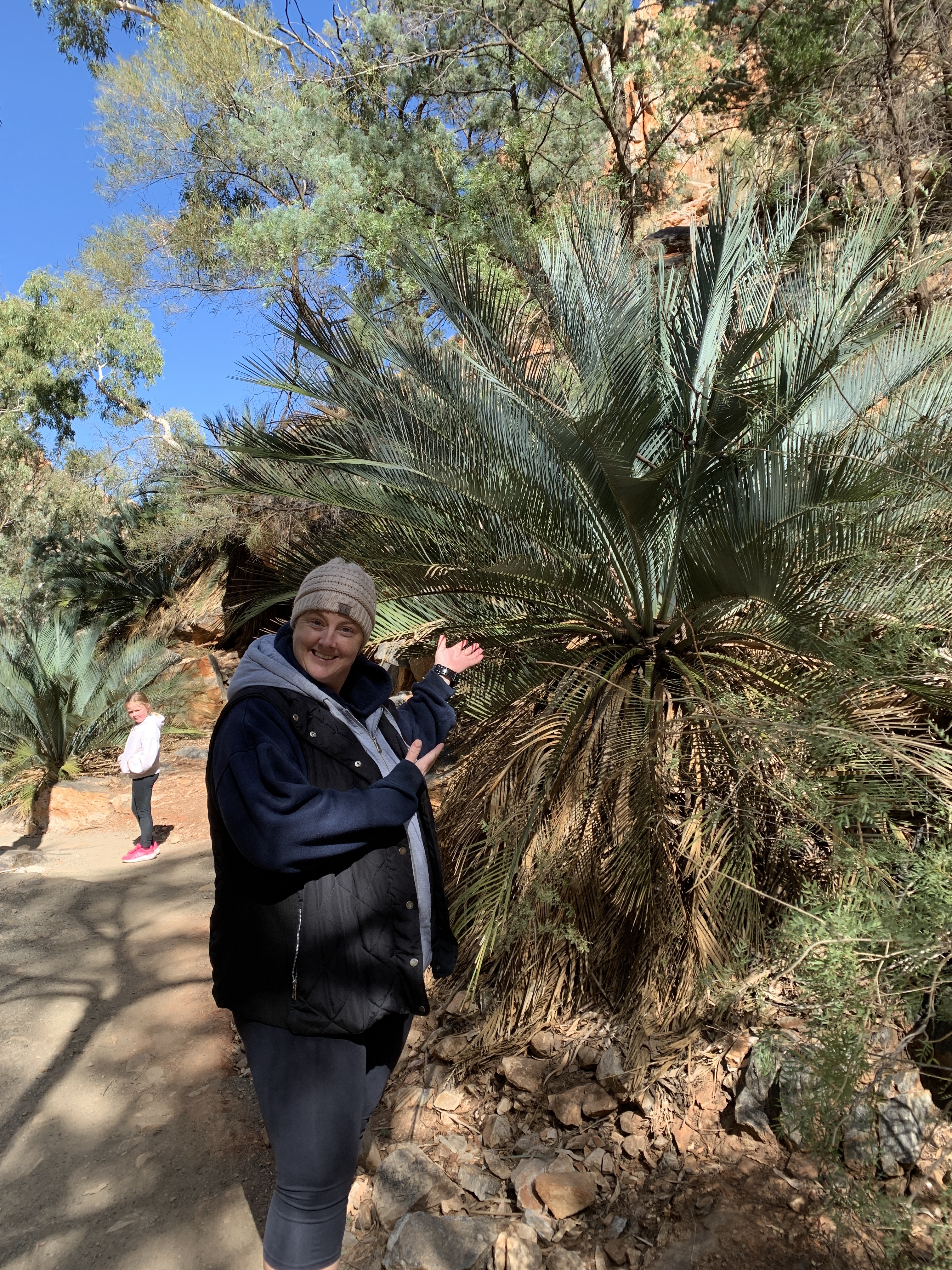
The realityGorgeous cycads
We continued our journey westwards and pulled into Point Howard Lookout free camp. This was a great spot on top of a hill with a large flat area surround by low scrubby trees. You can free camp for 24 hours. We were able to park our RV‘s in close to the trees to block off the cold wind and we had a little camp fire in the centre.
Before we left Alice in the morning I’d put Apricot Chicken on in my little crockpot and it had been cooking all day. Once we were camped up I just had to cook up some rice and mixed veggies and dinner was ready. Delicious.
Ben had a turn sleeping in the motorhome and he was snug as a bug up in the Luton. We all appreciated our microfibre blankets as it was a very cold night. Do you have those? They are the best. They are so light but keep you very warm. We also love our diesel heater.
We just seem to fluke stuff everywhere we go. We had no idea that Territory Day was held on 1 July and here we were in Alice Springs. Territory Day is a big deal in Alice and is the one day of the year when it is legal to let off your own fireworks. We’d noticed a few places in town with large Fireworks For Sale signs. It’s been such a long time since we were able to buy fireworks in NSW.
Our third day in Alice day began with a visit to Alice Springs Desert Park. We wanted to get there in time for the 10.00am Free Flight Bird Show as we’d heard from other travelers that it was worth going to. We arrived at the park around 9.30 and, after paying our entry and picking up a park map, we set off to find the Ampitheatre. On the way we passed the Dingo enclosure. A lone Dingo was sunning himself looking back at us as we looked at him.
The Ampitheatre is a concrete structure with tiered seats set facing the spectacular West McDonell Ranges. On the way to our seats the eagle-eyed amongst the visitors spotted a bird sitting on one of the support arms of the overhead shade shelter. Ben thought it might be a fake one until it moved.
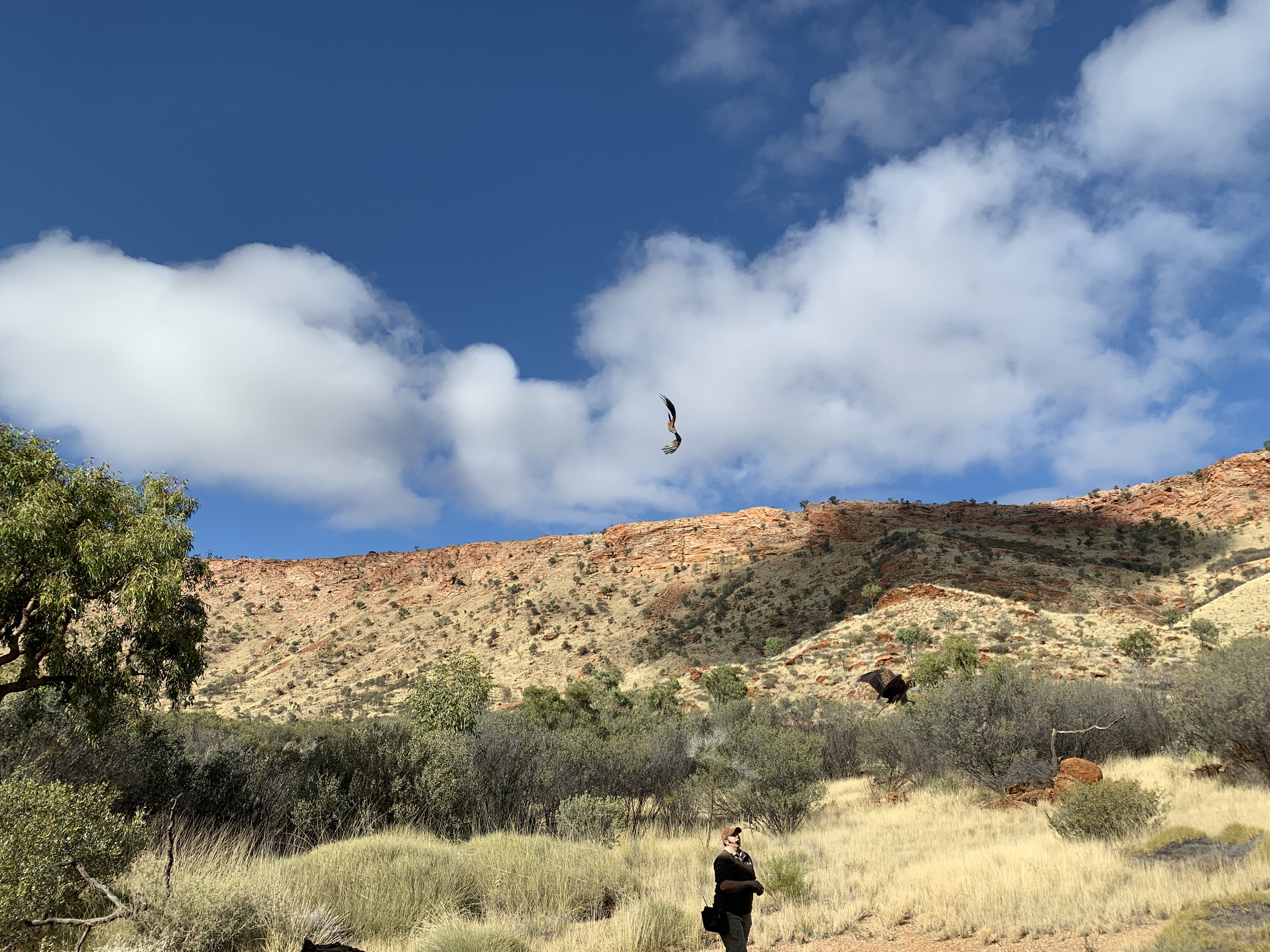
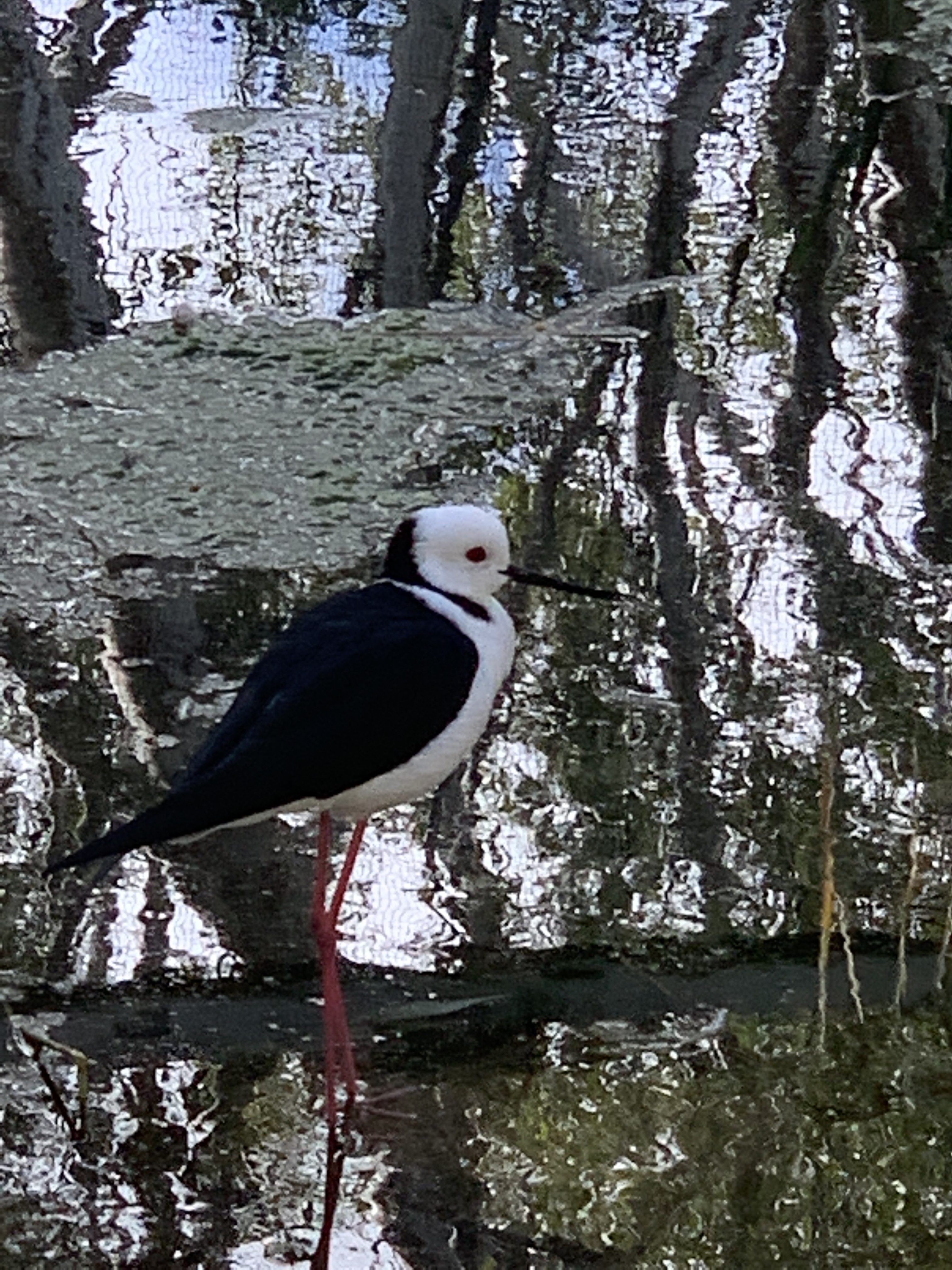
The bird show was presented very professionally by keeper Erin, who kept up an interesting commentary throughout. The birds on show were kites, a magpie, a Blue Heron, a Barn Owl, and the final star of the show a huge Wedge-tailed Eagle. We found out that the bird sitting on the strut as we arrived was a Tawny Frogmouth. Erin was helped in her presentation by a tiny Willy Wagtail named Bruce who almost stole the show.
We all really enjoyed the bird show and recommend visitors make sure you time it right to see it. The bird show is on at 10am and 3pm every day.
The park is divided into three areas, the Desert Rivers, Sand Country, Woodland as well as the Nocturnal House.
Following the Bird Show we headed through the Desert Rivers section of the park. I was amazed at the variety of fish found in the Finke River system on display in an aquarium.
Awaye Flat is an large shade shelter area with wooden seats for visitors. Here we spent an hour listening to Rueben, anAboriginal guide, talk about the Aboriginal way of life, their tools and weapons, how to light fires, Aboriginal history of Australia and the many different clans and skin groups and how that works. The hour passed by very quickly as Reuben was a good public speaker and passionate about his subject. He was happy to answer questions.
Interestingly he talked about what to call an Aboriginal person. Do we call them Aboriginal, Indigenous or the newer term, First Nations. Reuben’s answer was simple. He said to ‘ask them’.
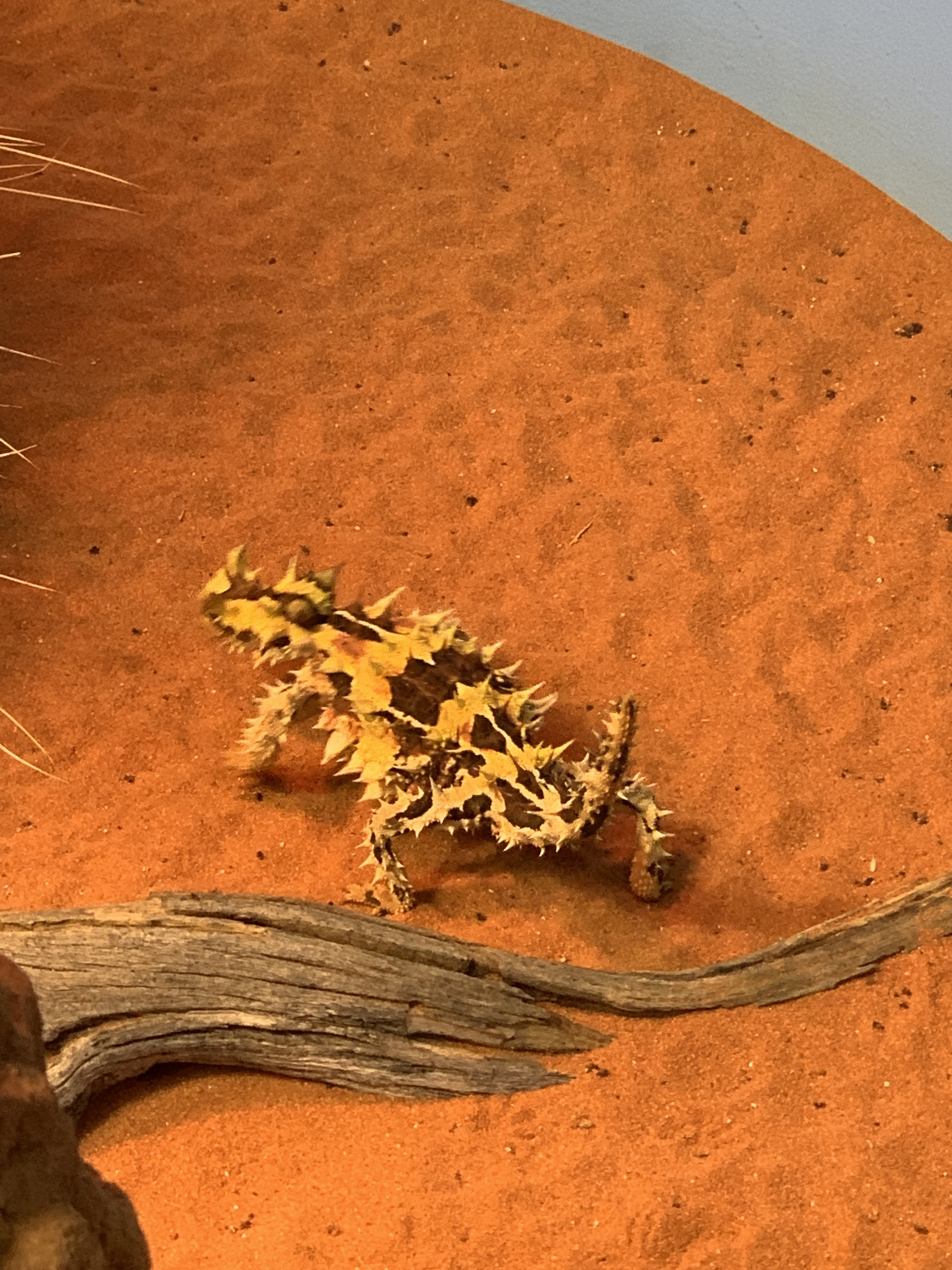
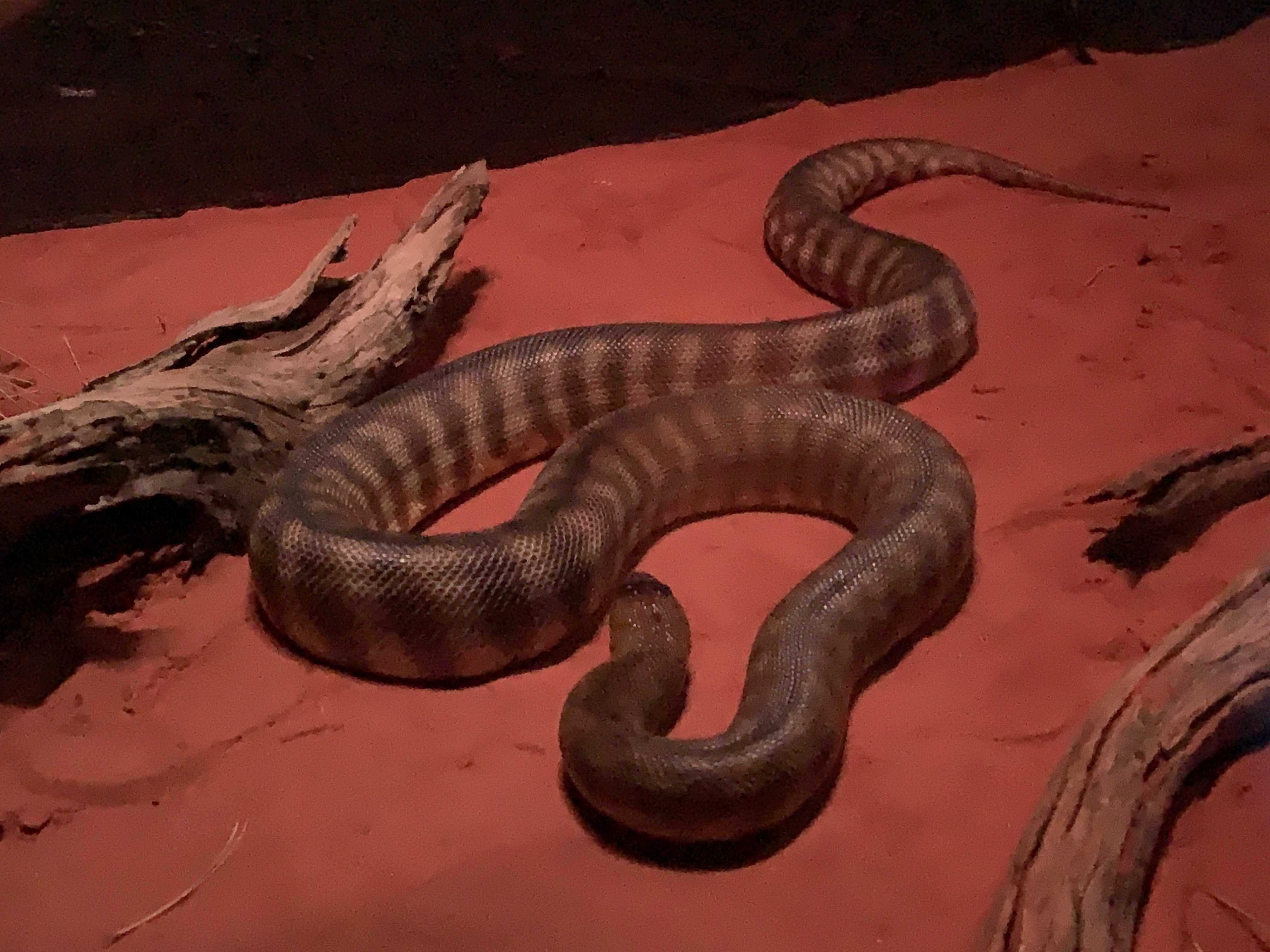
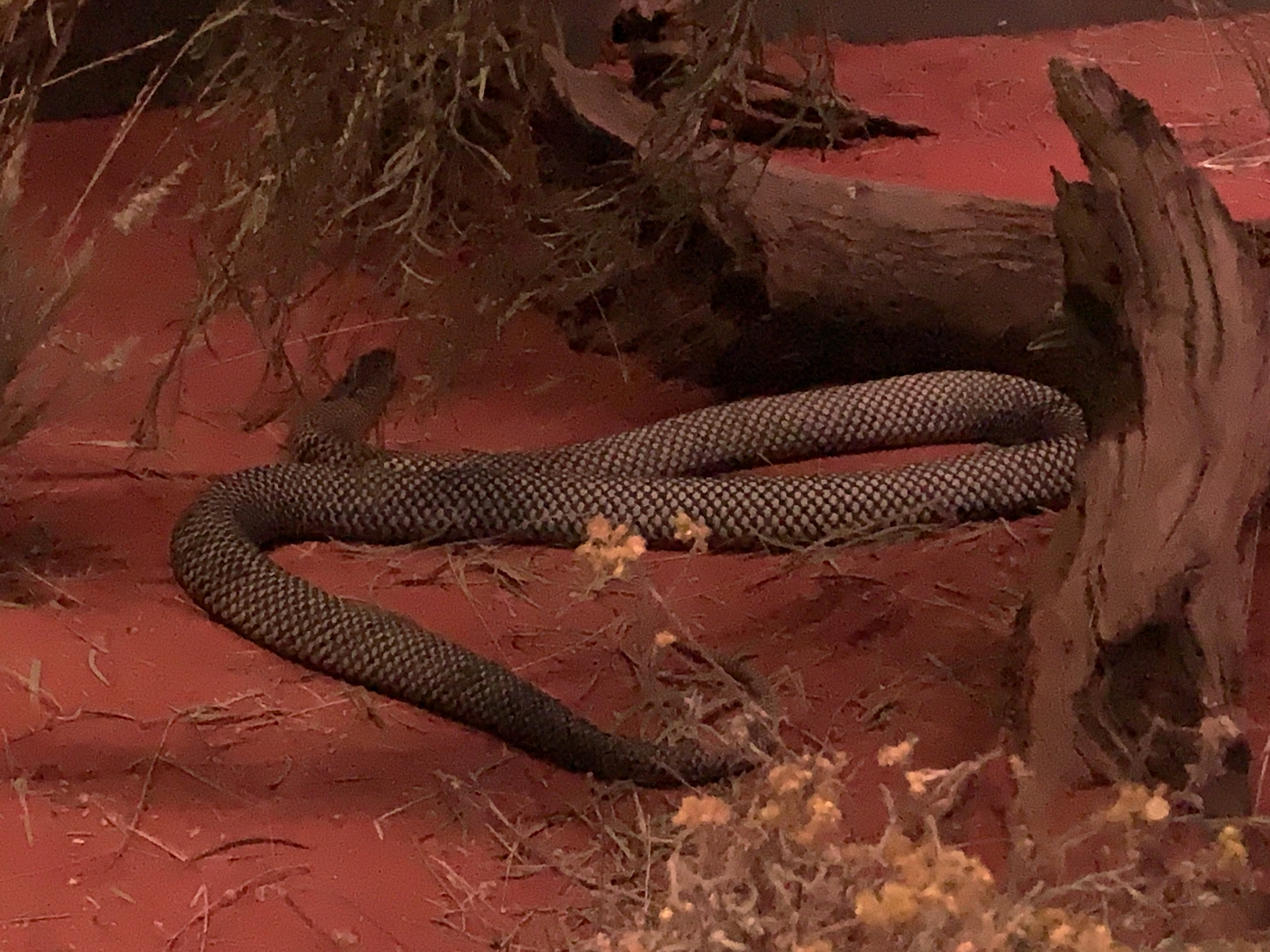
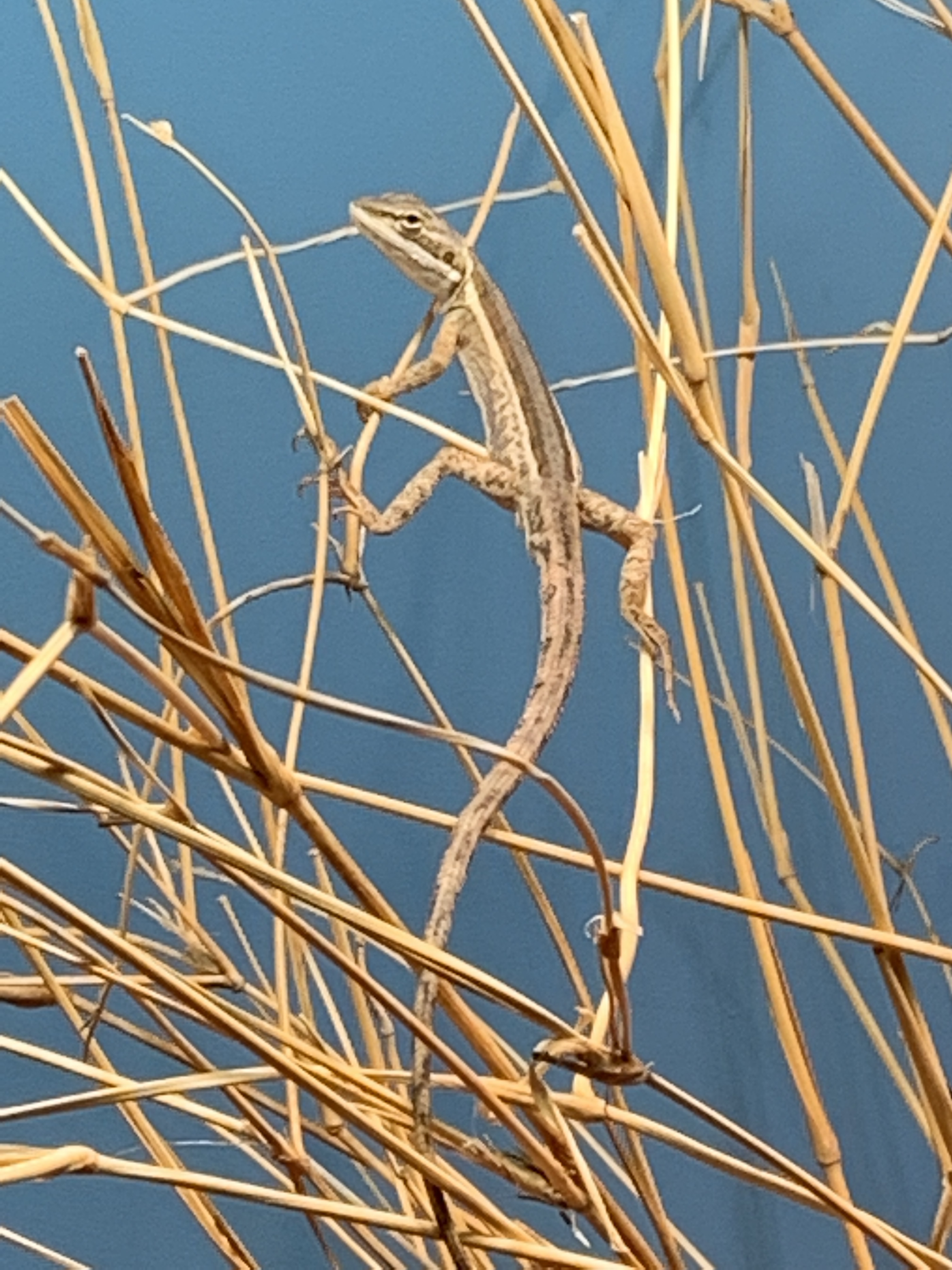
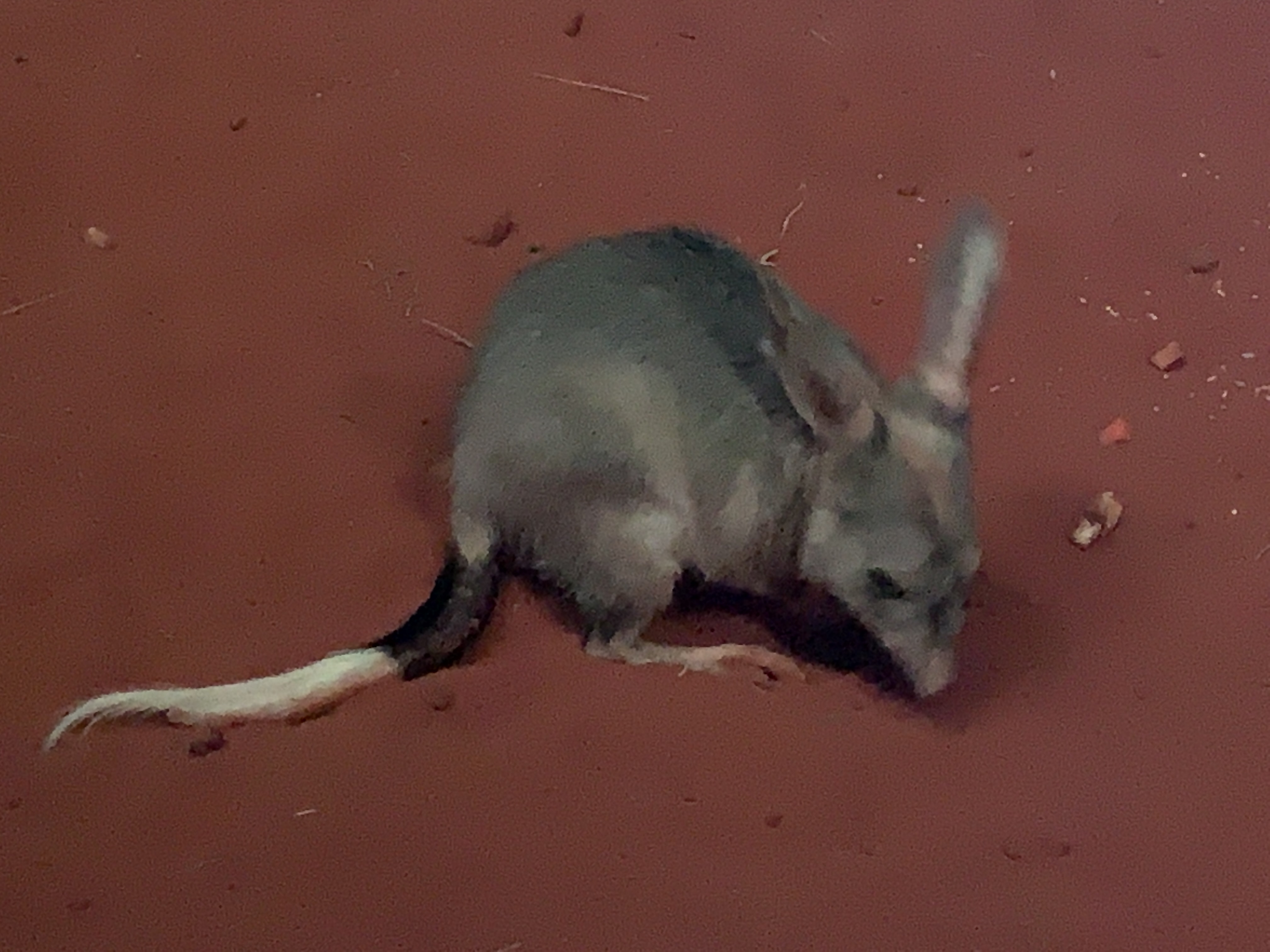
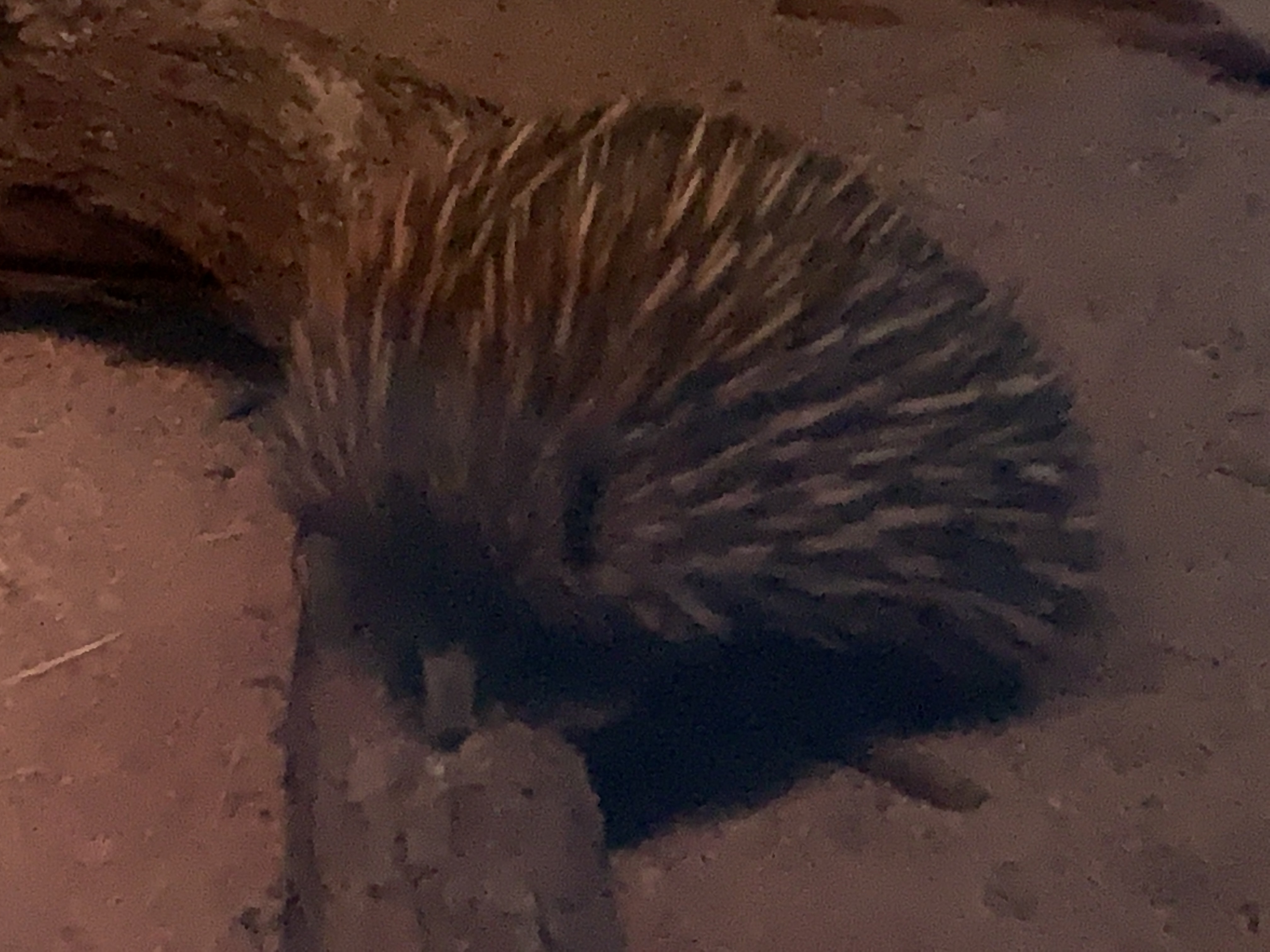
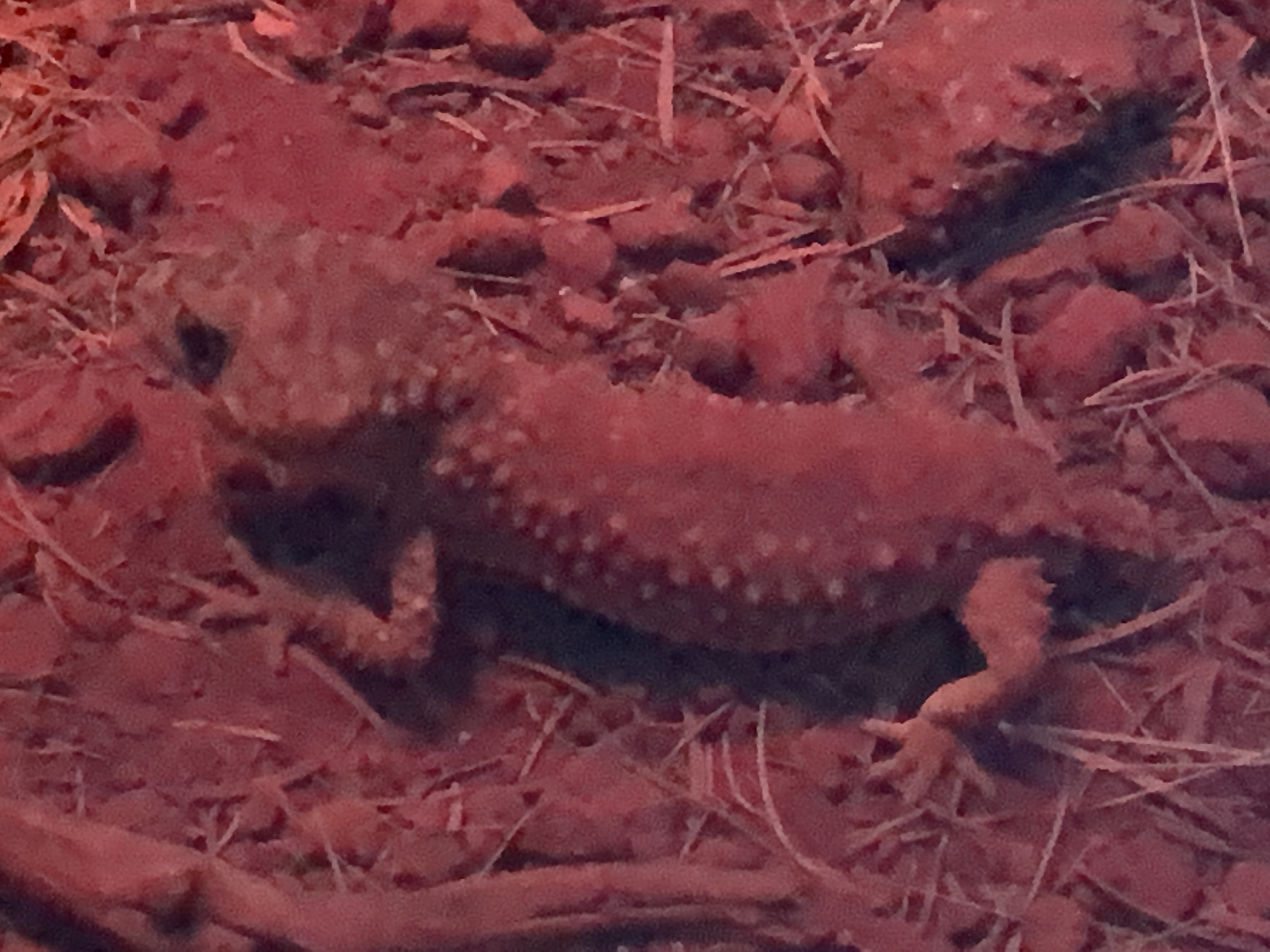
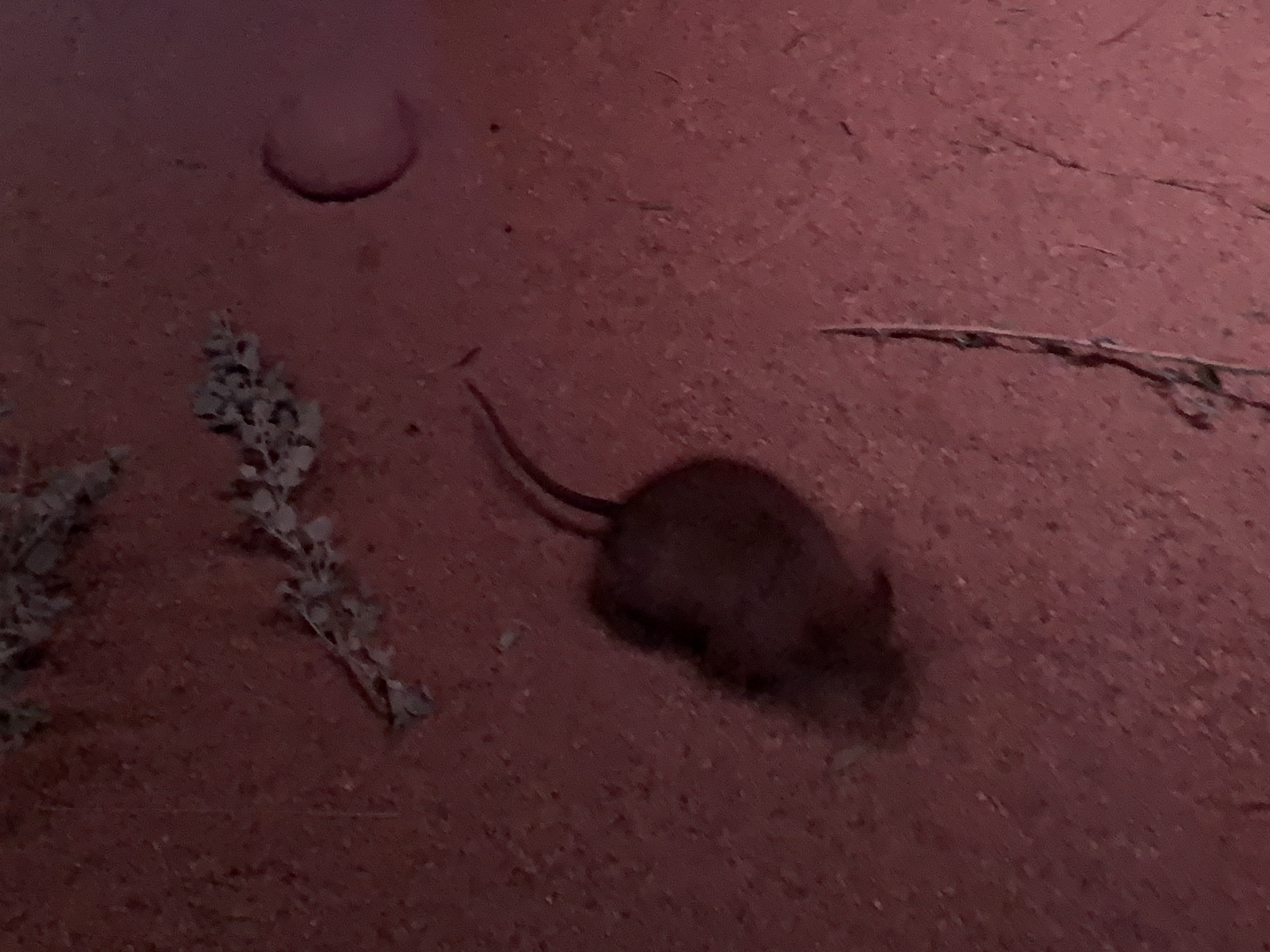
Next up we went through the Sand Country section to get to the Nocturnal House. The Nocturnal House is a large building with excellent displays of rare and endangered nocturnal animals of The Red Centre. We finally had a name for the little mice that we had running around our camp in the desert on the way to Alice. They are called Spinifex Hopping Mice.
We spent quite a long time in the Nocturnal House as there was so much to see.
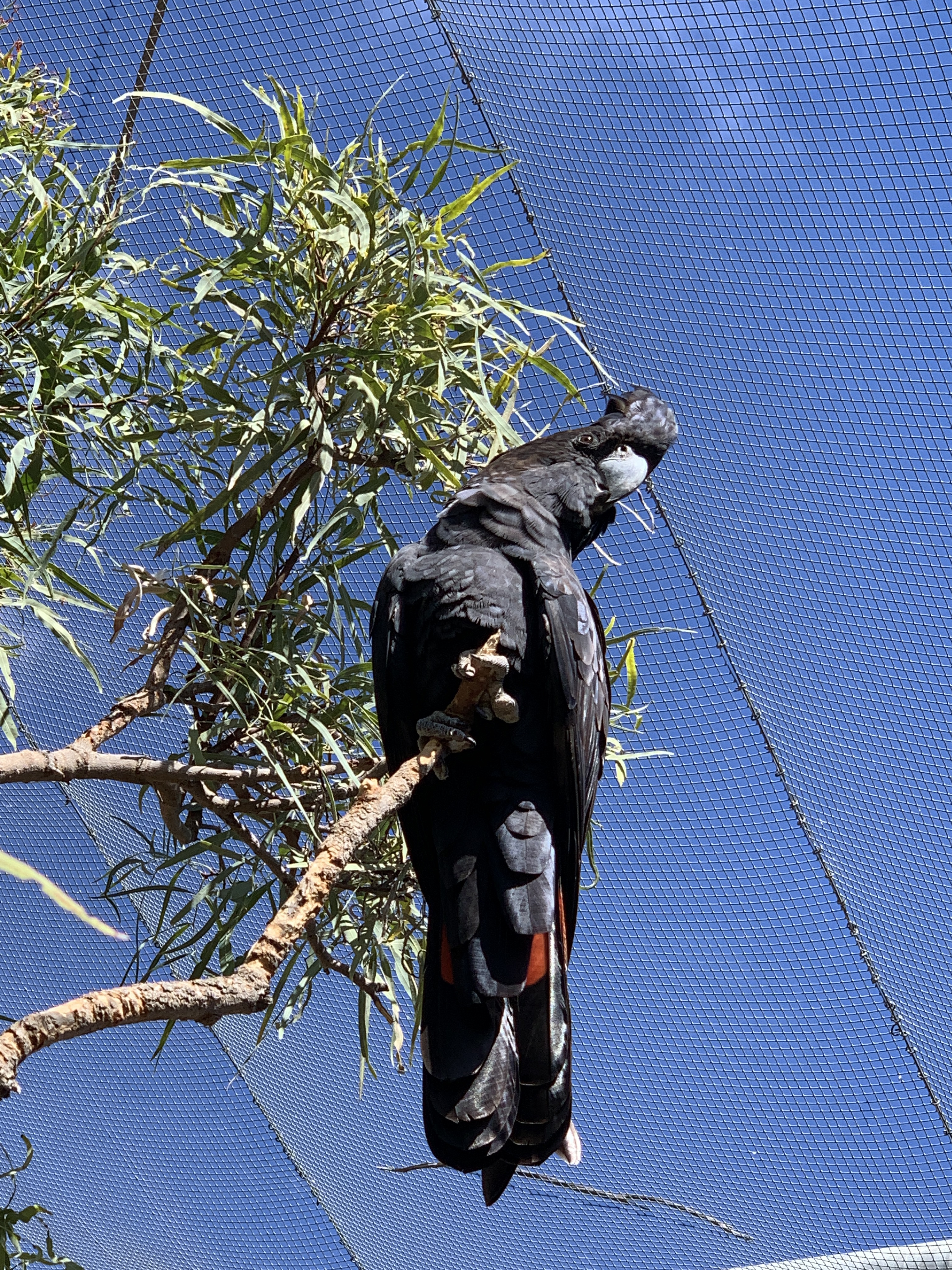
We then walked through the Woodland section of the park that included a couple of fabulous bird aviaries and a red kangaroo enclosure before making our way back to where we started.
Sadly the Cafe at the Desert Park is not currently operational. They have no one willing to take it on at this time and as our tummies were rumbling by this time we decided to head back to camp for a late lunch.
In the late afternoon Pa took Ben & Maddie to the pool, while Katie and I did the groceries for our trip out to the West McDonell Ranges. Riley was reading his book!
In the evening Rich stayed back at camp while the rest of us piled in the car for the short journey to Blatherskite Park to go to the Alice Springs Show and watch the Territory Day Fireworks.
Off to the show
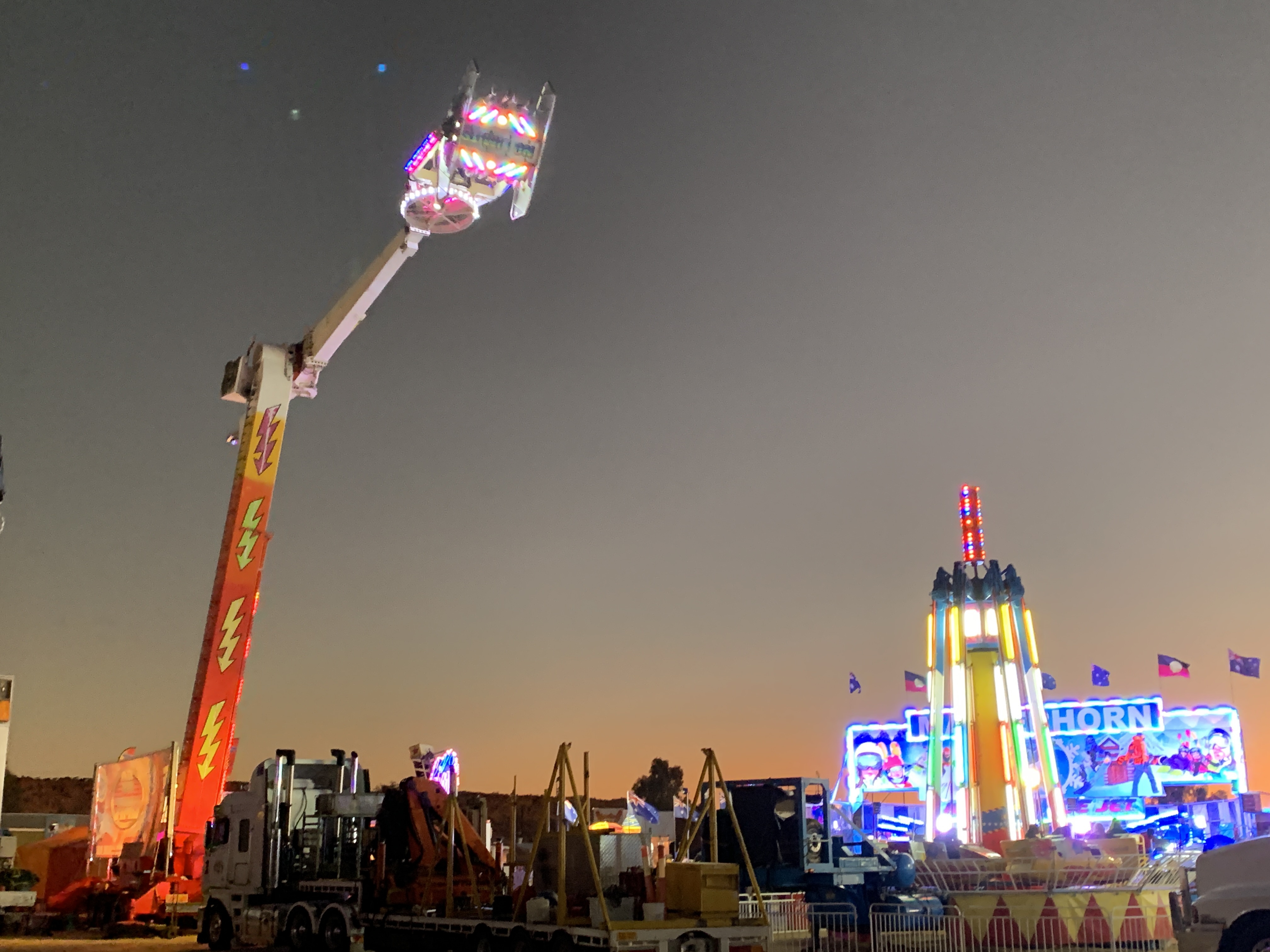
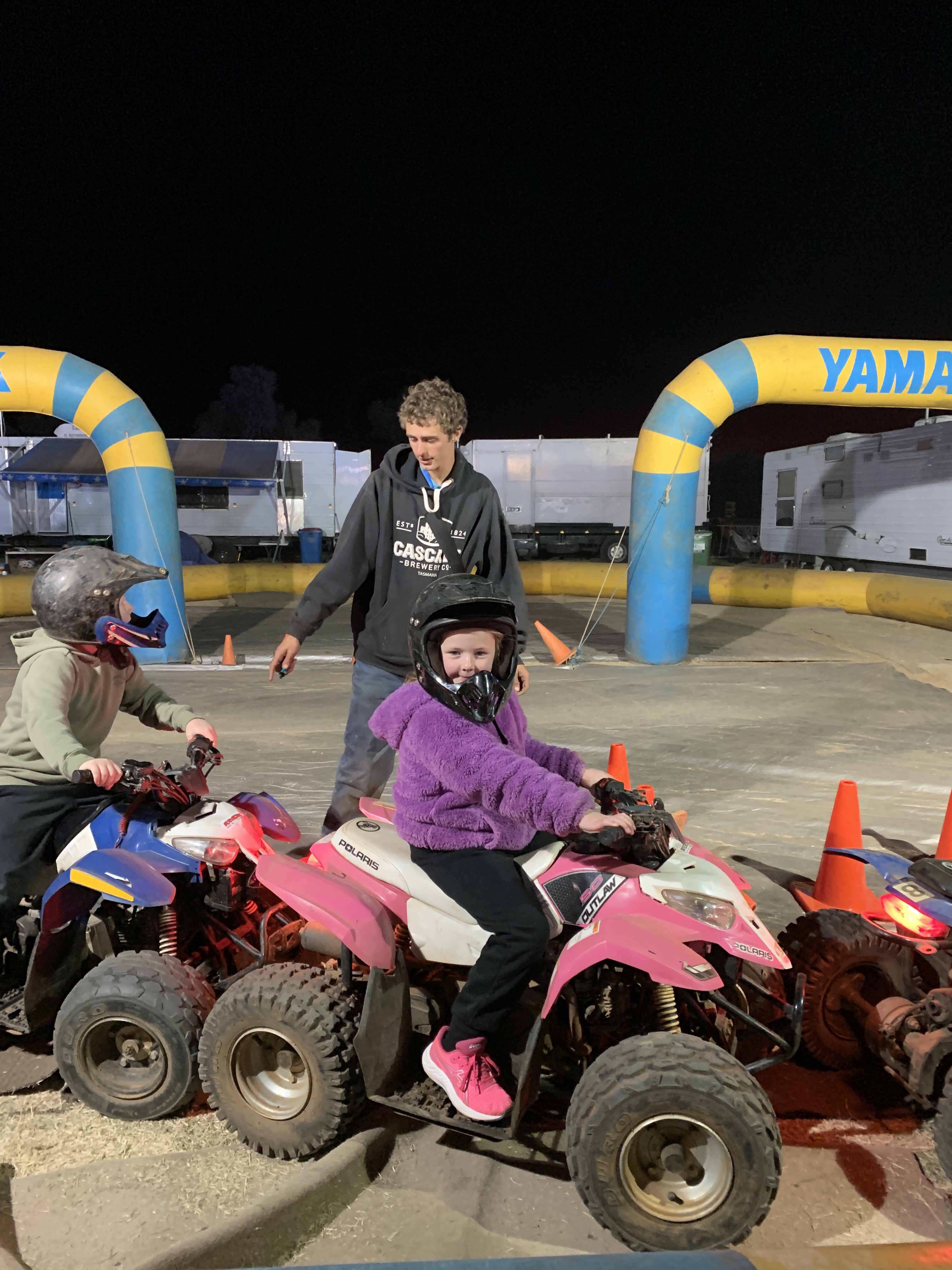
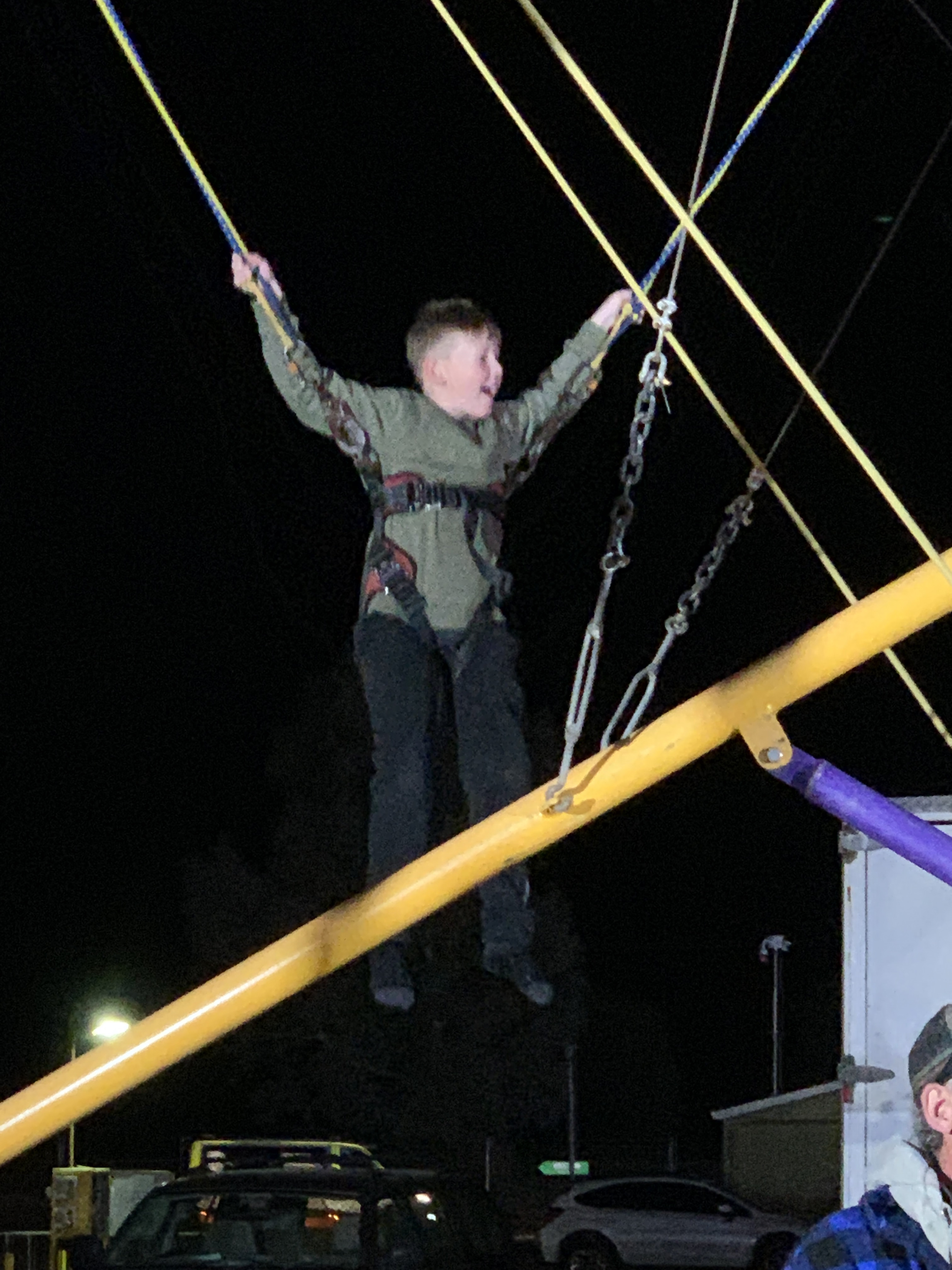
What a fabulous time we had. The kids all wanted to go on the rides so they went on the Dodgem Cars, we all went on the Ferris Wheel together, Ben & Maddie had a go at four-wheeler motorbikes and the Big Bungy while Riley had a go at shooting hoops and throwing darts. What fun!
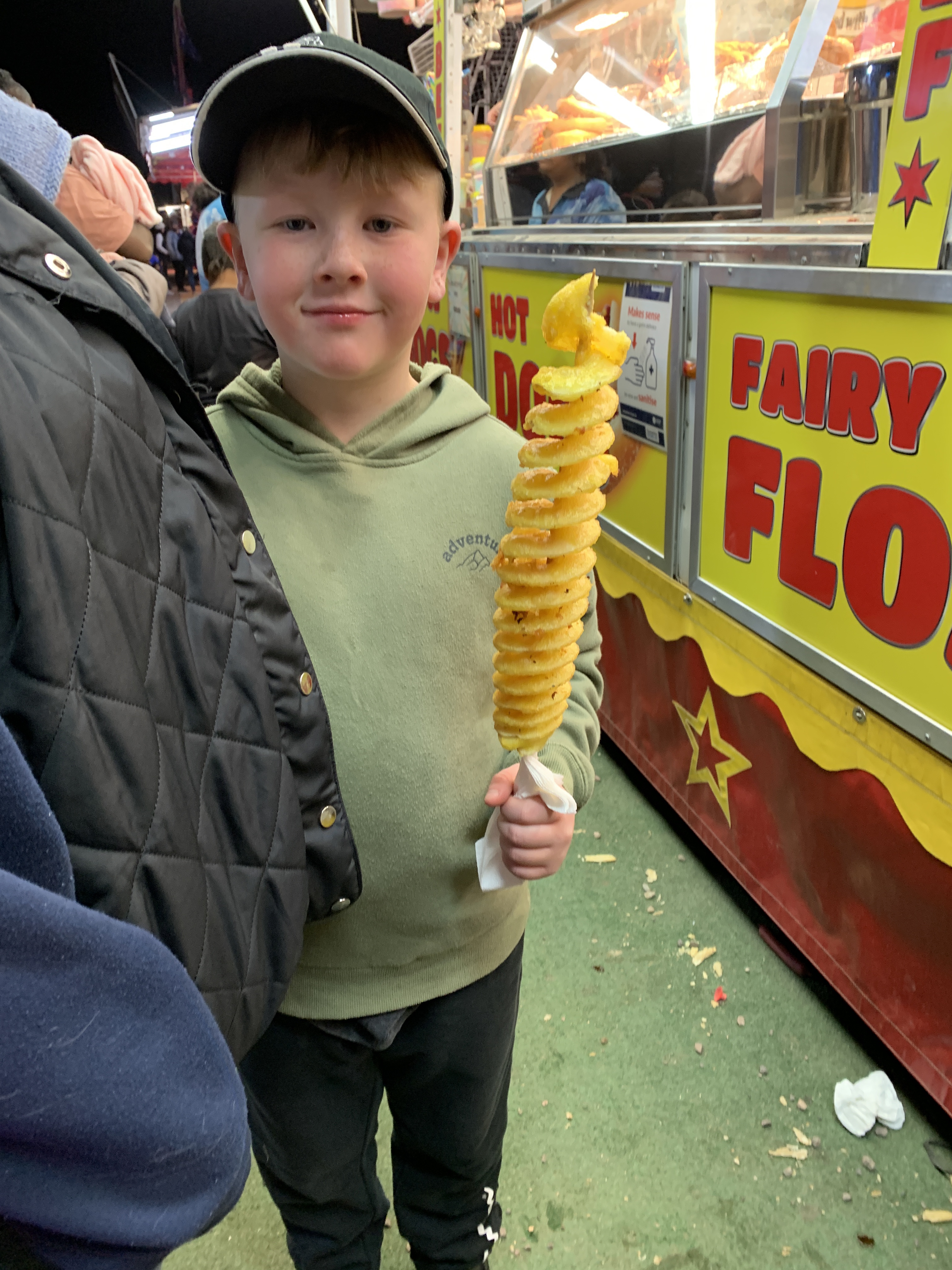
We made sure to buy something to eat then made our way to the grandstand to set up to watch the fireworks at 8pm. We found a position on the grass in front of the grandstand and sat on our picnic rug eating our gourmet dinners of dim sims, hot chips, spiral potato on a stick, Dagwood dog with sauce and a stuffed baked potato.
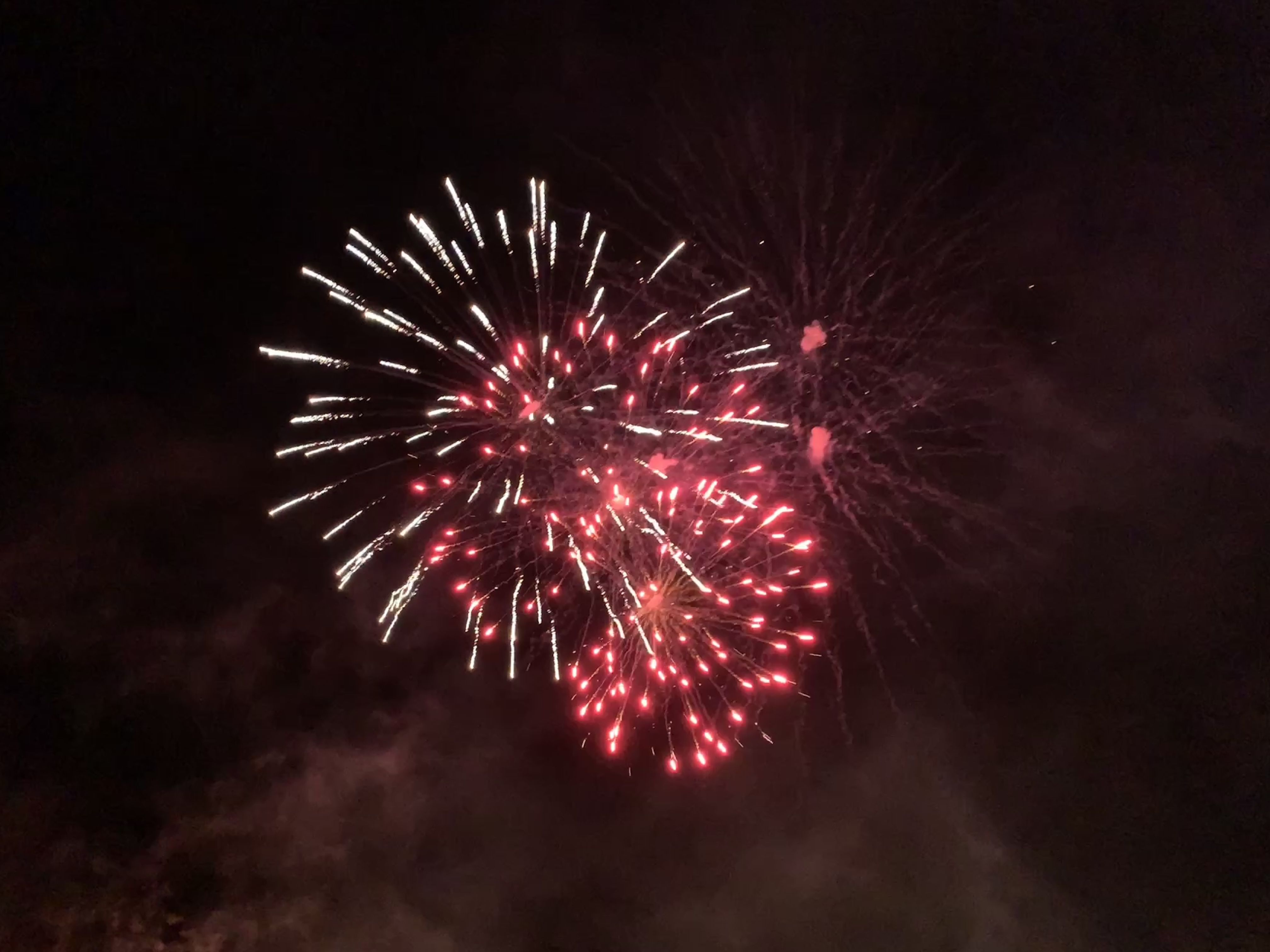
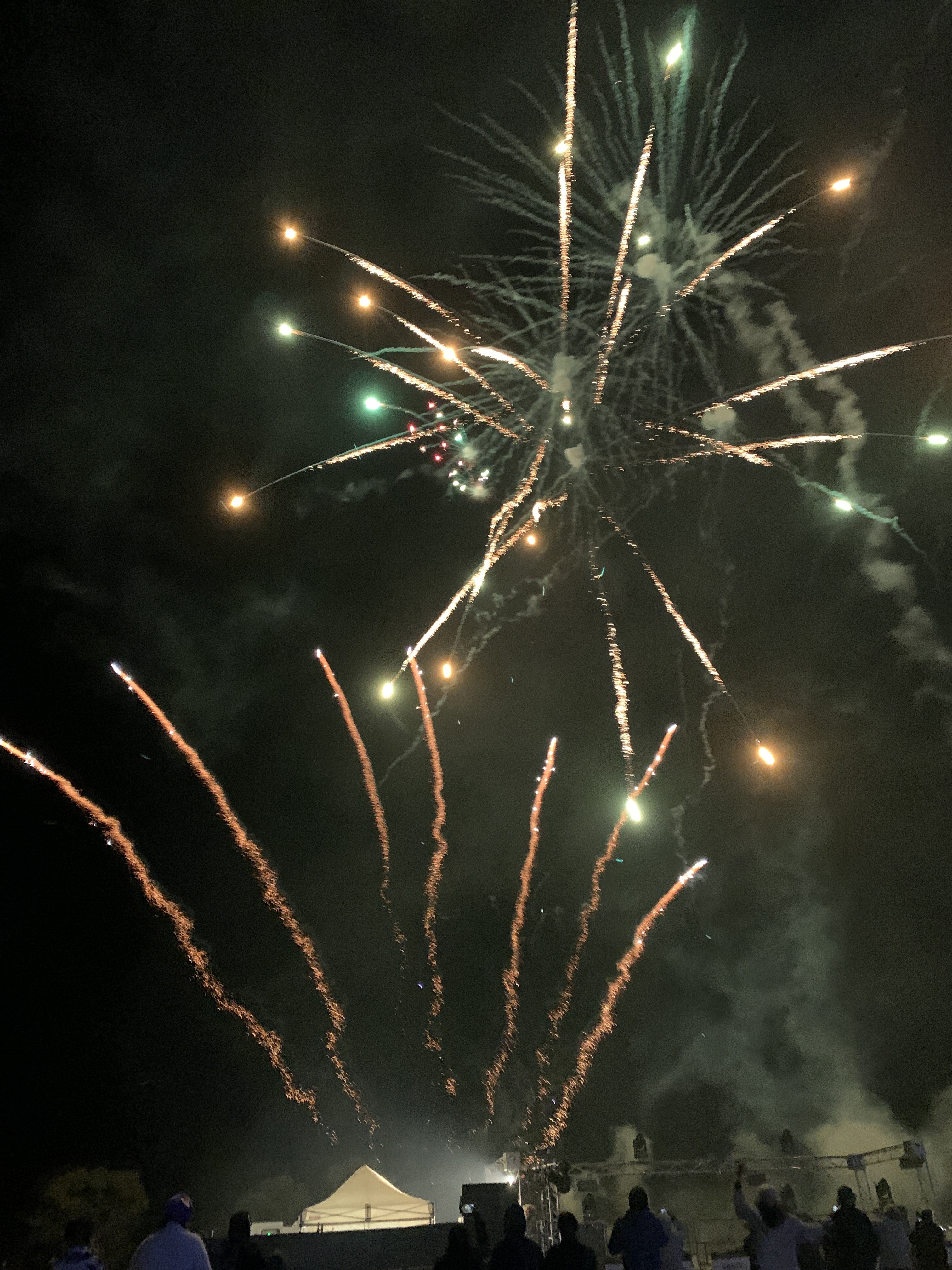
The fireworks started right on time after a countdown by the MC. The crowd helped call out the countdown. The display ran for about 20 minutes and was set to music. It was an awesome fireworks display and there was lots of cheering and clapping by the crowd when it finally finished.
Of course then all the crowd had to leave to go home so we walked, along with the thousands of others, back to the carpark. People had been encouraged to use public transport to get to Blatherskite Park however there were still a lot of cars. We thought it might take quite a long time to get out however we were out of there in no time at all.
The kids declared on the way home ‘this is the best holiday ever and we’re not even half way through’.
As we drove into our caravan park who should we find sitting on a ledge with another old bloke, Pa. Pa had made a friend and they were both out the front of the park watching fireworks. They reckoned it had been amazingly dangerous. The bloke across the road nearly set his house and fence on fire, a grass fire was started in the other direction. In a word, mayhem. They were having a great time watching it all.
Another great day was over on this fabulous adventure to The Red Centre. We have learnt so much already and there’s still so much to see.
We set off to be tourists in Alice Springs and our first stop was the Tourist Information Centre. This is located in the heart of the CBD. There is plenty of parking nearby. It is handy that all six of us can fit in Katie’s Prado so we can travel around together. If we were on our own we’d just go in the motorhome.
We spent a half an hour exploring the Information Centre and talking with the guides. We asked lots of questions about the West McDonnell Ranges to prepare for our trip out there. Things like where to camp, is there water available, are there dump points out there. Vital information to know BEFORE you go!
Armed with lots of brochures and maps we set off just up the street to visit the Megafauna Centre. The museum was still closed so we took advantage of the excellent coffee shop opposite and bought some morning tea.
We were the first in the doors when the museum opened at 10am. What an excellent museum. We recommend this one to all families especially if you have a budding scientist in your midst.
In the late 1950’s an Aboriginal station hand at Alcoota Station found the bone of an ancient animal on the ground. He knew it wasnt a cattle or kangaroo bone and was too large to be any animal he knew to be living in the area.So he passed it to the station manager who passed the bones on to an Alice Springs collector Mr R Gordy.
The find soon became know to two scientist at Alice springs, Keith Rochow and Alan Newsome who then travelled out to Alcoota to investigate. What they found was the largest most significant megafauna site anywhere in Australia. This was an exciting find in the world of palaeontology and the news spread around the world.. The long and painstaking collection and processing of fossils is still continuing today.
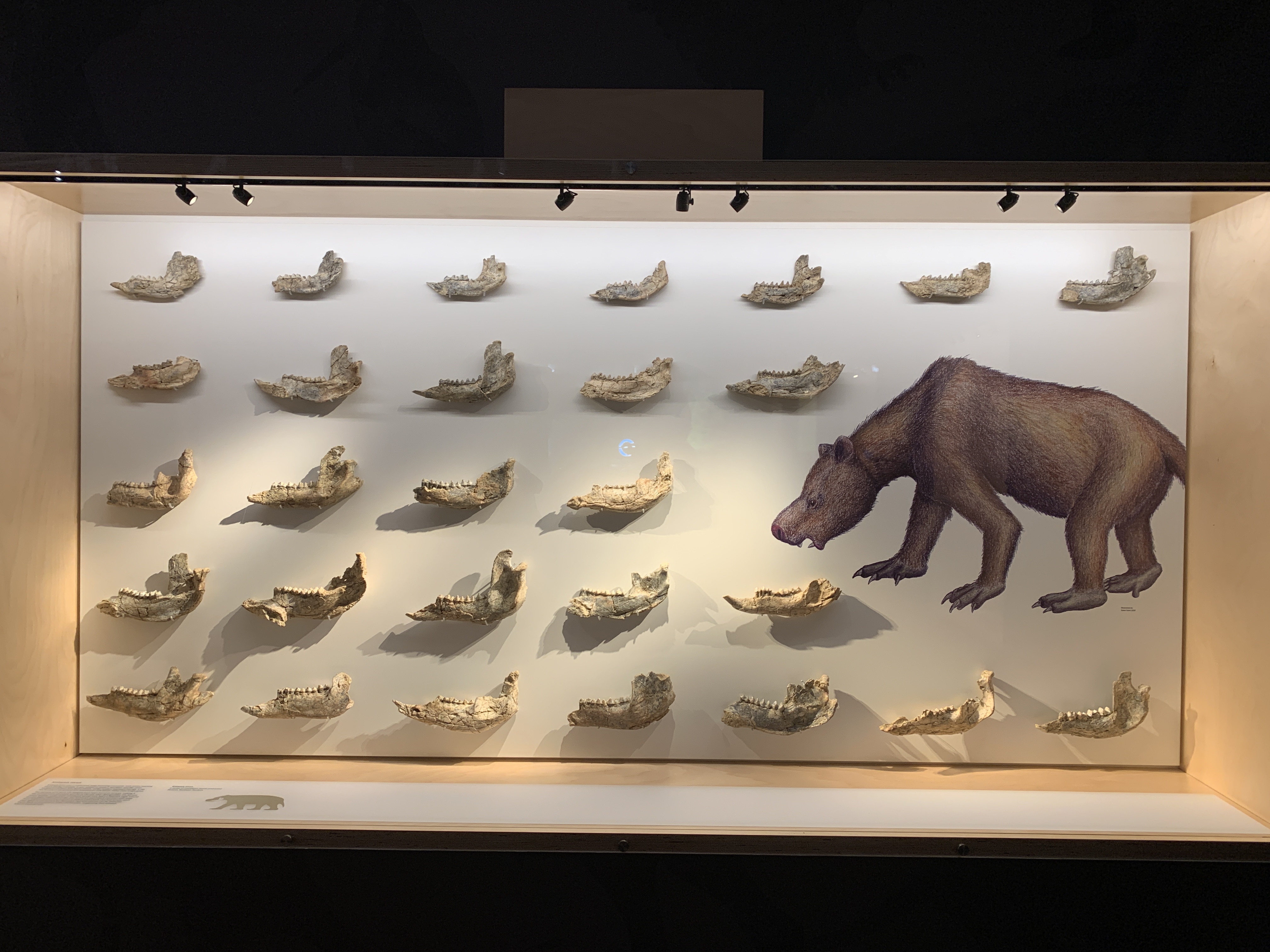
Megafauna evolved and thrived in Australia over 8 million years until they all became extinct approximately 42,000 years ago. The first people arrived in Australia some 65,000 years ago so they would probably have hunted megafauna.
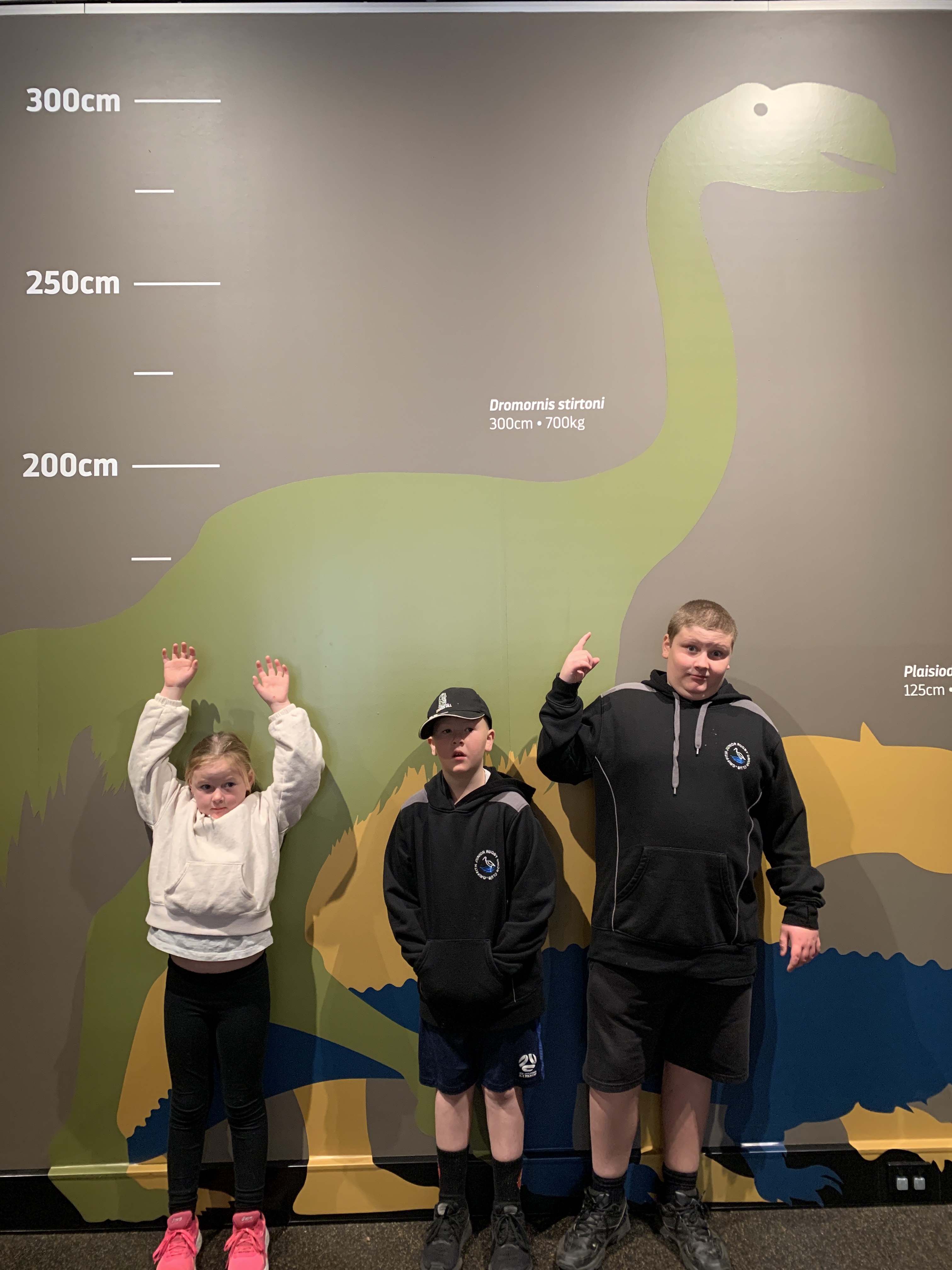
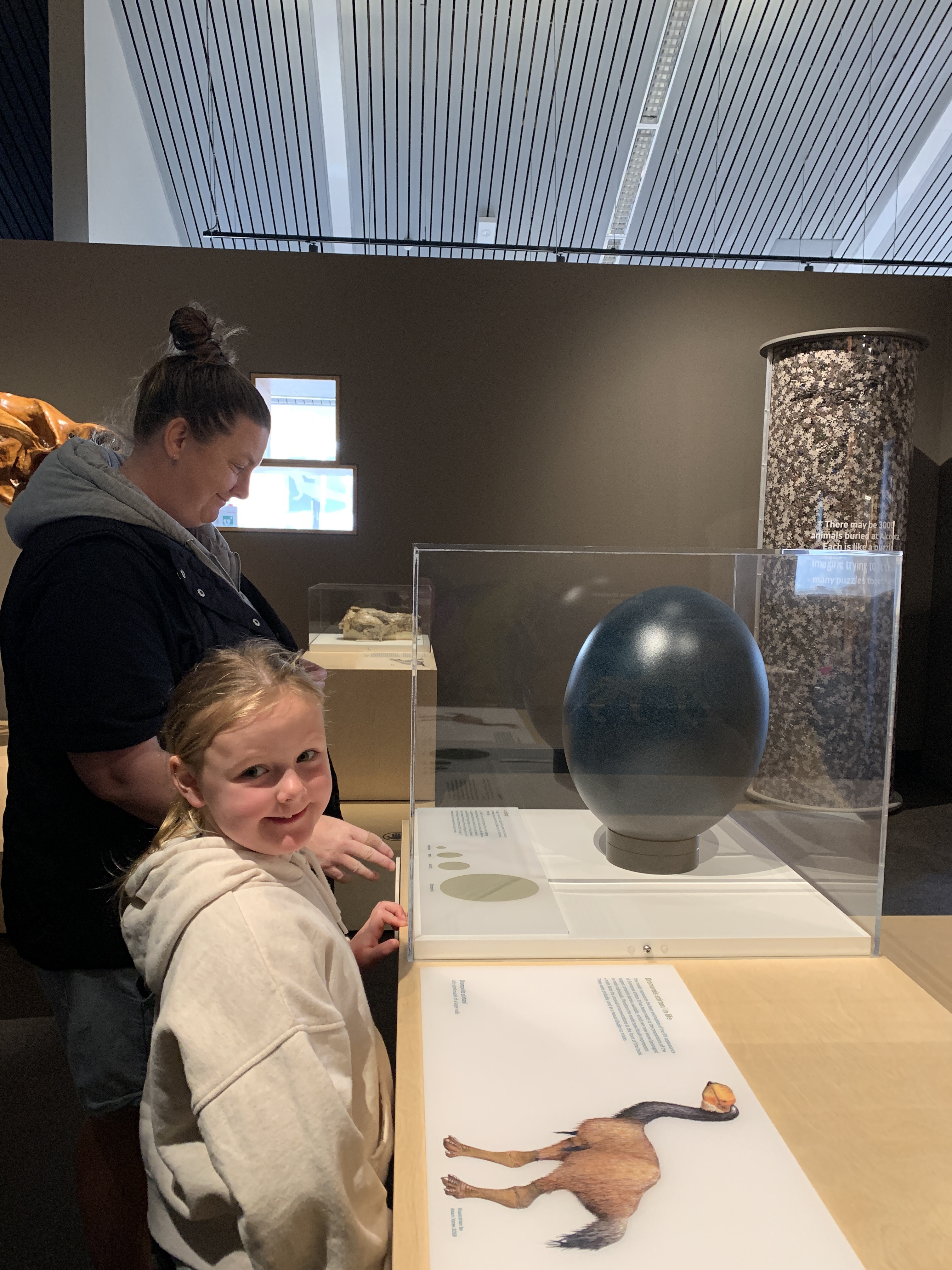
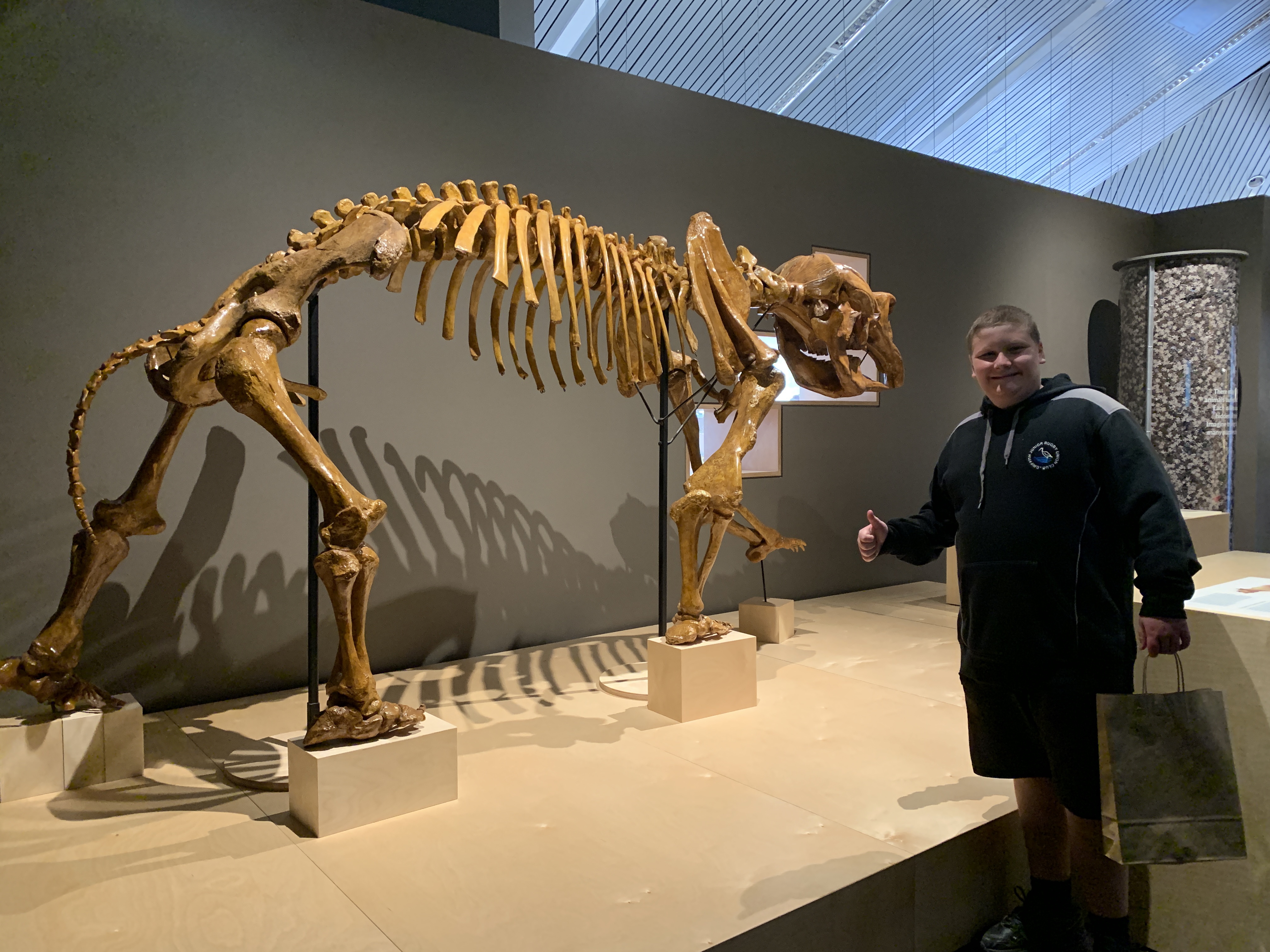
The fossil displays are very good and the children enjoyed exploring the museum. Your can see the largest flightless bird to ever walk the earth. Dromornis stirtoni stood 3 metres tall and weighed up to 500kg.
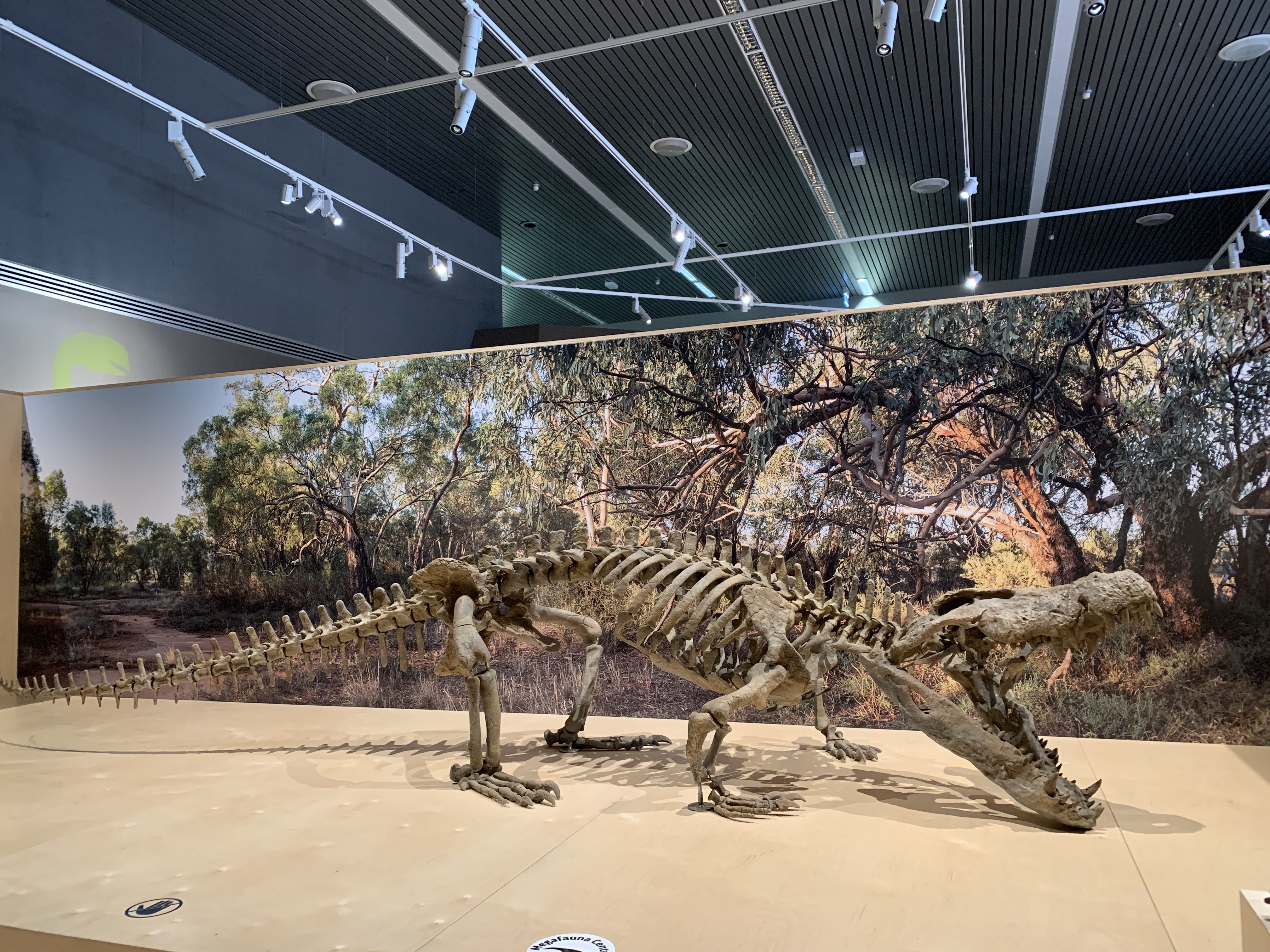
Your can see a full skeleton of a huge crocodile that would have made our current salties look small.
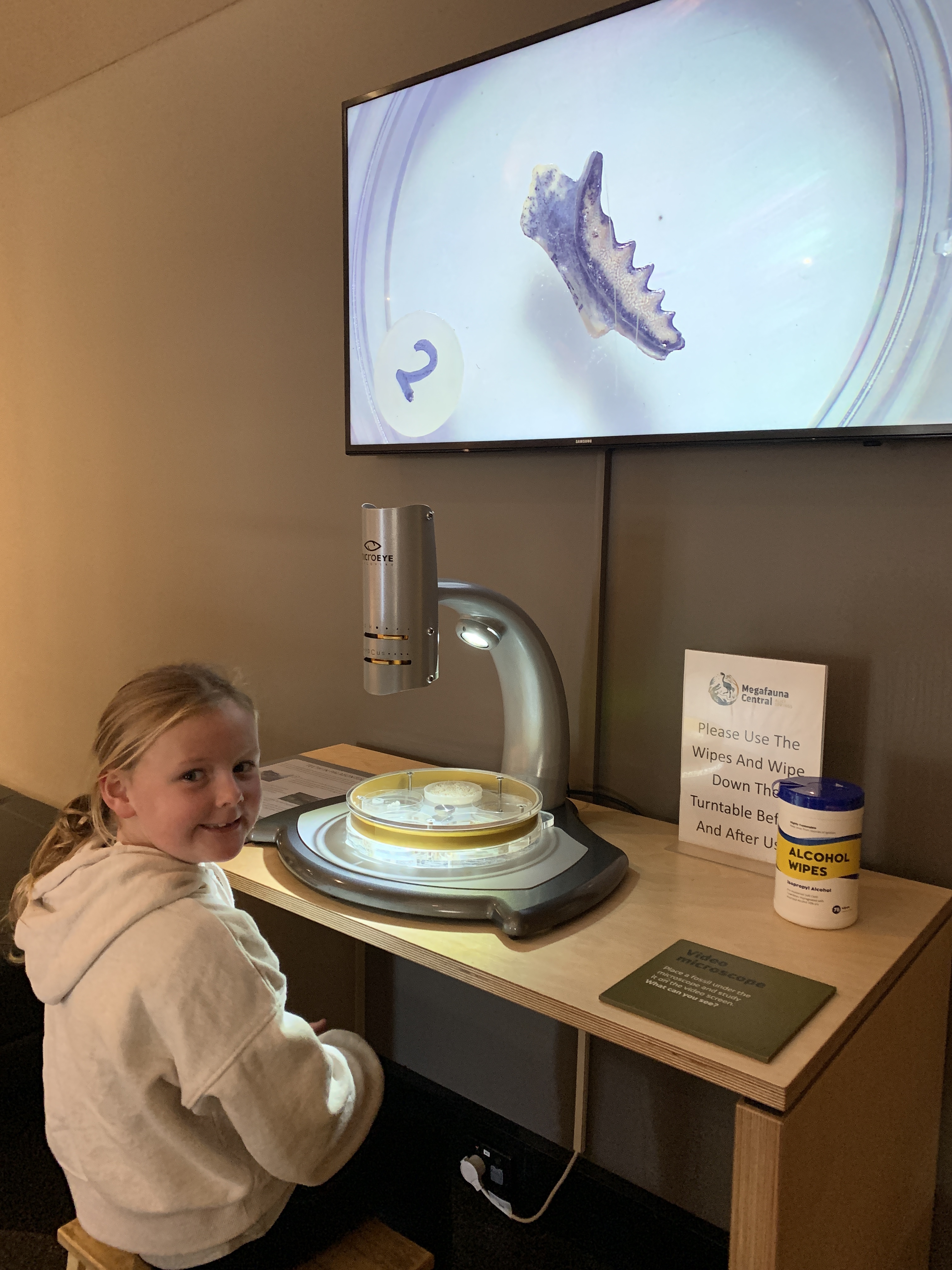
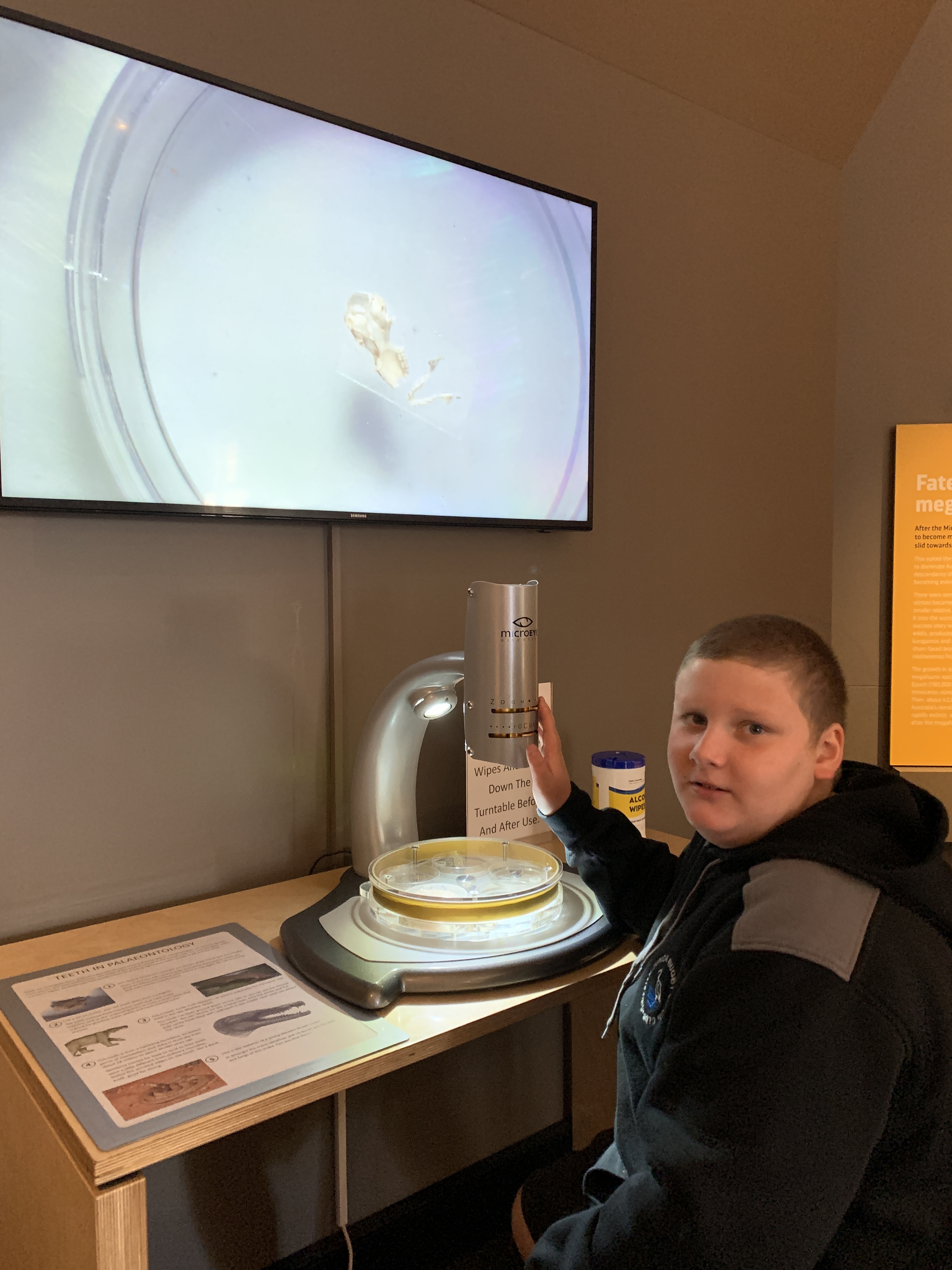
They liked being measured up against the wall comparing themselves to the size of the megafauna. Another display they really liked was the microscope. Here they could practice being scientists and view a number of dishes under the microscope, zooming in and out to search for more details.
You can even view into the laboratory where the fossils are processed.
We spent an hour at the Megafauna Centre and I recommend it to families or anyone interested in our historic past. Entry to Megafauna Central is free.
Megafauna Central, Alice Springs
Our next stop was the Anzac Hill Lookout. As Alice Springs is set right amongst the McDonell Ranges there had to be a lookout and we found it going north. Anzac Hill commemorates all those locals who have fought in all conflicts. The cenotaph is at the top of the hill. The view afforded from the hill provides a 360 degree view of the town. We could look across the CBD towards the gap where the Stuart Highway and the Ghan train line runs through. The caravan park we are staying in was on the other side of the gap. It was blowing a very cold wind at the lookout so we didnt spend too much time there.
There’s the GhanAnzac Hill Lookout
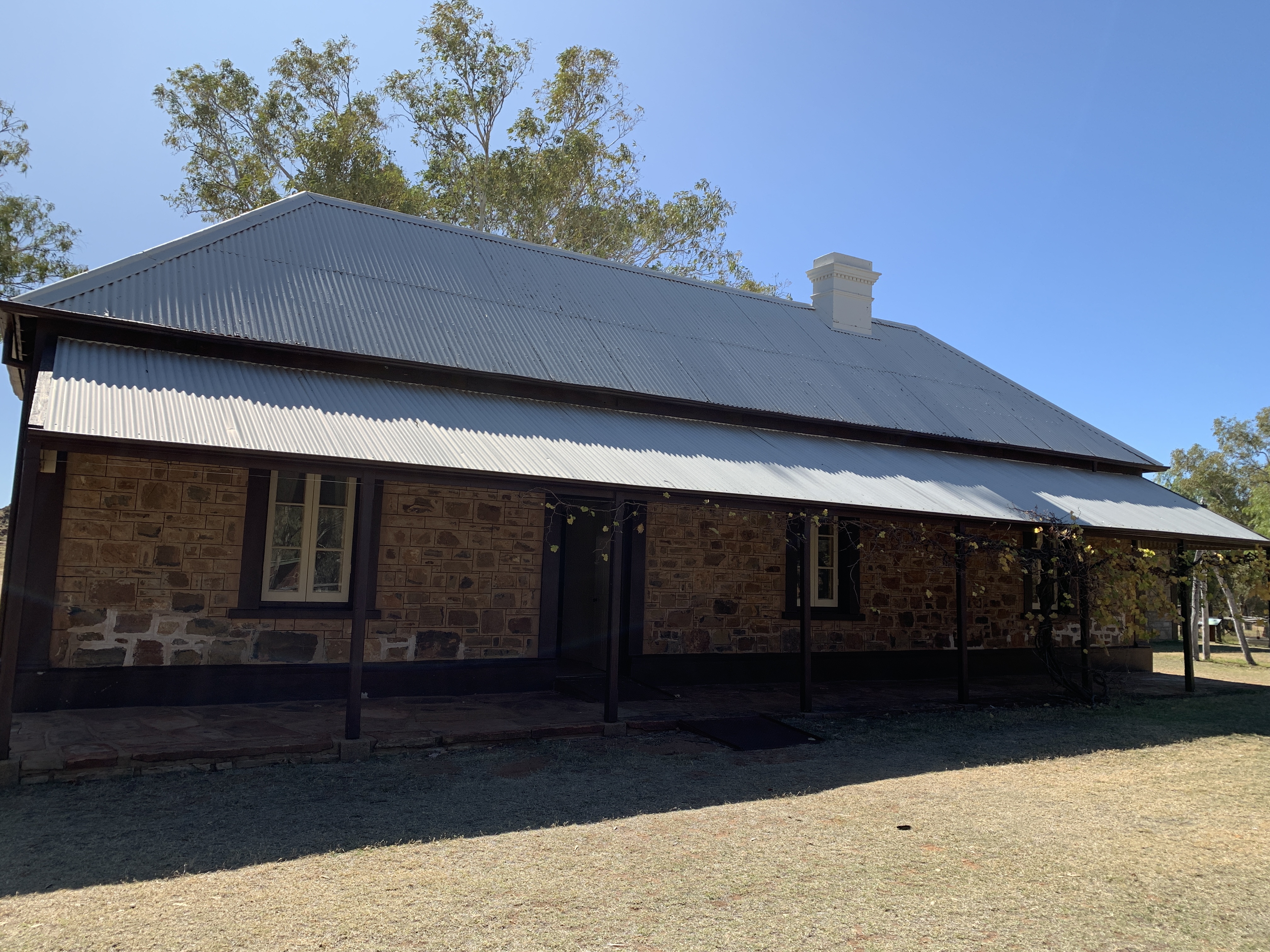
We continued northwards to visit the Historic Telegraph Station. This fabulous piece of Australian history has been lovingly preserved for all to visit. The Telegraph Station is a reminder of an incredible time in our country’s history when we became connected to the rest of the world. The overland telegraph connected to a submarine cable that linked Port Darwin to Indonesia. From there it connected to the rest of the world. This changed our country forever. It no longer took 3-6 months for news to reach or arrive from Europe. It would now only take 5 hours.
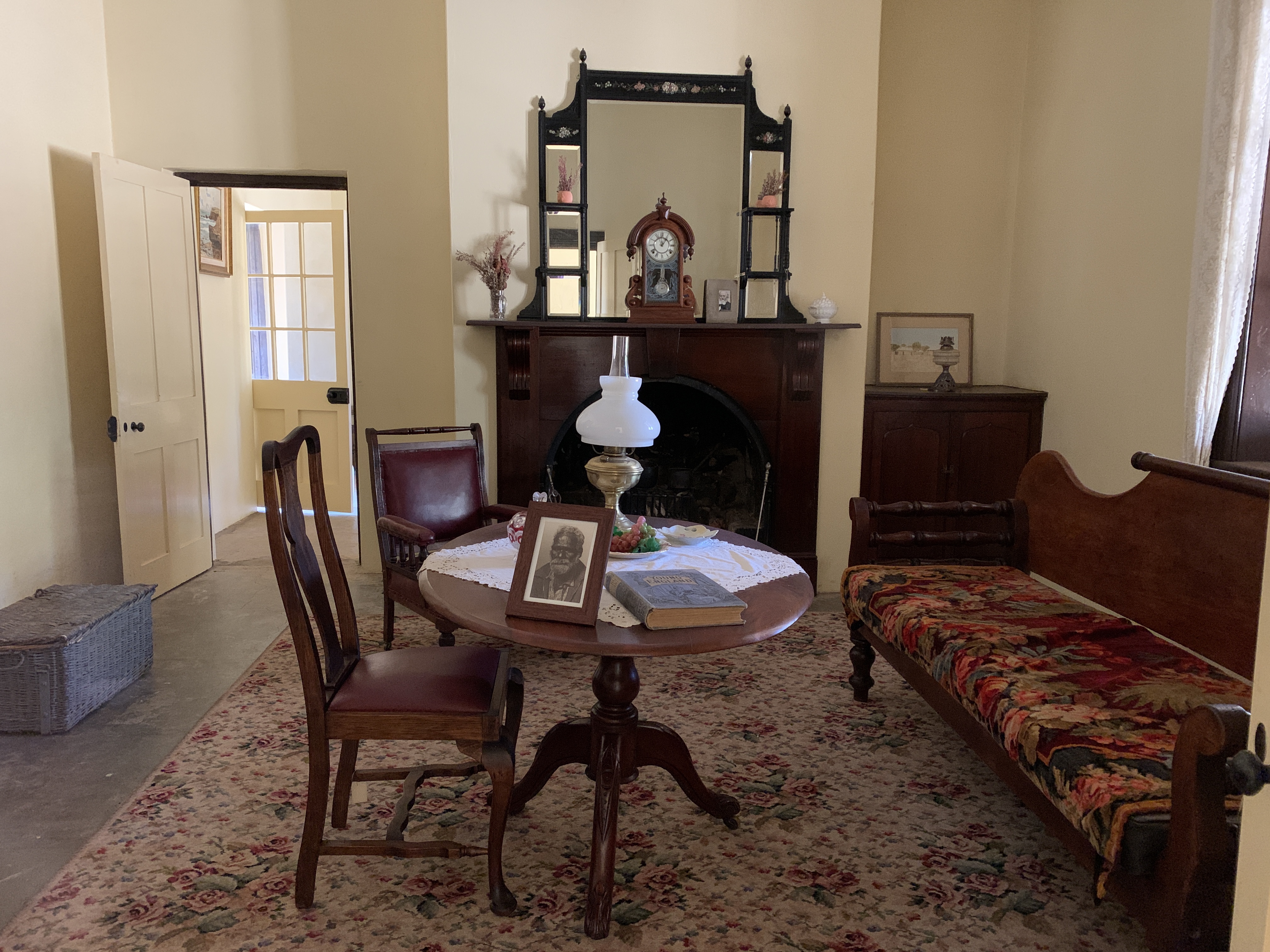
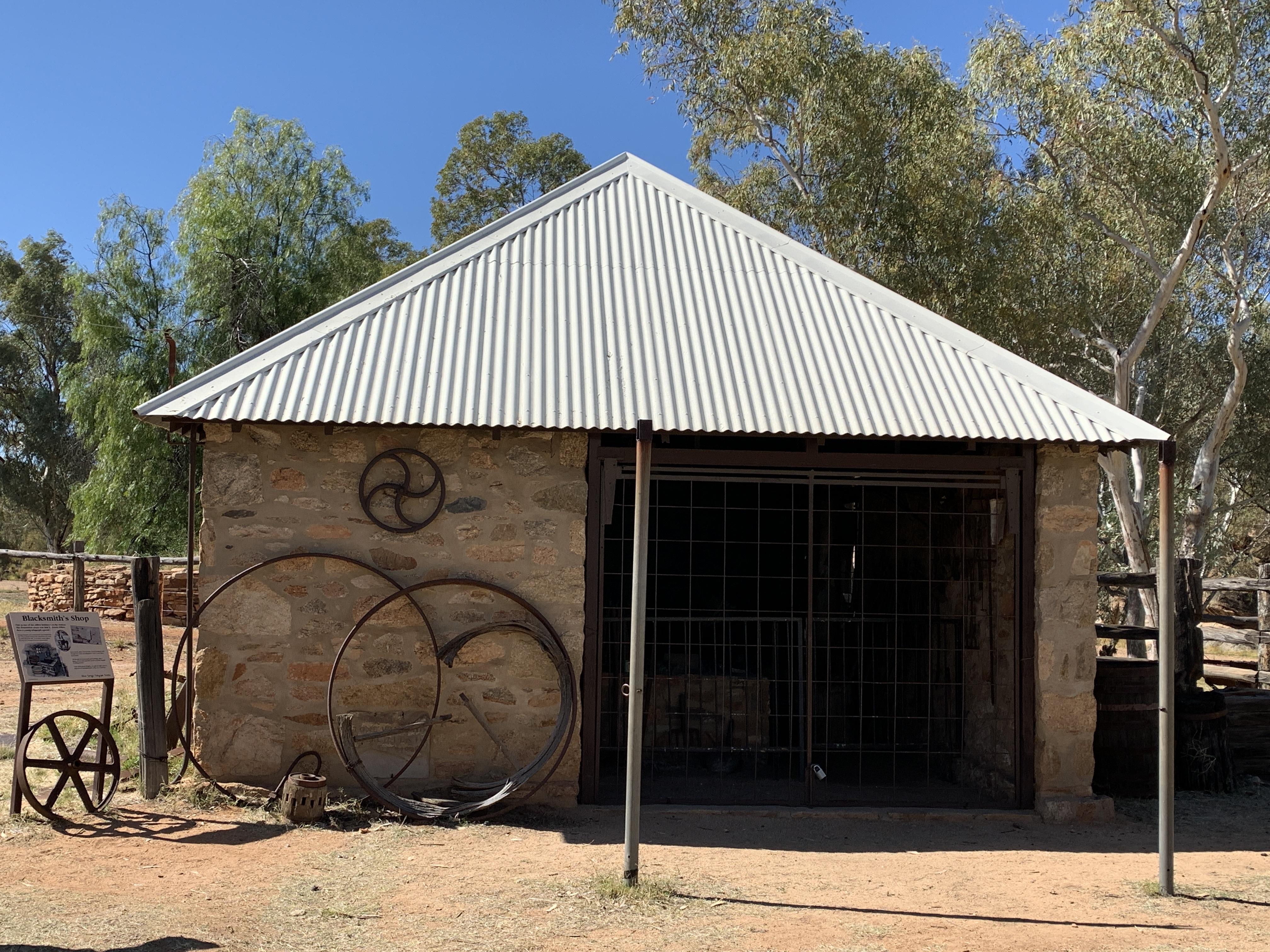
The Alice Springs Telegraph Station (ASTS) was built in 1871. The central building was known as The Barracks. Each telegraph station along the way had a barracks. ASTS grew over time as more people were needed. Station masters brought their whole family to live at the station so a school room was needed. A Station Masters house was built, a kitchen, a Post Office, a Blacksmiths shop, barns and storerooms and storage rooms for the Stations large bank of batteries that powered the telegraph.
We arrived just in time to do a guided tour of the station and we learned a bit about station life and the importance of the overland telegraph to our developing country. The guide issued the children with a quiz that they needed to find the answers for during their visit. If they got all the answers correct they would get a prize at the end.
While all the construction and development was going on at the ASTS just a bit further south a new township was being established and growing. The town was named Stuart after the great Scottish explorer John McDouall Stuart. Gold had been discovered 100 kilometres away at Artlunga in 1887 and the the township of Stuart was established in 1888.
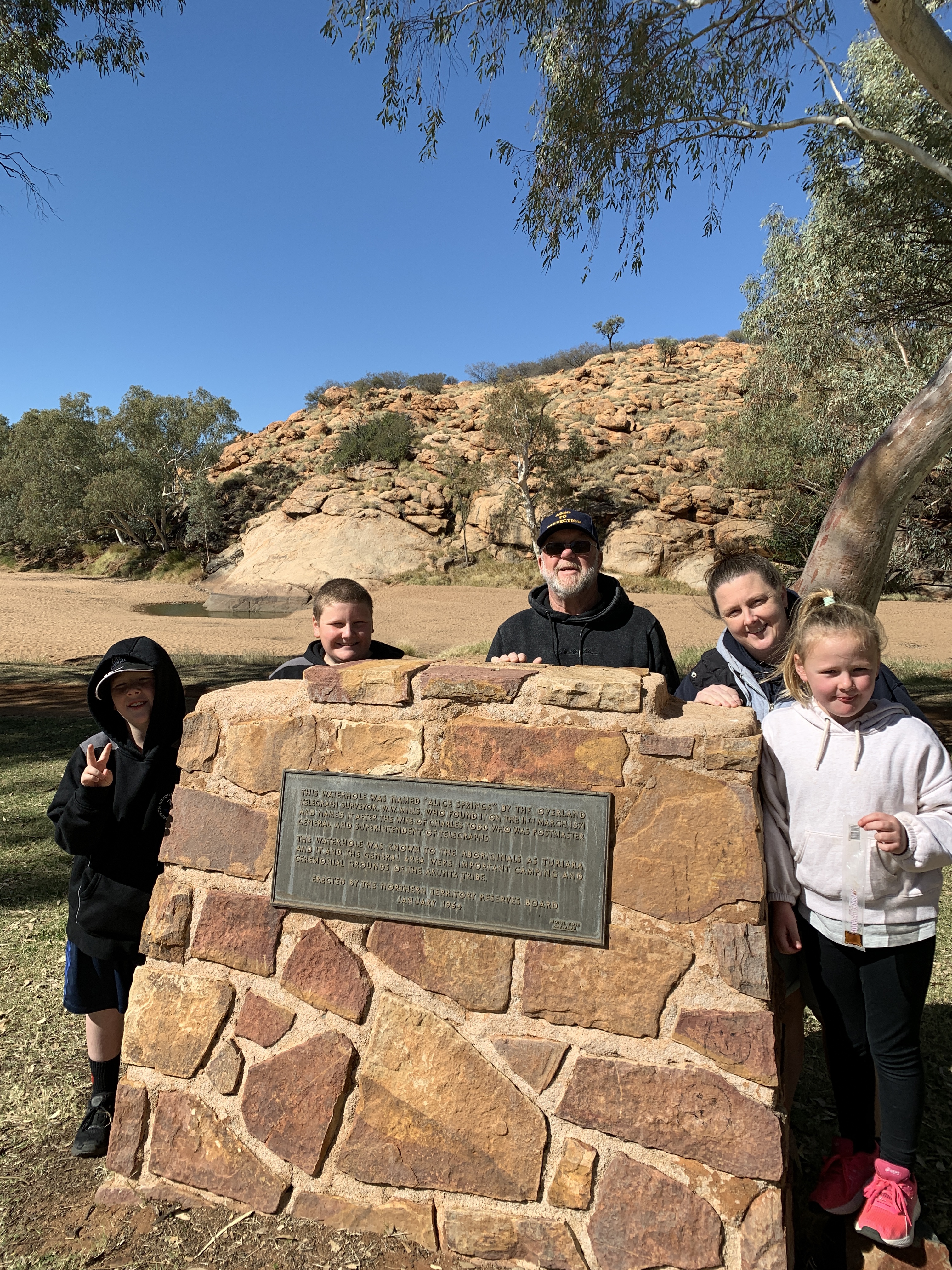
It was at the ASTS we learnt how Alice Springs got its name. The Todd River passes by and there is a waterhole that rarely dries out right near the station. The Arrernte people know it as a sacred site and it has been used by their people for thousands of years for camping, ceremonies and trading. Explorer-surveyor William W Mills falsely believed it to be a spring and named it after Mrs Alice Todd, the wife of Sir Charles Todd, the Postmaster-General of South Australia. The river is named after him.
The arrival of the telephone spelt the end of the telegraph and the station finally closed in 1932. In 1933 Stuart town was renamed Alice Springs.
A sad part of the history of the ASTS is the Bungalow era. This was during the time where the governments of the day thought it was a good idea to remove Aboriginal children from their families and place them in institutions. The ASTS had a large corrugated iron building that slept 130 children. Many of those children now identify as the Stolen Generation although there are also many stories of happy childhoods growing up at the Bungalow in Alice Springs.
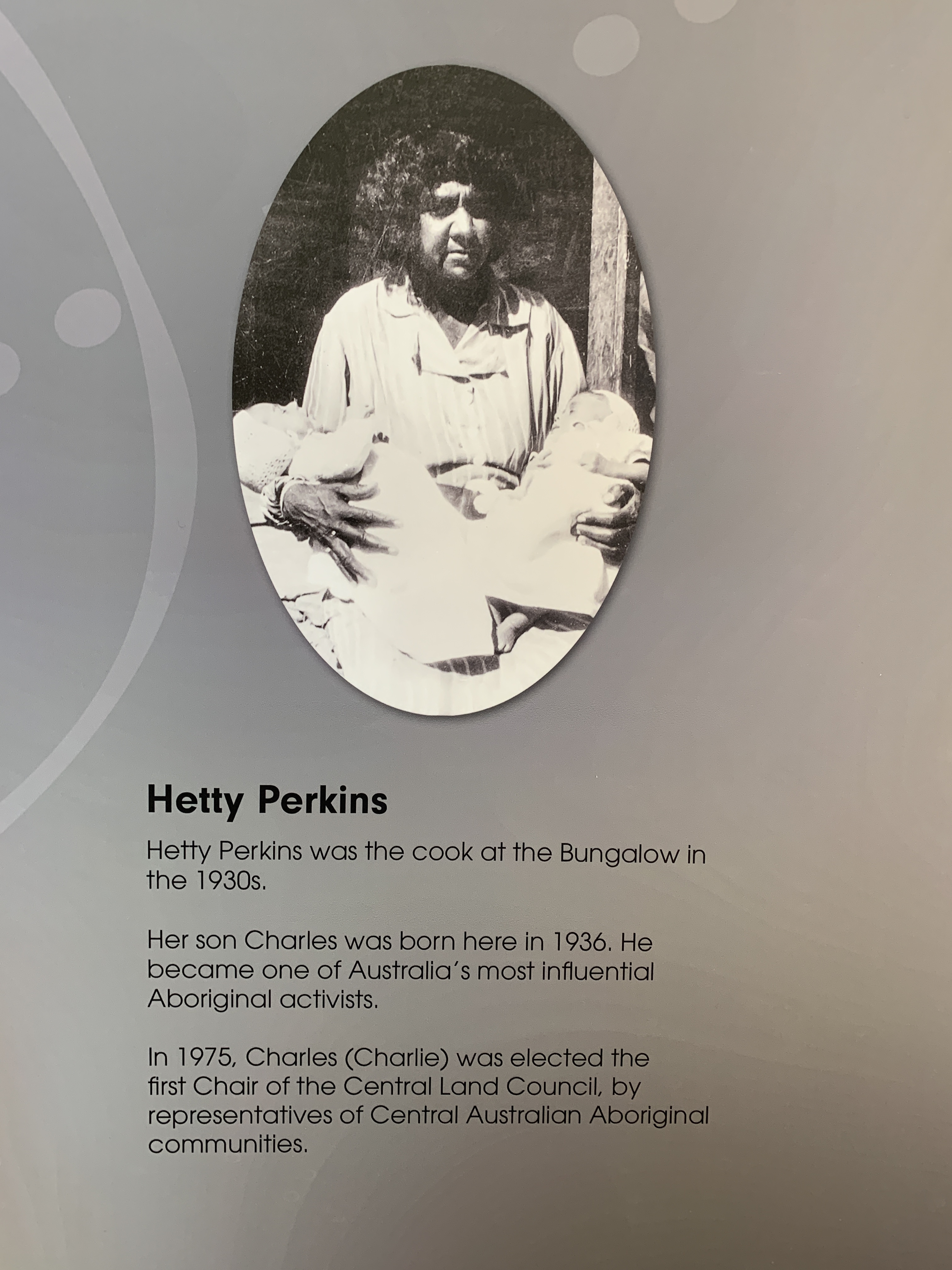
Hetty Perkins was the cook at the Bungalow in the 1930’s. She is the mother of Charles Perkins who was born there in 1936. Charles went on to become the first Chair of the Central Land Council in 1975.
The Bungalow building was removed in the 1960’s.
As we wandered around the site we noticed lots of workers setting up tables and chairs. Richard went and asked and discovered they were setting up for a dinner and evening for passengers on The Ghan. We spent a couple of hours exploring the historic buildings and the ‘Alice Springs”.
On the way out the children handed in their quiz sheets and they all got a Zooper Dooper as a reward. The quiz was a great way to get the children interested in the centre by looking for answers to the questions.
The Battery RoomStationmasters HouseAlice Springs waterhole in the backgroundThat’s a gun hole (never used)BlacksmithThe Historic Alice Springs Telegraph Station
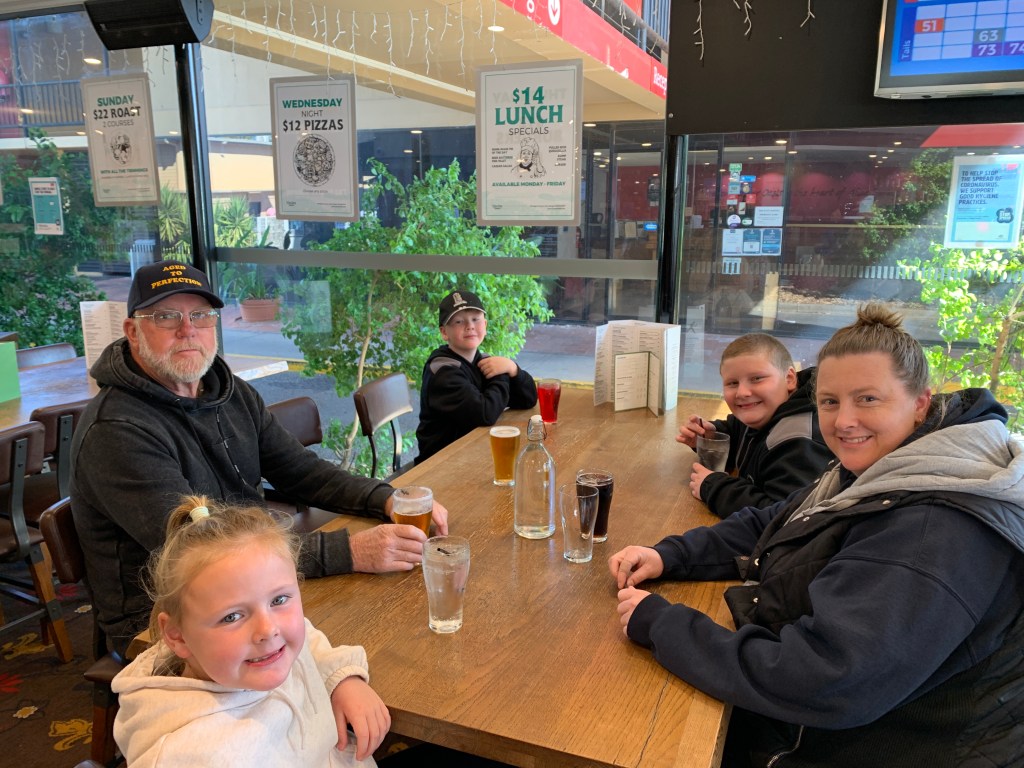
Back in town we decided to have lunch out. Uncles Tavern looked like a busy place and that’s always a good sign the food is good. We all enjoyed our pub grub lunch. It was a bit of a treat having lunch out.
Pub lunch at Uncles Tavern
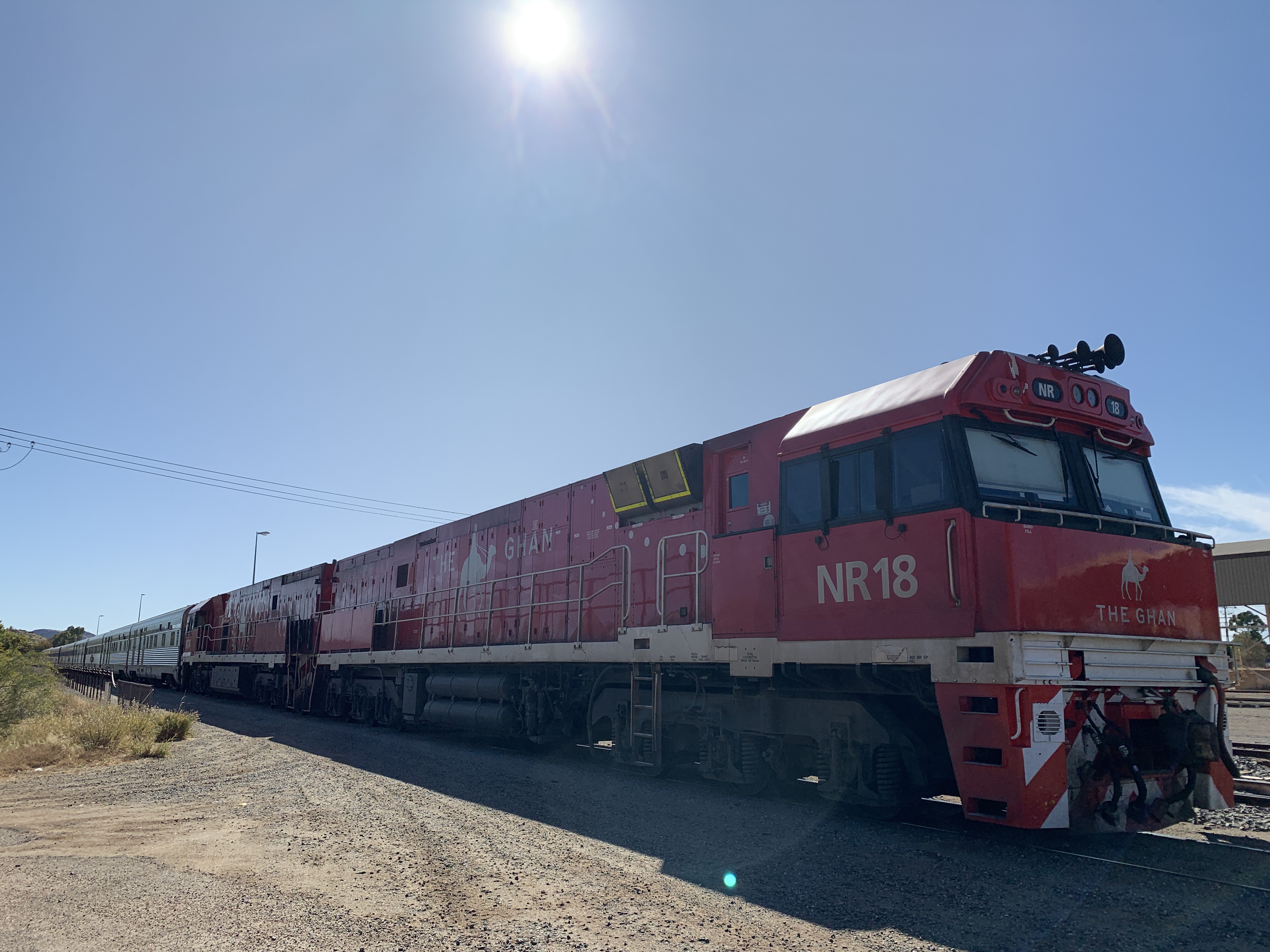
On our way back to camp I asked if we could detour past the railway station so I could get photos of the famous Ghan which had arrive earlier that day and would stay in town until the passengers had enjoyed their dinner and evening at the ASTS. I love trains and was excited to get up so close to the famous red locomotives.
The mighty Ghan
Back at camp we spent the rest of the afternoon reading, resting and the kids went swimming. They were enjoying staying at the Discovery Parks – Alice Springs. The pool had a waterslide that they seemed happy to go up and down for hours.
We had an early dinner at 6pm so Rich and I could take the children to the free show at the Entertainment Centre in the park. The Red Centre Show featured singer/songwriter/photographer Barry Skipsy. Katie had an evening to herself!
The show commenced at 7pm and went for an hour and a half. Barry (Skip) sang some of his own songs as well as some other iconic Aussie songs by other artists. While entertaining us with his songs he was accompanied by a large screen show of some of the beautiful photos he’s taken over the years of the Australian bush. It was a great show and he was very entertaining. The children certainly enjoyed the show. We all enjoyed the show so much that we bought two of his CD’s to play in the car.
Alice Springs, The Alice or just plain Alice is the largest town in The Red Centre. It has a population of some 27,000 people, many of them indigenous. We left our lovely camp spot about 9.30am and set off for the last 250km to get to Alice.
Rich and I are both sure we heard a mouse in our motorhome during the night however there was no sign of it in the morning.
Passed by the famous Erldunda Roadhouse around 10.20km. The roadhouse sits at the intersection of the Stuart and Lassiter Highways. The Lassiter Highway is the road to Uluru, the Olgas and Kings Canyon. We’ll be going that way on the way back.
The roadhouse looked like it was having renovations done out the front where the fuel pumps are and we’d heard that diesel was $3.18L there.
Erldunda, the junction of the Stuart and Lassiter Highways
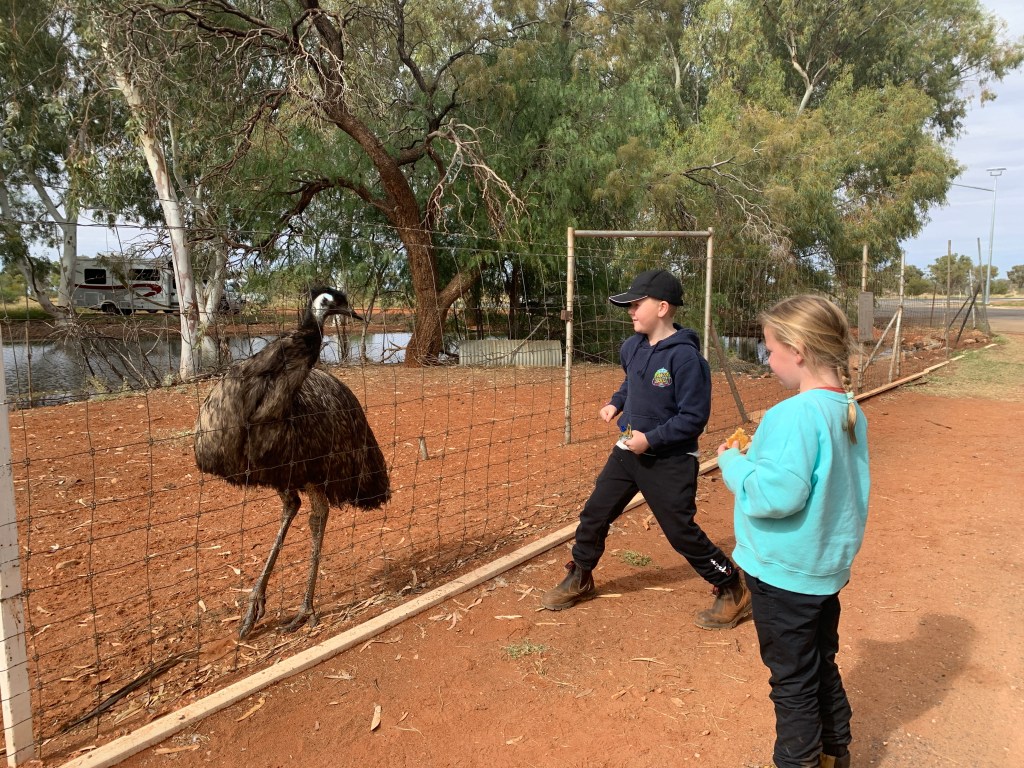
We had a short break at Stuart’s Well Roadhouse where the kids loved seeing emus and camels. While there a Sunliner Navian 601 motorhome pulled in and I got chatting to the bloke who owns it. It was only 6 months old and they absolutely love it. I hope they get many years of travelling in their beautiful motorhome.
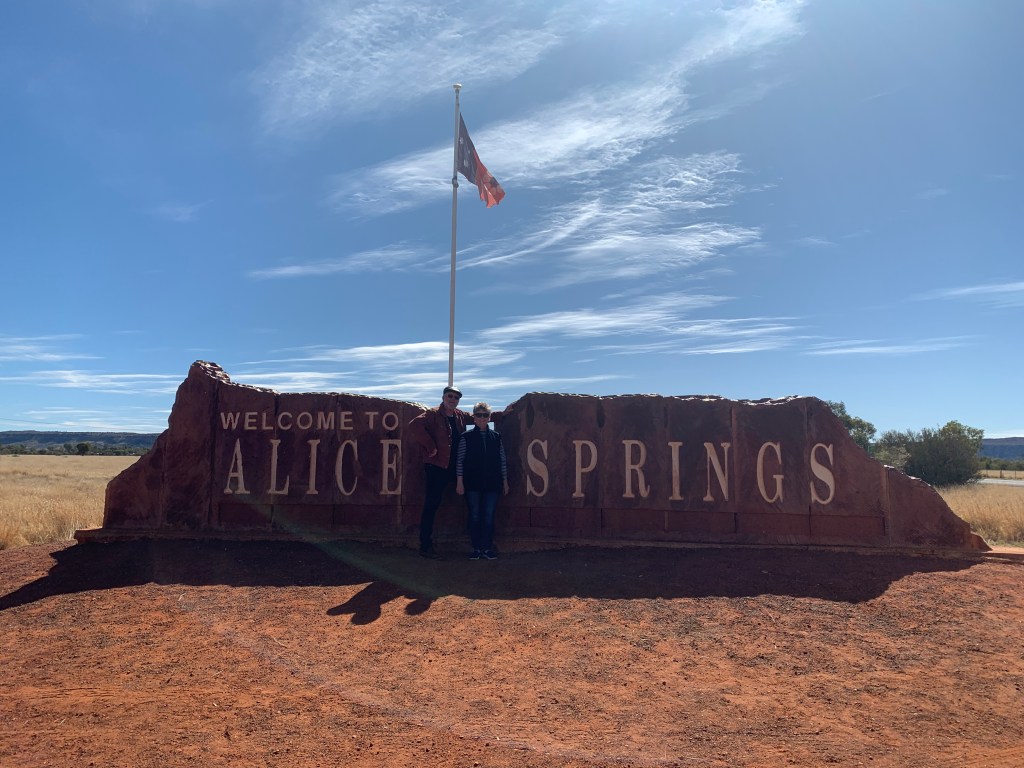
We arrived in Alice Springs at lunch time and, after taking photos at the town sign, found our way to the Discovery Parks – Alice Springs where we had two powered sites booked. Check-in was made easy by their express check-in for pre-paid bookings. There was a basket on the counter in Reception with envelopes without name on. Everything we needed was in the envelope.
We quickly settled in to our great sites. We each have a gravel area (to park the car & van and motorhome on). Next to that is a concrete slab (for under your awning) and next to that is a grass area. Yep, that’s right, I said grass. It’s even green grass.
This is a large park with lots of facilities. There are multiple amenities blocks, camp kitchens, a swimming pool, jumping pillows, a pump track and we have a playground right next to us. The kids love it! And so does Katie. No red dirt here!
Kate an I spent the afternoon getting rid of the red dirt in our RV’s and washing everything. It was even time to change the sheets! OMG how much red dirt was inside. You should have seen the colour of the water when I mopped the floor!
While Katie and I were being very domestic, Pa took the kids to the pool after they’d had a great time at the Jumping Pillow.
Late in the afternoon we went for a drive into Alice downtown to look for a supermarket. We are all so surprised by Alice. It is nothing like we expected. We all expected it to be a town in the flat red desert. Instead we find it is a large town in amongst stunning rocky hills with the dry river bed of the famous Todd River running through. It’s really very different to what we expected. We found where the Tourist Information Centre is and across the road is Megafauna Central, one the places the children want to visit.
We found a Woolworths, stocked up on supplies and headed back to camp where Katie prepared a delicious pasta bolognese for dinner. We sat under the MH awning and enjoyed our dinner al fresco. It was a happy dinner.
We’ve decided we are going to be tourists tomorrow check out lots of Alice activities.
It was a very cold night, getting down to 3 degrees in the early hours of the morning. I was very pleased to hear that the boys slept well in their swags. It’s good to know they are snug and warm even on those very cold nights. There was a brisk breeze blowing and it was cold whilst we packed up our camp at the Big4 Stuart Range CP in Coober Pedy.
We are all really getting into a good routine for packing up camp now and everyone is co-operating. It’s great to see.
We both had to use the dump point and fill up with fresh water before we left the park. It cost us $2 to fill our water tanks at the metered tap.
Farewell to the Big4 Stuart Range Coober Pedy
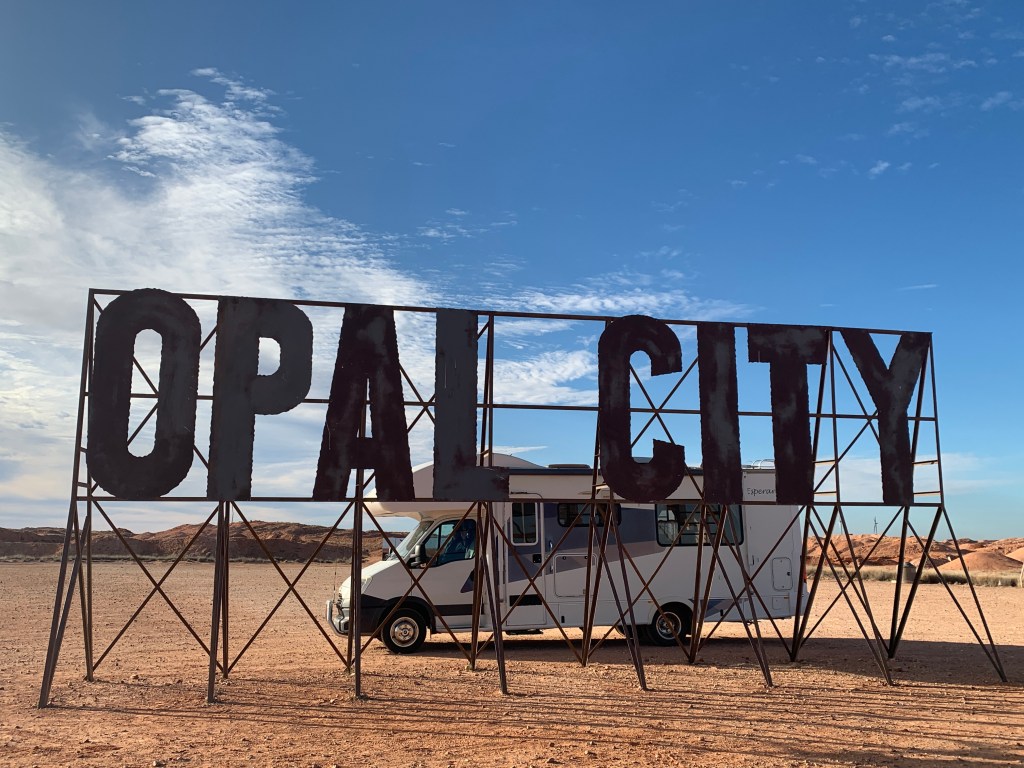
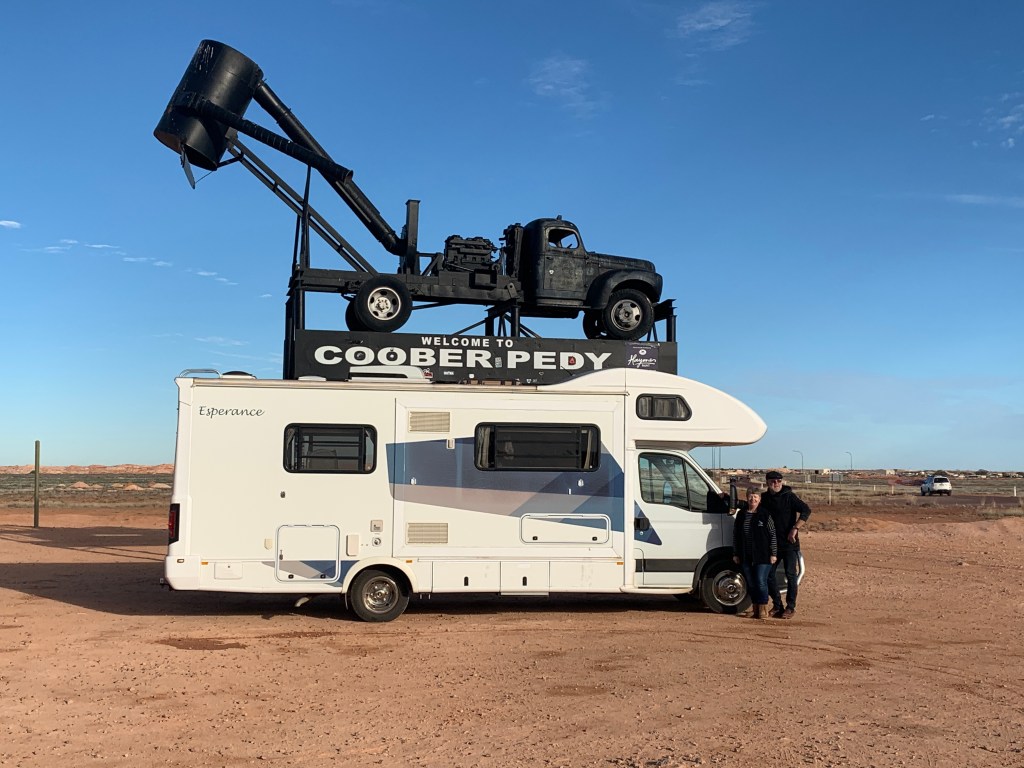
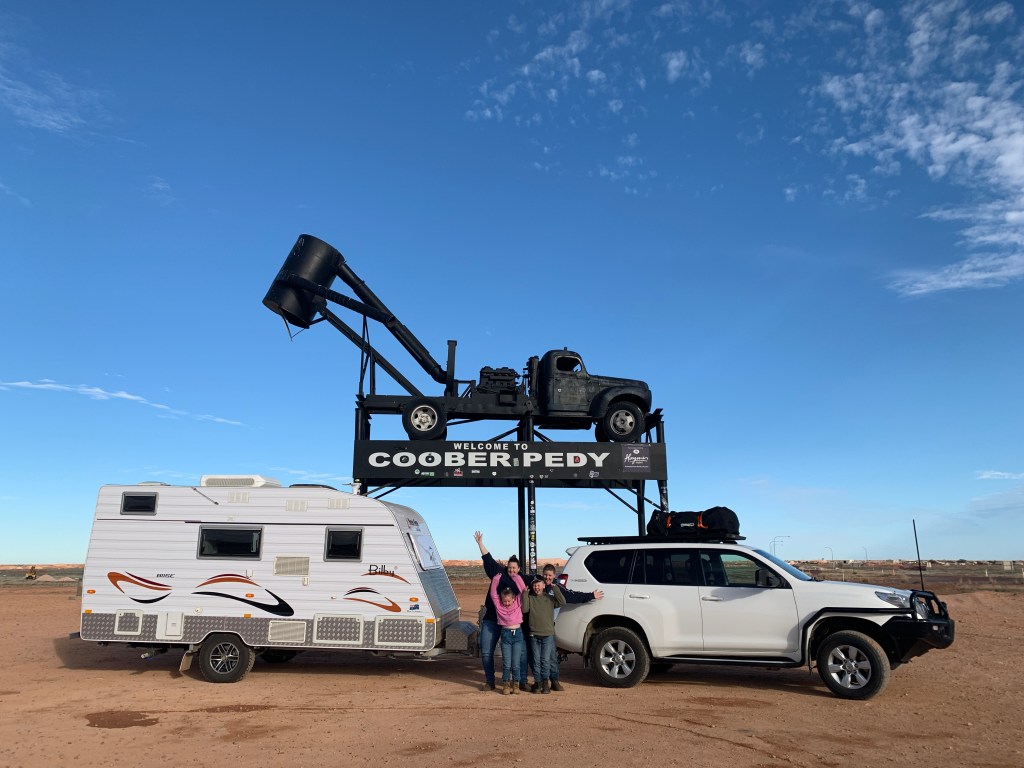
Our first stop was to the town sign where we stopped on arrival but were surrounded by rally cars. We were able to get our photos taken and now have that great memory of our trip.
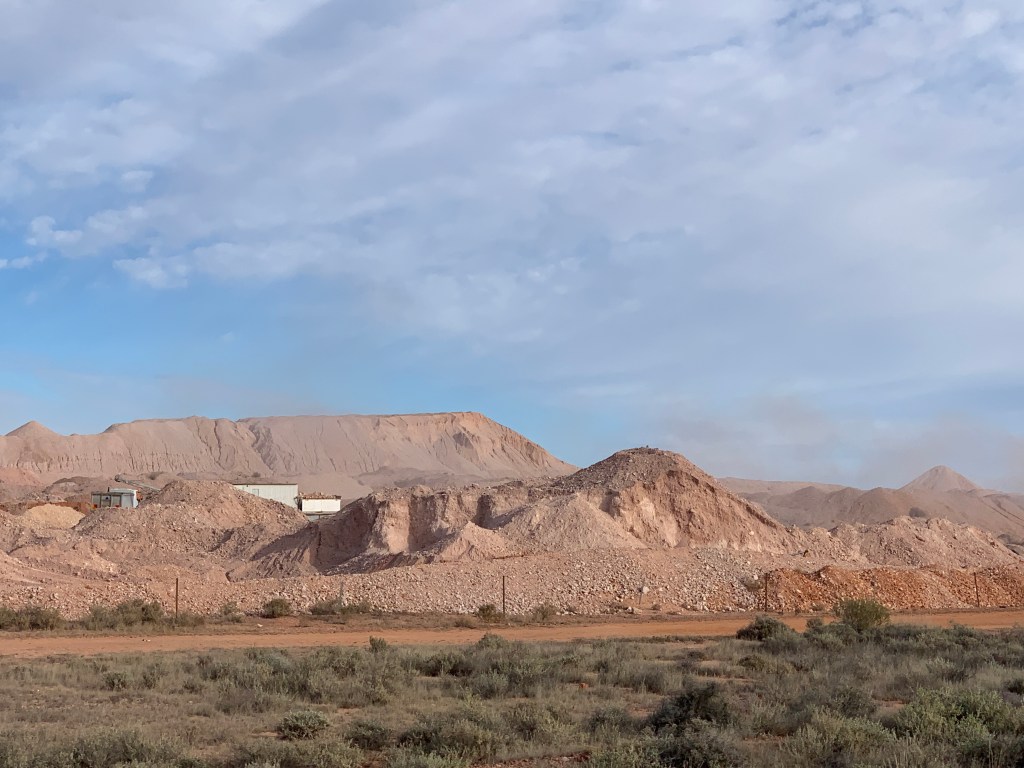
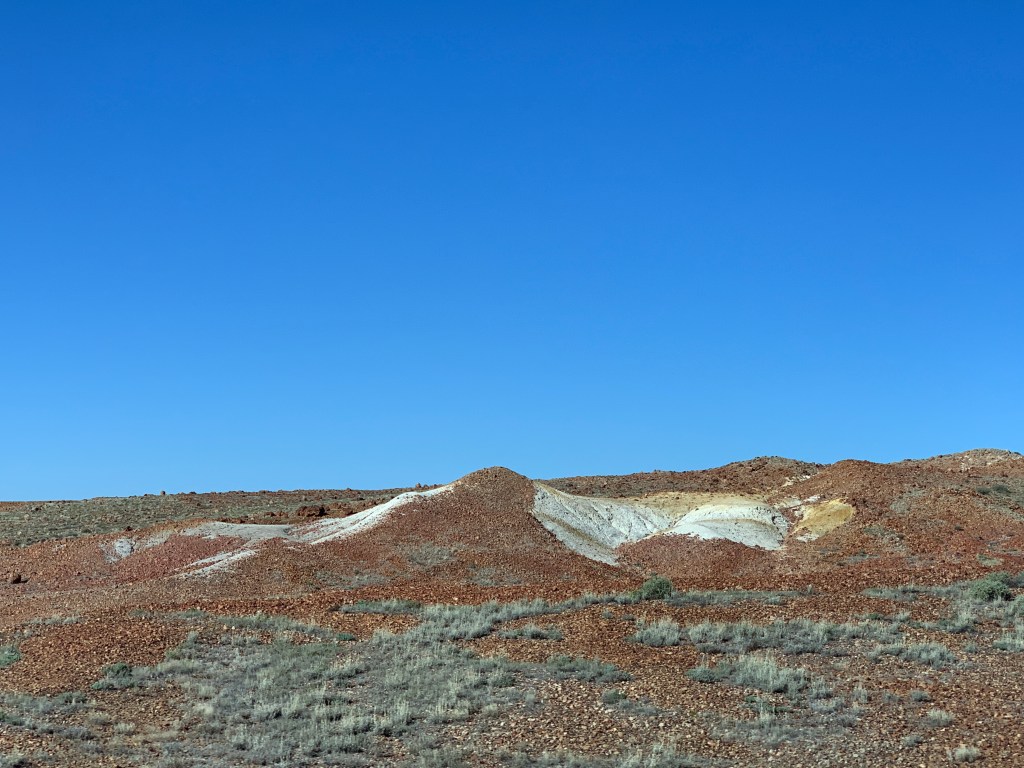
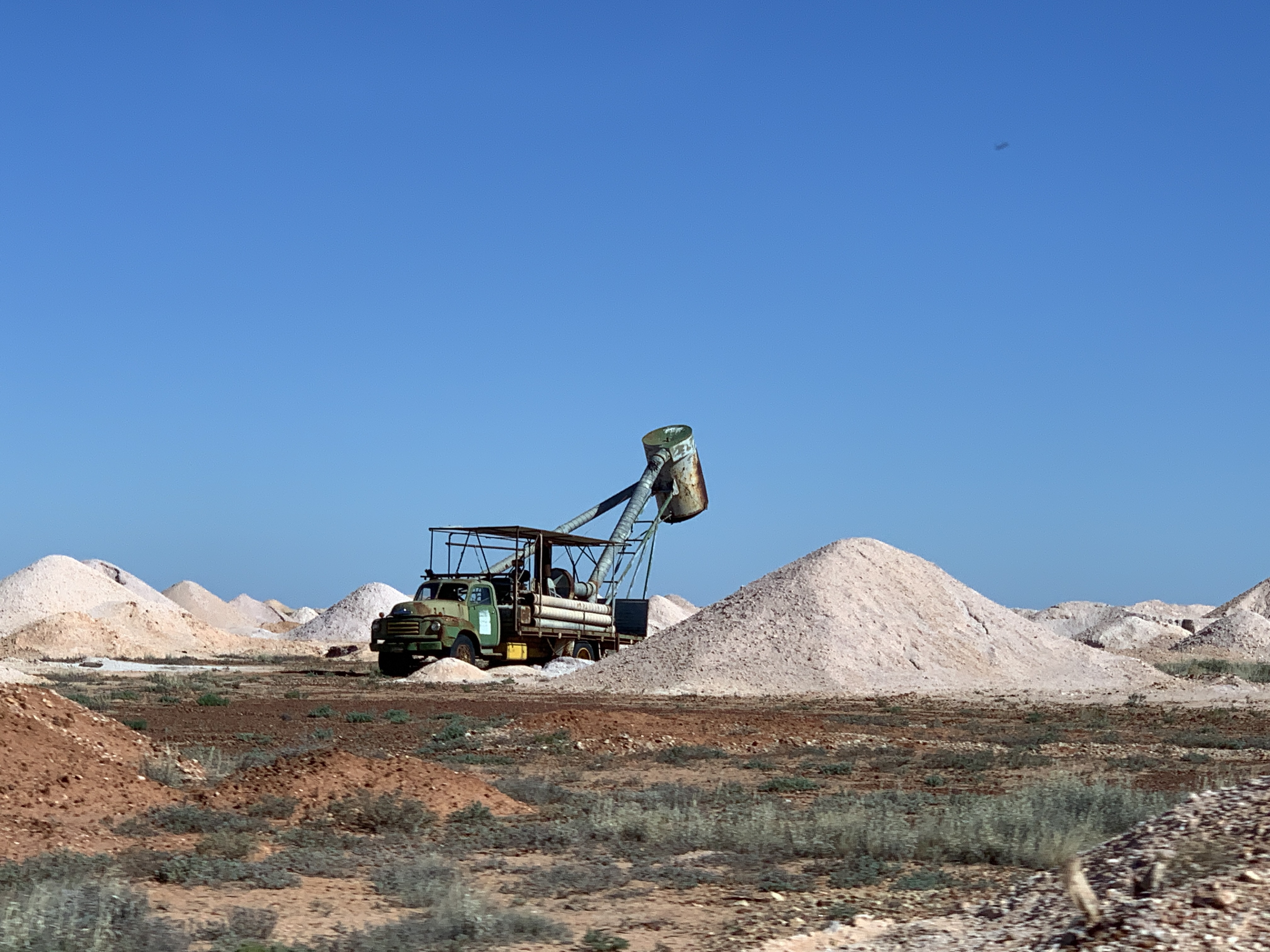
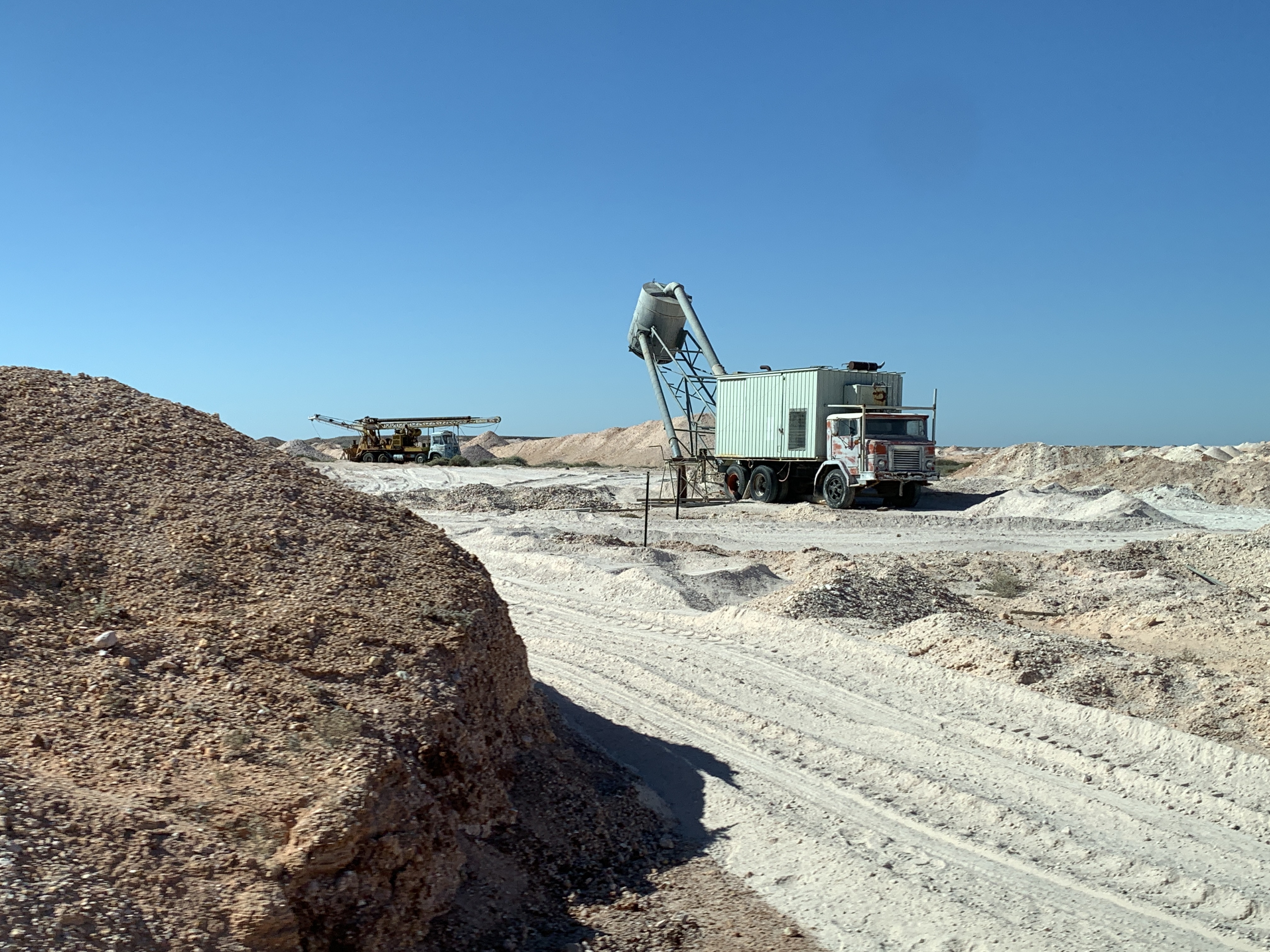
We headed off northwards and for 30-40km you travel through the Coober Pedy Opal fields. There are literally hundreds of thousands of little conical piles of dirt made by miners sinking an exploration shaft.
It makes for quite a bizarre landscape.
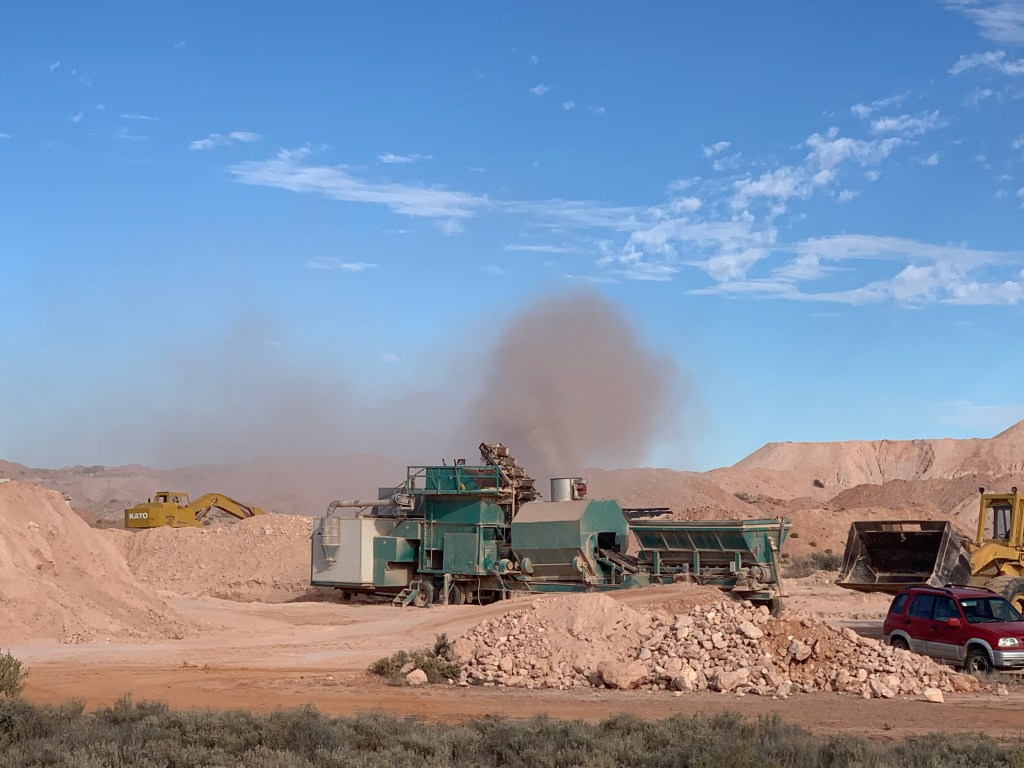
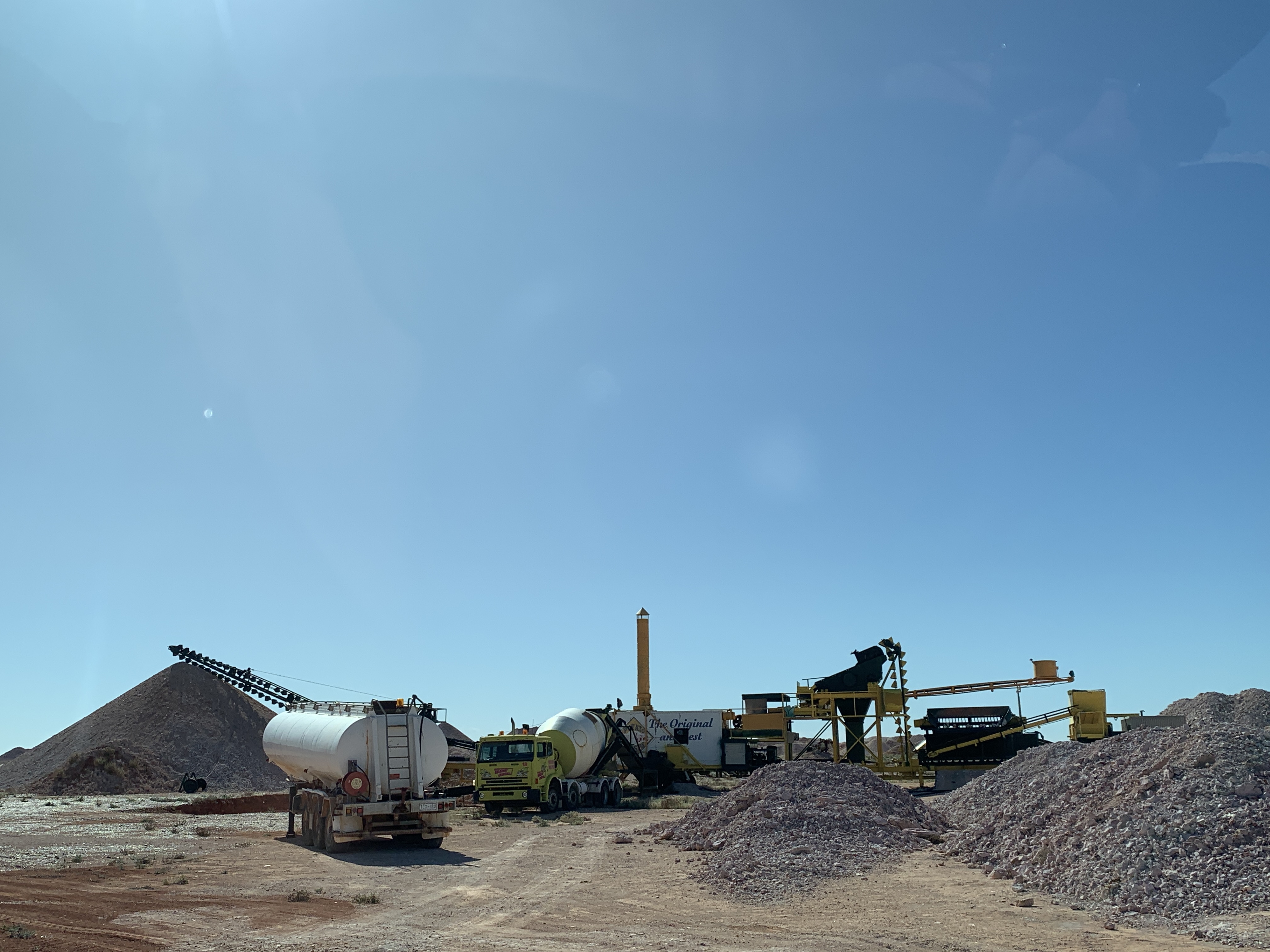
It was a bit exciting when we approached one lot of mining to see dust flying and realised it was a miner in action. We slowed right down to watch as we went by. It had been the only mine we’d seen that was operating.
We use our UHF to keep in contact as we travel along. We made comments along this part of the journey how impressed we were with the road. It is a really good wide tar road. There are RV’s of all descriptions out and about and the the road trains out there are three or four trailers long.
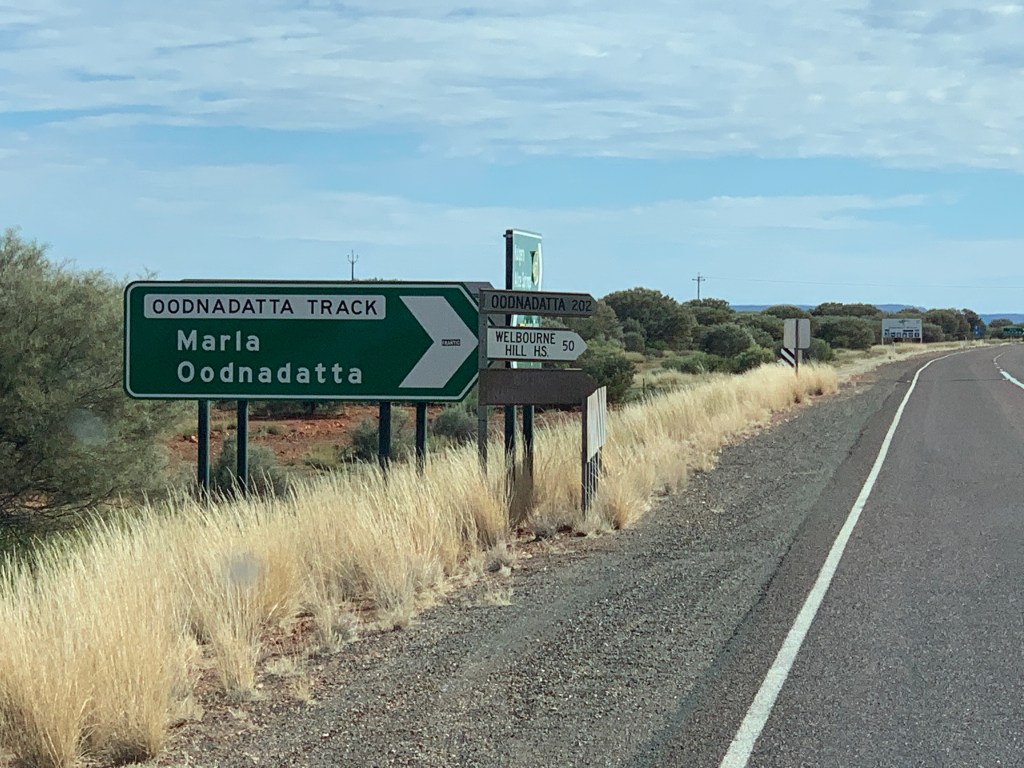
Around midday we drove past Marla, population 245, with its huge roadhouse. Lots of vans and trucks were pulled in there.
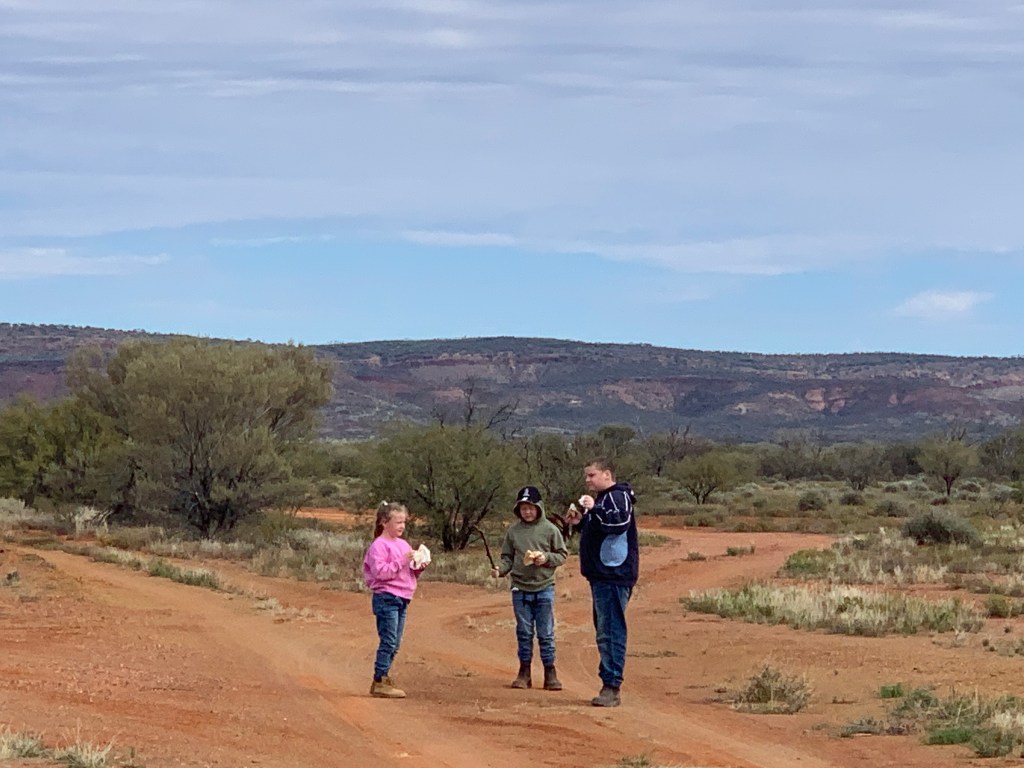
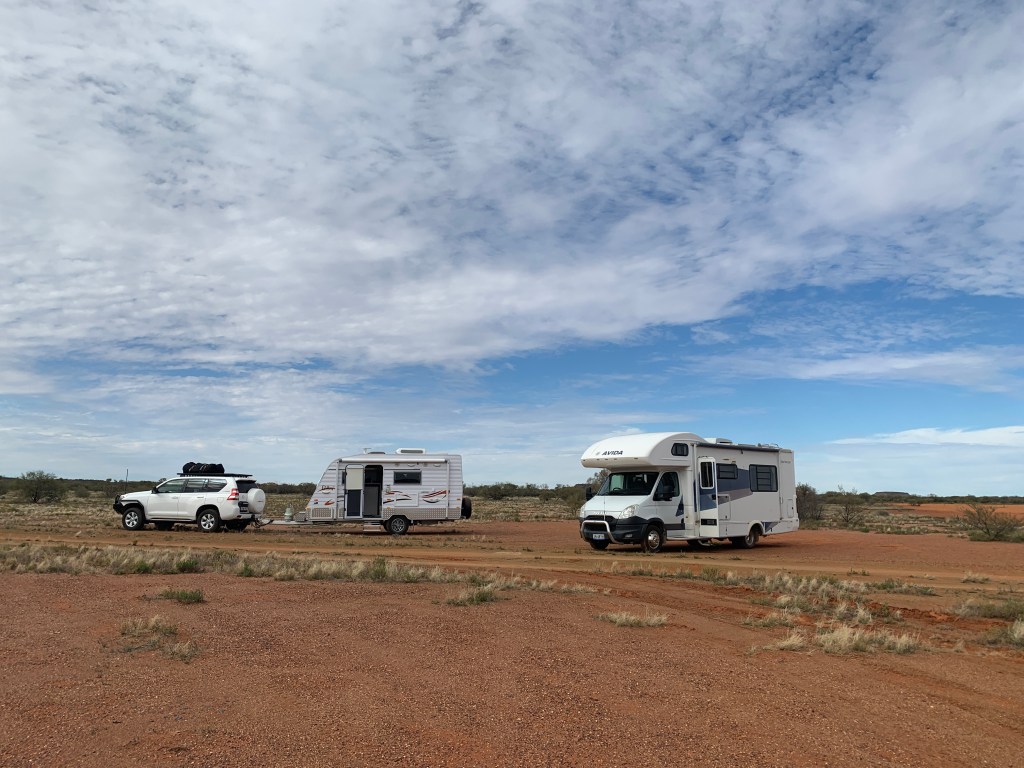
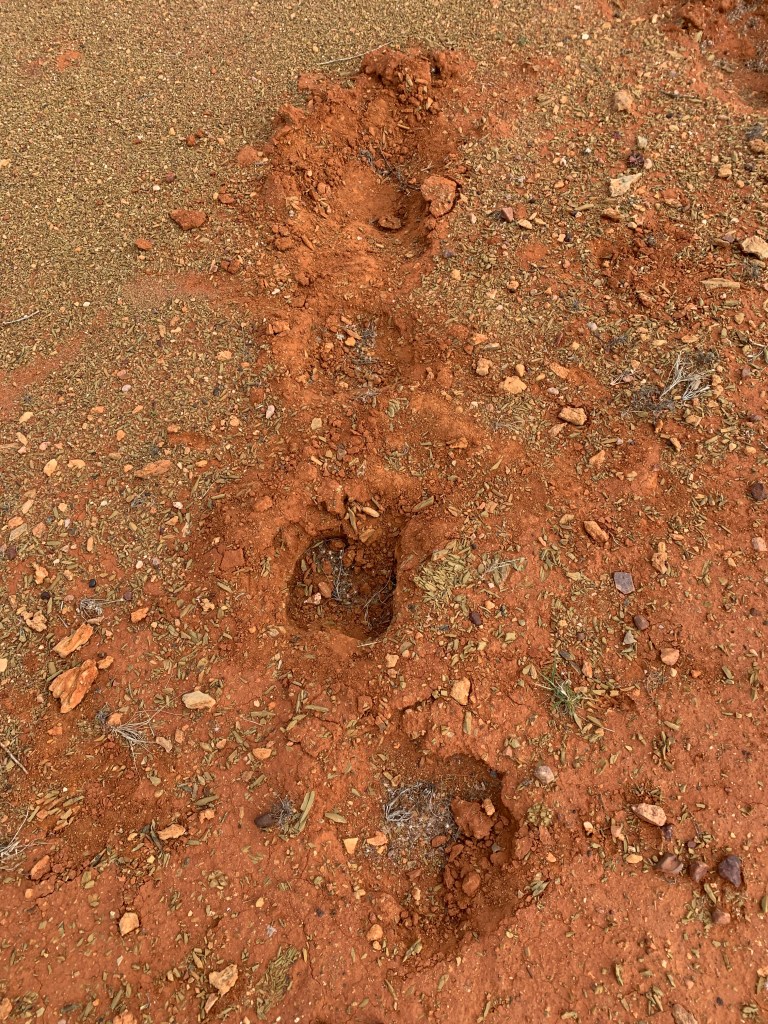
We continued on and pulled off the road at a spot marked in WikiCamps as Mount John Rest Area. This is not a true Rest Area just a track off to the west of the highway into the scrub, however it leads to some large flat areas away from the road. There’s lots of trees so you wouldn’t get much road noise at night. It was here while we had a lunch break that Ben found ‘camel tracks’. Well, at least he decided that’s what they were. He was quite excited by his find. What do you think? Do they look like camel tracks to you?
Ben’s camel tracks
We just had to stop at the SA/NT border and take some photos. Love the one of Katie and the children with one foot in SA and one in NT!
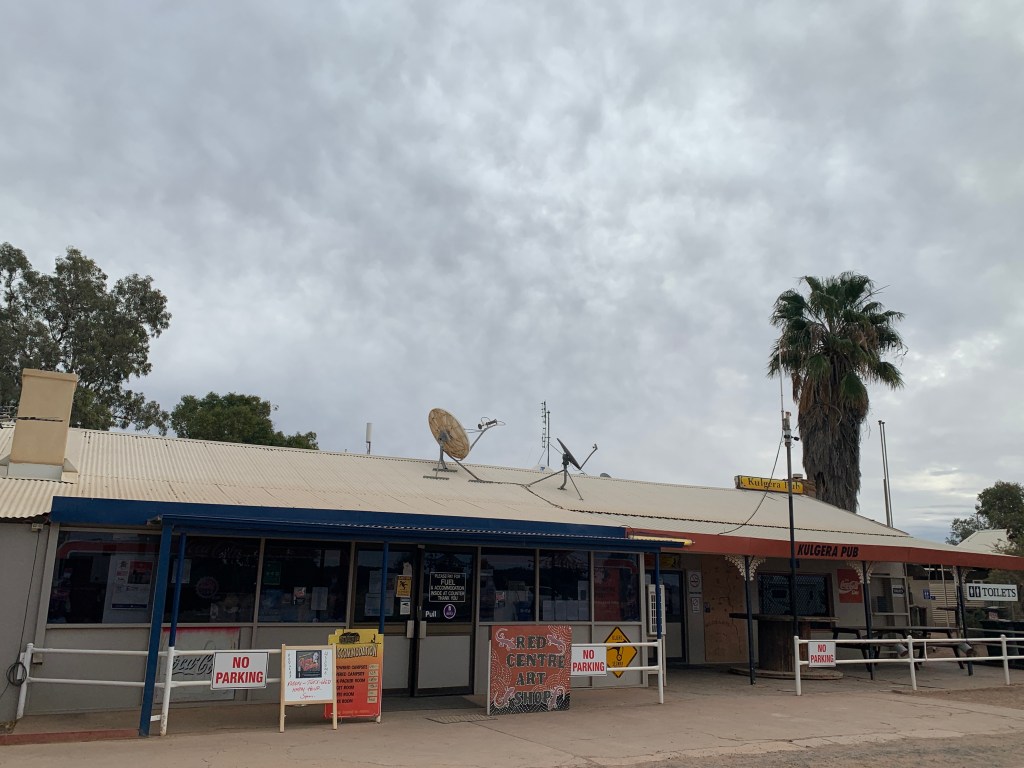
We stopped for fuel at Kulgera Roadhouse which is only 19km past the border.
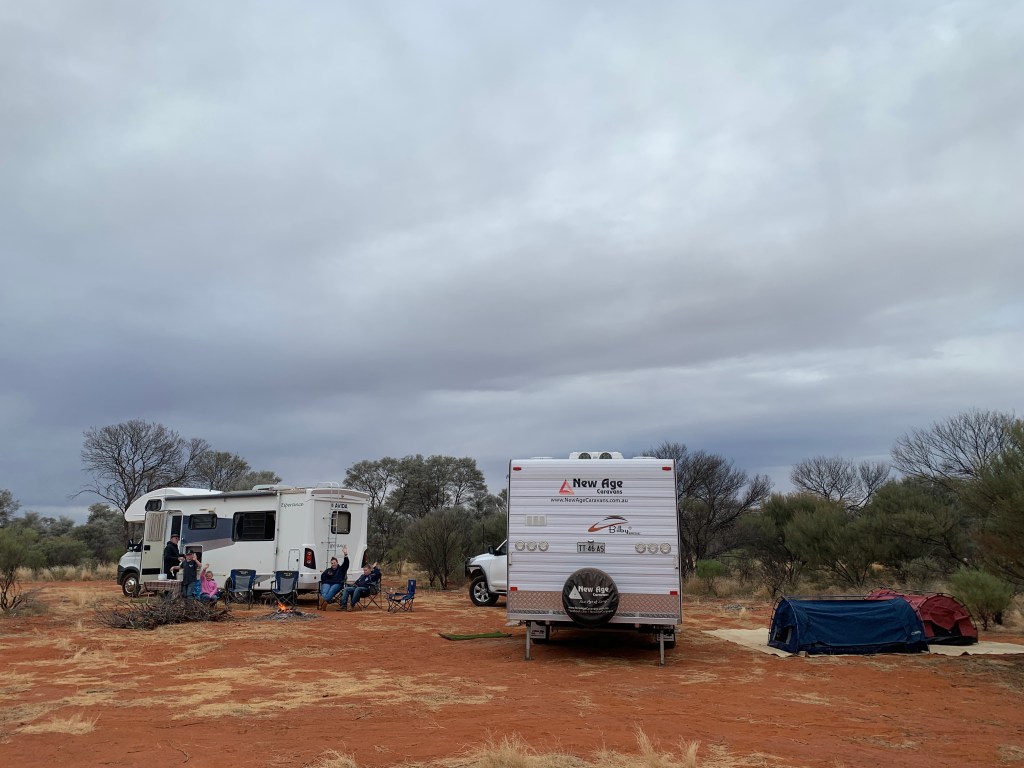
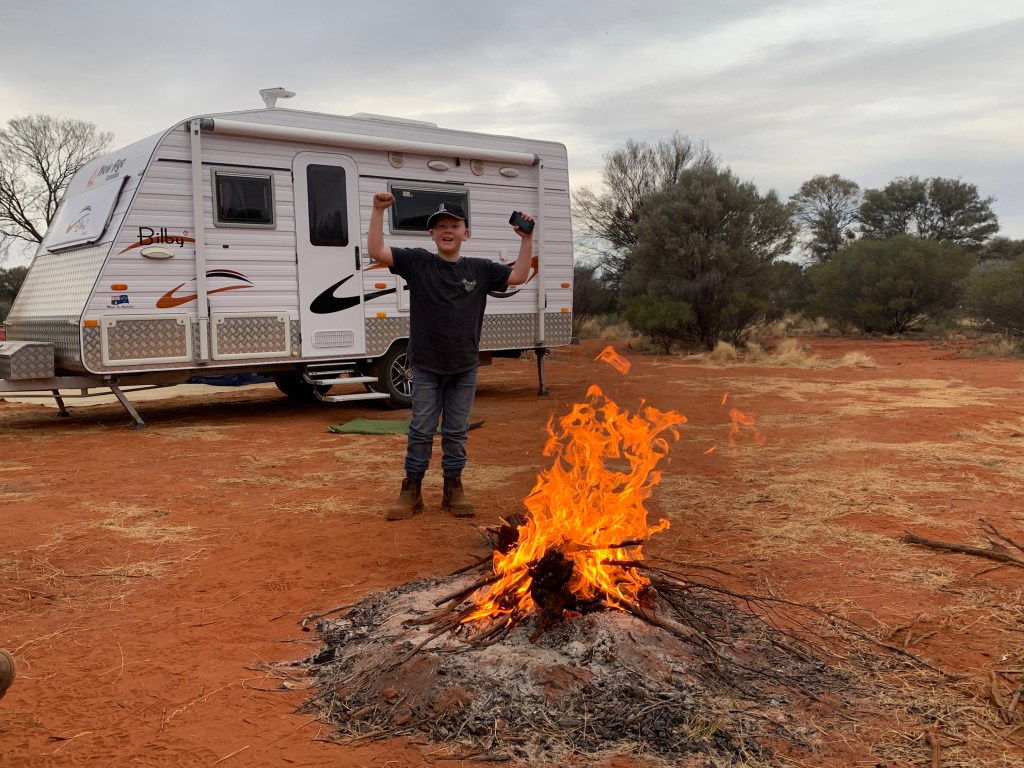
With only 250km to go to get to Alice we pulled into truck stop that showed on WikiCamps that there was plenty of camp spots at the southern end. We arrived there to find lots of red dirt tracks leading into the bush and plenty of good spots to camp. We found a spot well away from the road and quickly set up camp around a previously used fire. Once camp was set up the children set off to scavenge for wood. They are pretty good at this now and in no time at all we had a lovely little fire going.
I’d put on a beef casserole in the crockpot in the morning and it had been slow cooking all day. I cooked some broccoli and heated up some garlic naan to go with it and we all sat around our little fire with yummy bowls of stew.
While setting up and sitting around we fire we were joined by the cutest little native animals. They looked a bit like mice but had much bigger ears and they hopped. There were hundreds of them. They even came right up under our chairs. They were so quick. At first Maddie was a bit scared of them but after a while she realised they weren’t going to do anything except hop about and she relaxed and watched them. They were funny to watch as they scurried aobut searching for food. Hopefully we will find out what they are called when we go to the Desert Park in Alice Springs.
Sadly the bus tours from the Big4 Stuart Range Caravan Park were not able to be run as the bus driver had influenza and was contagious. The receptionist recommended we try Noble Tours so we’d called them and booked in for the morning tour. We had to be up bright and early though as the tour began at the Umoona Opal Mine & Museum at 8.00am.
We were all up and ready to go by 7.45 and set off towards town. The Umoona Opal Mine & Museum is in the main street and has a large carpark out the front. We were able to park there and leave the car there while we headed off on tour in Noble Tours 4WD bus.
Our tour guide Aaron arrived promptly at 8.00am and led our small group into the Umoona Opal Mine & Museum. This excellent museum opened in 1985. The entry to the museum houses Aborignal artifacts and some models of mining machinery. The photo gallery follows and this excellent display showcases the history of the town.
The Fossil Museum showcases the rich fossils found in the area that was once underwater in the Euromanga Sea. From tiny shellfish to marine dinosaurs such as the ichthyosaurus and plesiosaurs. There is even a plesiosaur called Umoonasuarus. It was. Primitive plesiosaur that lived in the freezing inland sea long after its relatives were extinct elsewhere in the world.
Umoonasaurus
There is an Underground Cinema and an Opal shop.
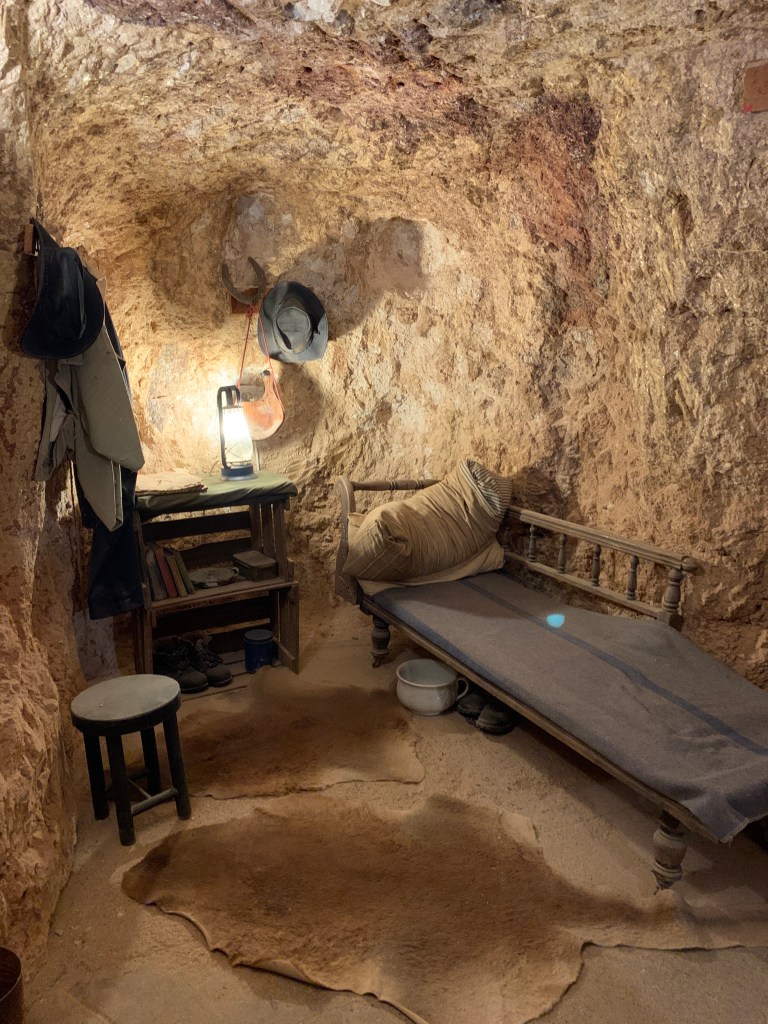
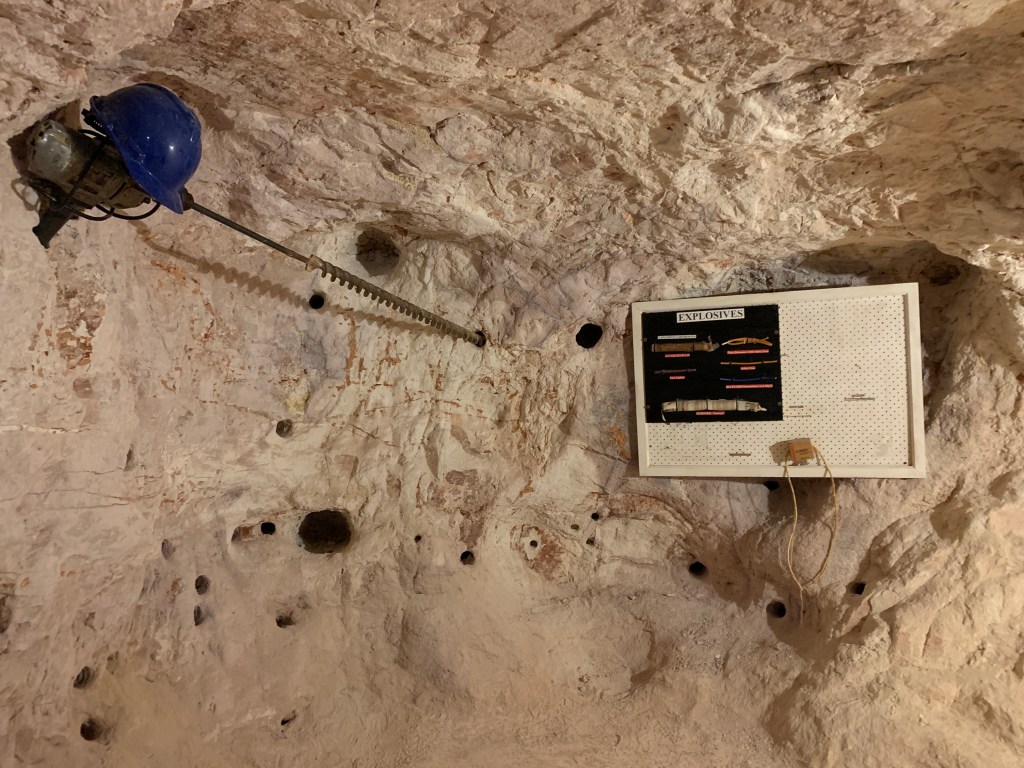
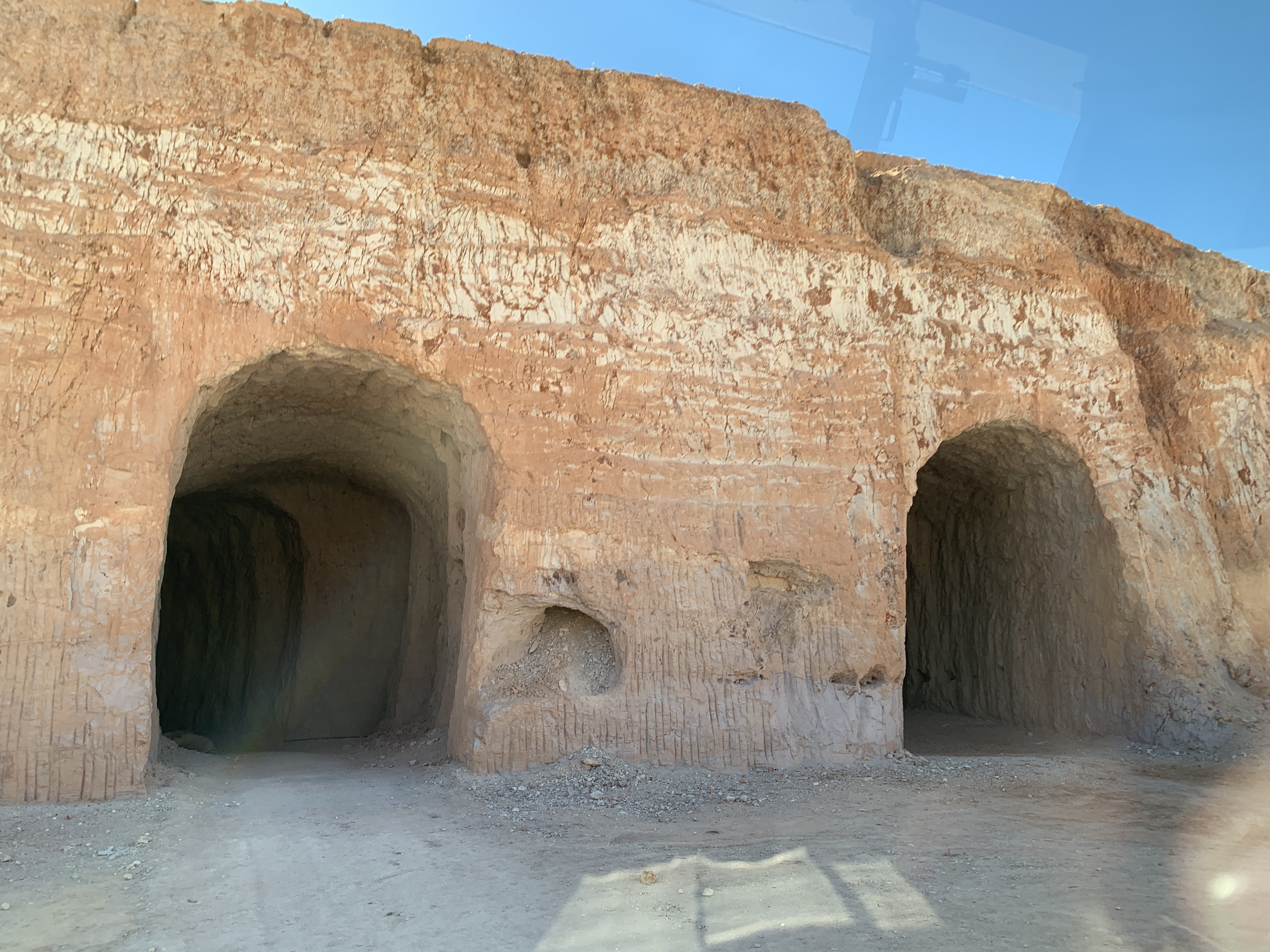
Our group was led through the labyrinth of tunnels and into a old fashioned dugout (undergound home). This shows a dugout that would have been dug out using hand tools. The rooms are small and the ceiling very low.
An old style dugout
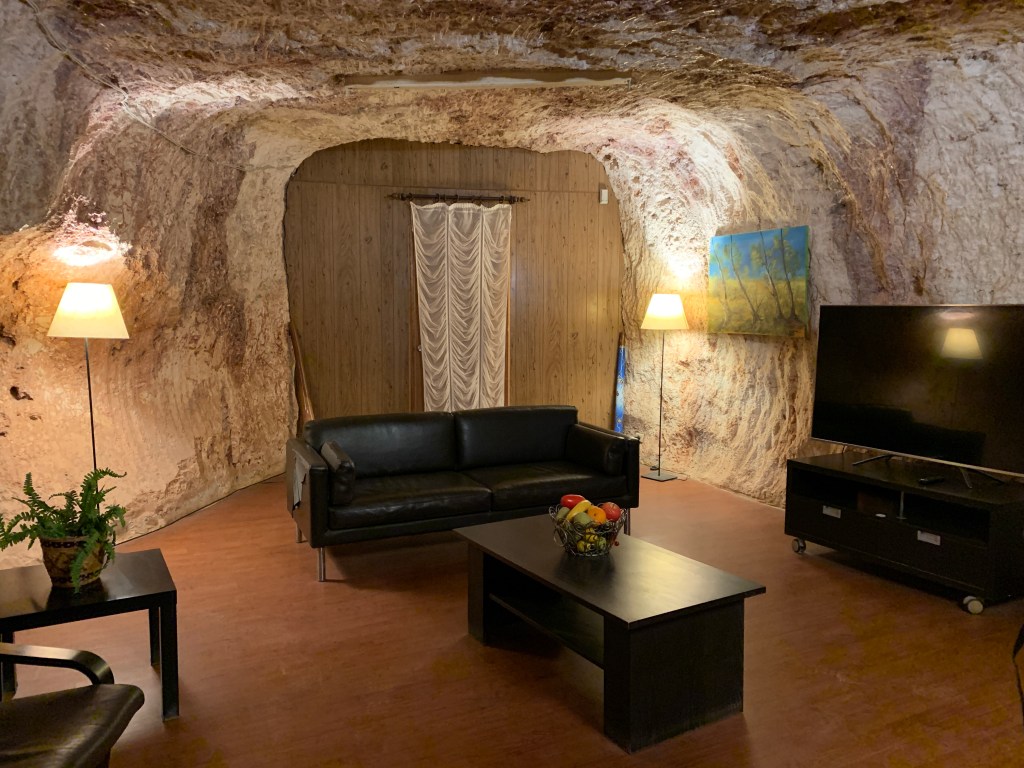
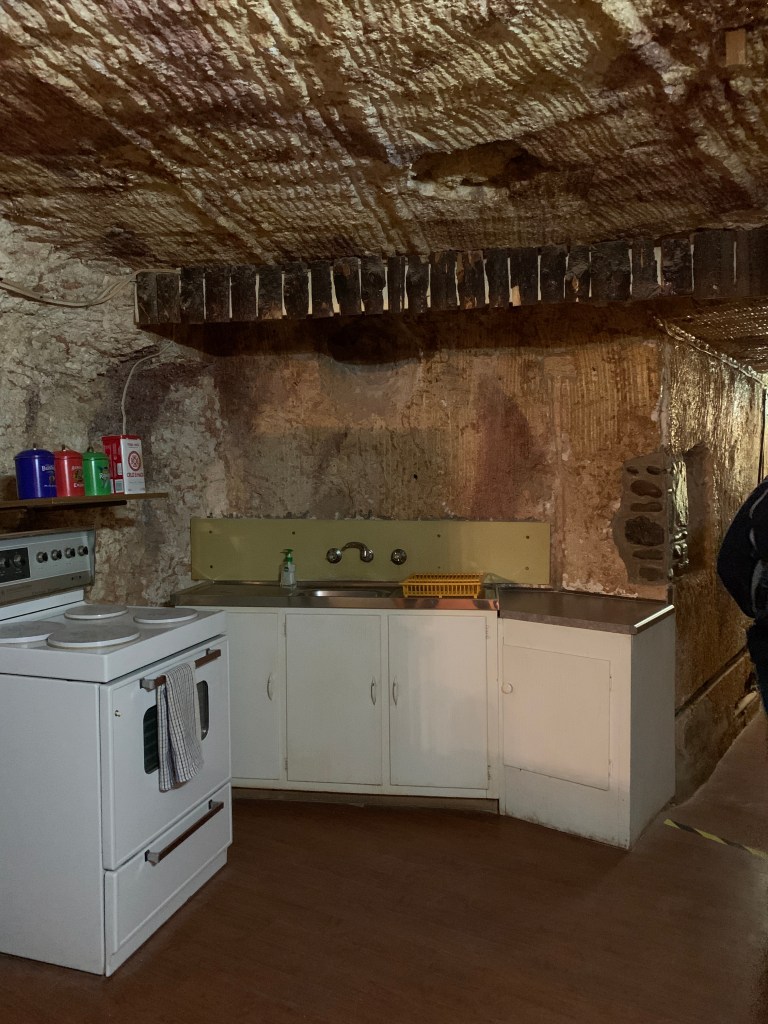
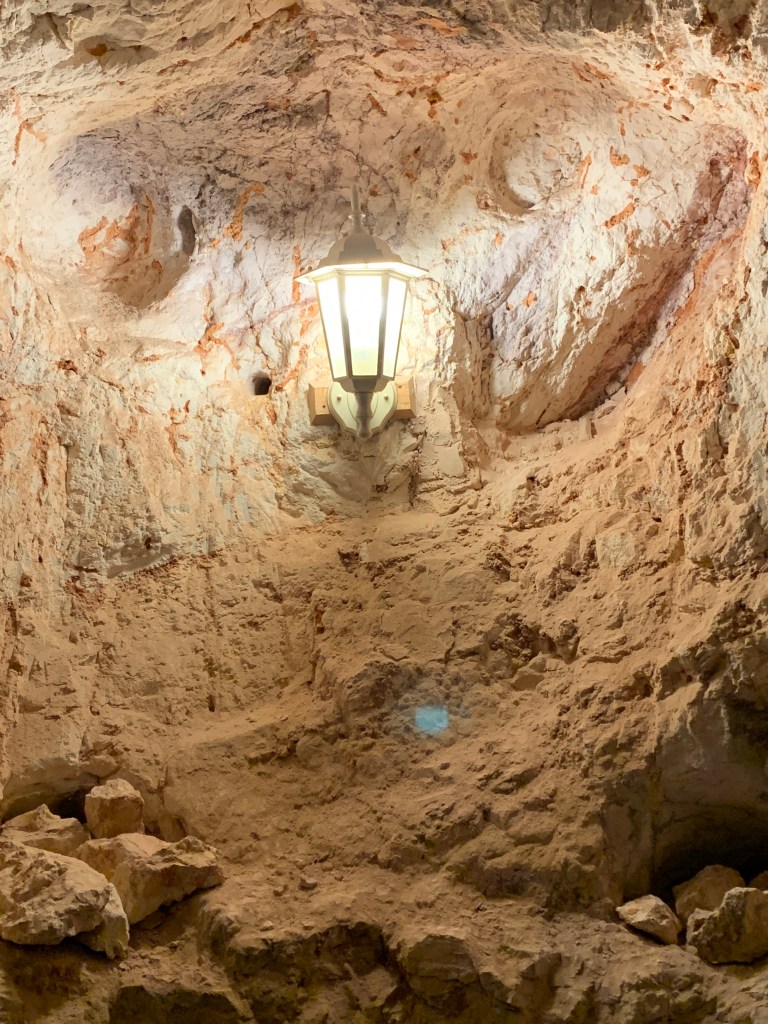
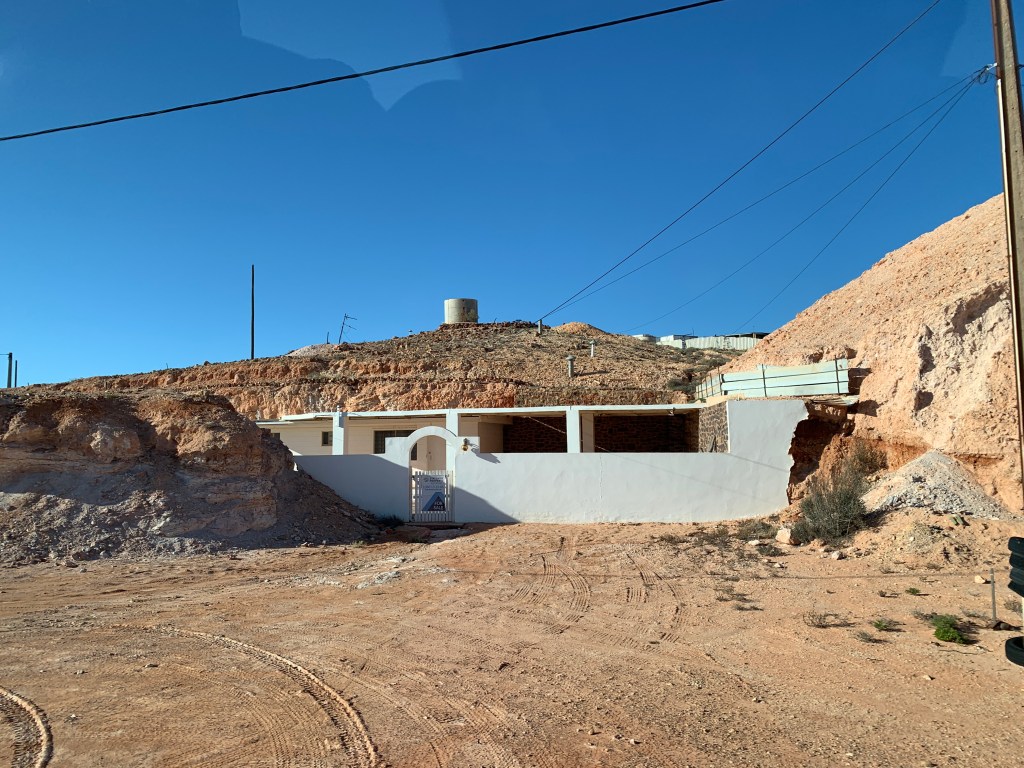
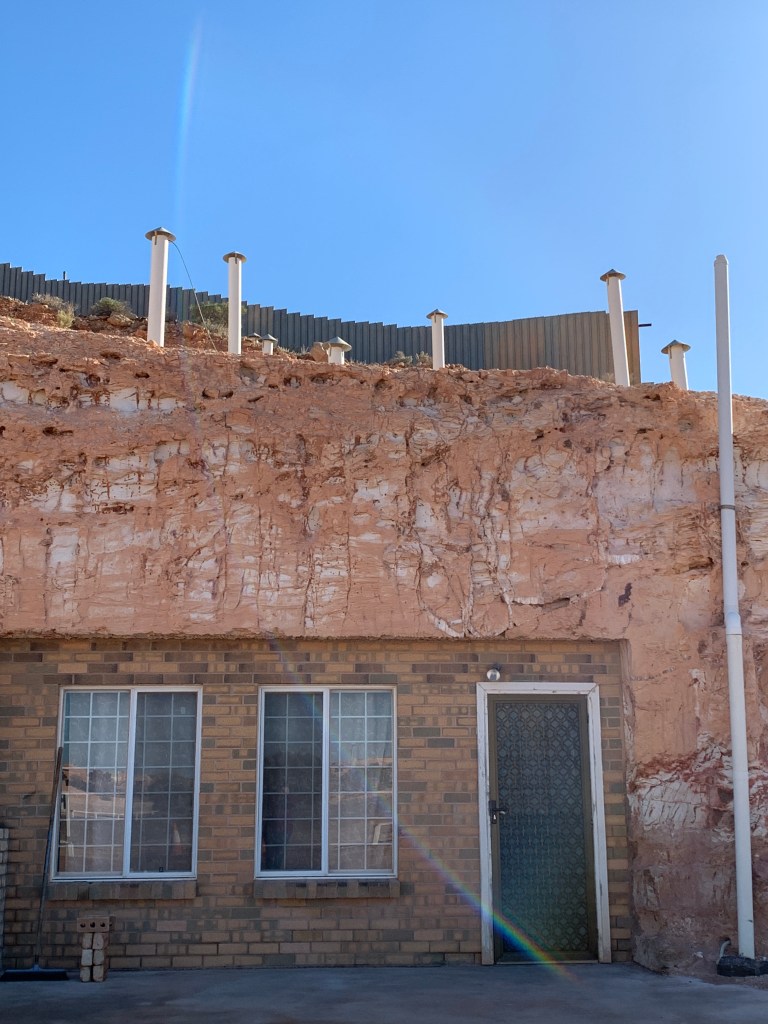
Next stop was an example of a modern dugout, a much larger construction made using modern mining machinery. The spaces were larger and the ceilings higher. The best part about living undergound is the constant temperature. It is a steady 19-25 degrees below ground. Coober Pedy can be freezing in winter and blowing hot in summer above ground. Approximately 50% of the population of Coober Pedy live underground. Most dugouts are excavated into the sides of hills rather than dug from mine shafts. Modern dugouts range from simple one bedroom dwellings to a 21 room mansion.
A modern dugout
We were then led into the opal mine and were shown the various mining techniques used and where to find the opal. We learnt that mining for opal is mostly about luck. You could sink a shaft and find nothing then someone could come along later and mine that same shaft just a few more inches and find thousands of dollars of precious opal.
There are only approximately 100 miners left in Coober Pedy and there are no big corporations. Mining for opal does not have a rate of return that the big corporations require. There’s no BHP out here!
That’s the magic stuff
Interestingly we learned that the local Aboriginal people who still follow their traditional culture will not live underground. They believe the underground is home for spirits and not for humans to live in so they choose to live in normal houses on the surface. These can be expensive to live in as their electricity costs are high due to having to run air conditioners and heaters. You don’t need either of those in a dugout.
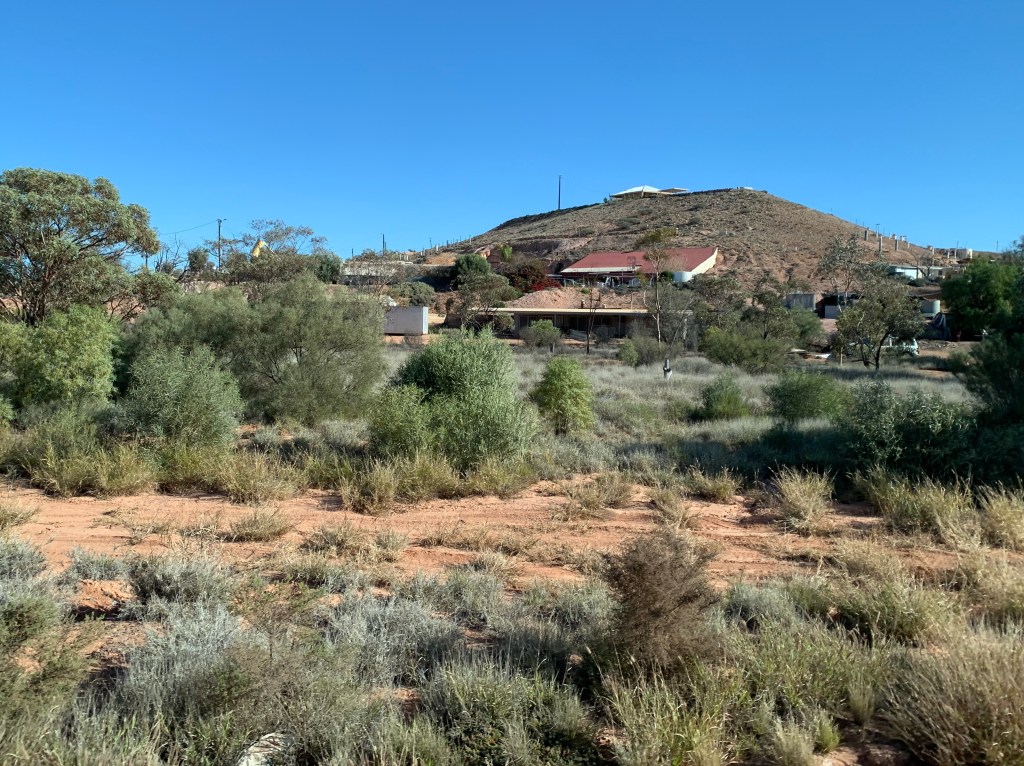
A good quality dugout will set you back $250,000 – $400,000 whilst a house on the surface can be picked up for $100,000. Of course there are always exceptions and we did see a few lovely homes on the surface while some of the dugouts didn’t look so great. It’s a bit hard to tell with a dugout though as it may only be a front door on the outside but inside is a full 3 bedroom home.
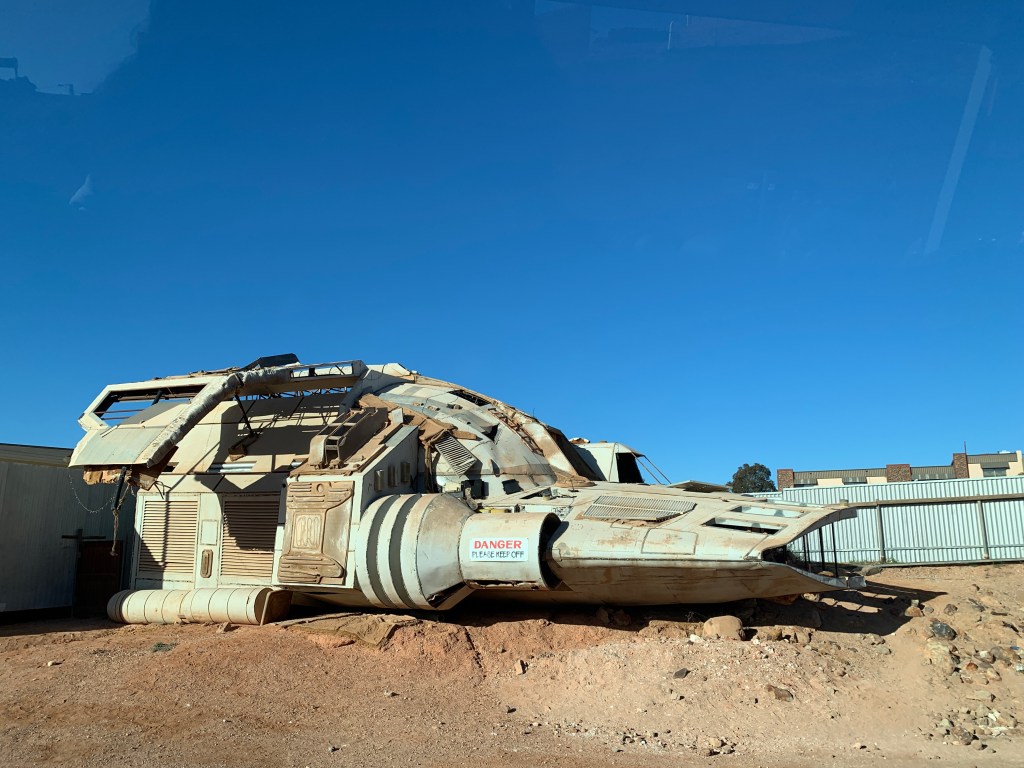
Spaceship movie prop
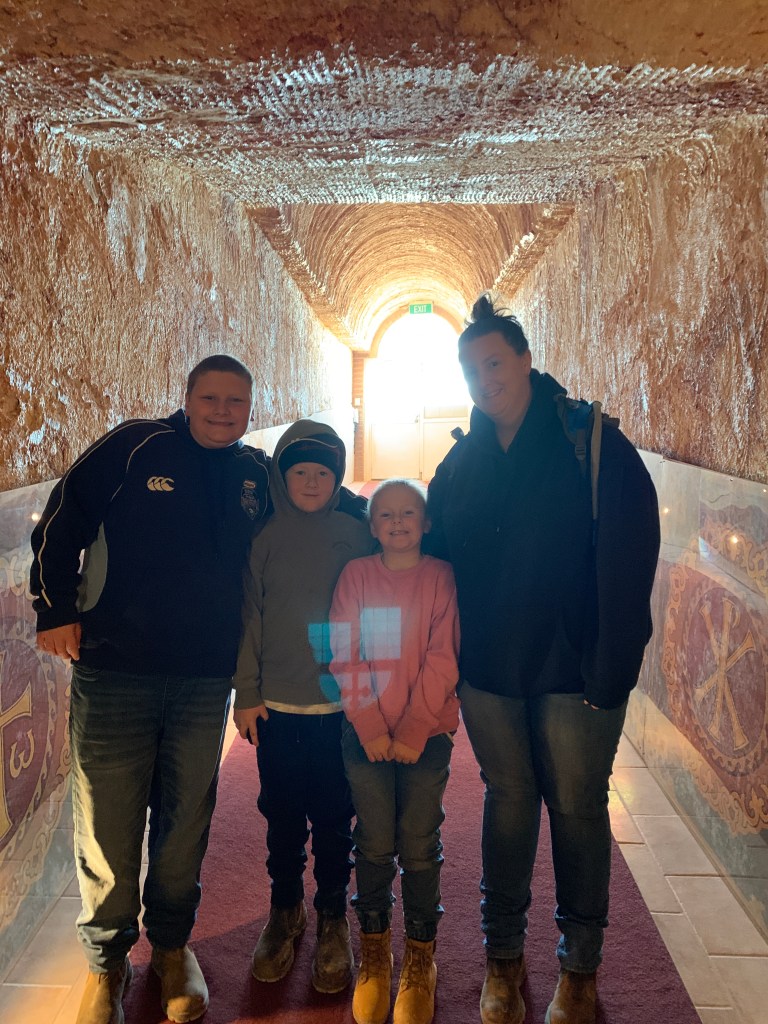
Next stop on on the tour was the underground Serbian church. What a stunning dugout.
Priests house next to churchStunning carvings
Then we all piled back on the 4WD bus and headed out of town where we drove across what is known as the Moon Plain. However they were not looking very moon like due to the recent rain and there was grass everywhere. I could imagine how it would usually look though, barren and rocky.
Moon Plain
Next we stopped at the Dog Fence. This fence is the longest fence in the world and is 5,600km long. The fence was built to protect the valuable sheep and wool industry from dingos and wild dogs. Dingos and wild dogs can kill or maim up to 50 sheep in one night and the fence has done a great job of stopping that from happening. It has to be constantly repaired and traverses across South Australia, New South Wales and Queensland.
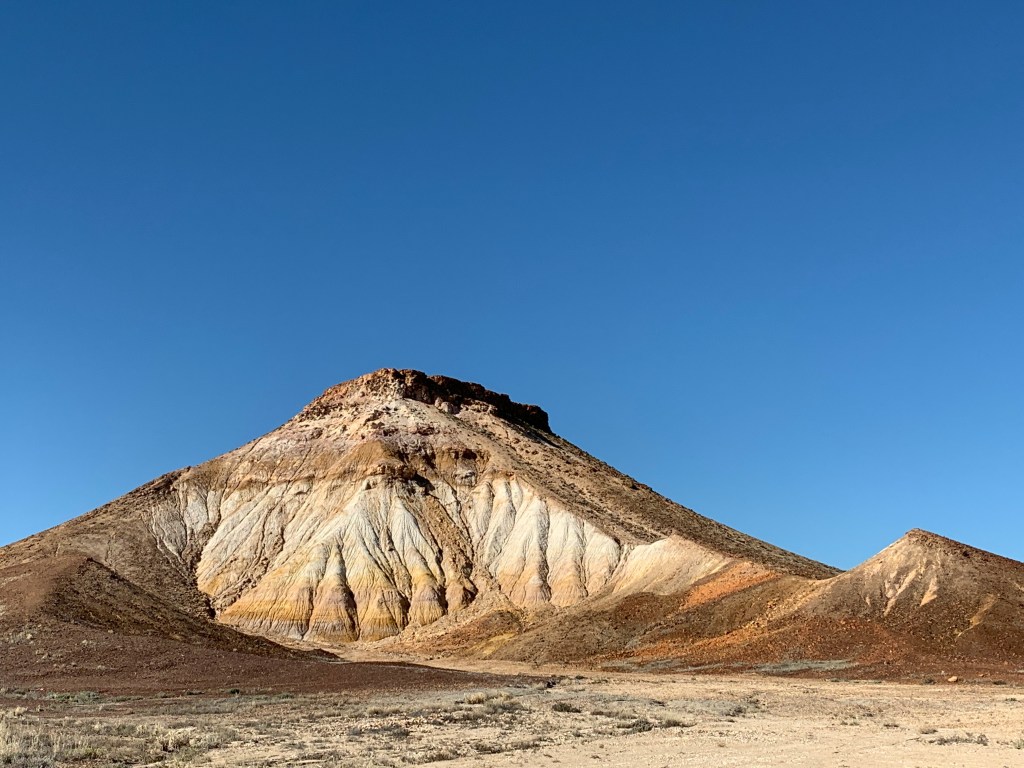
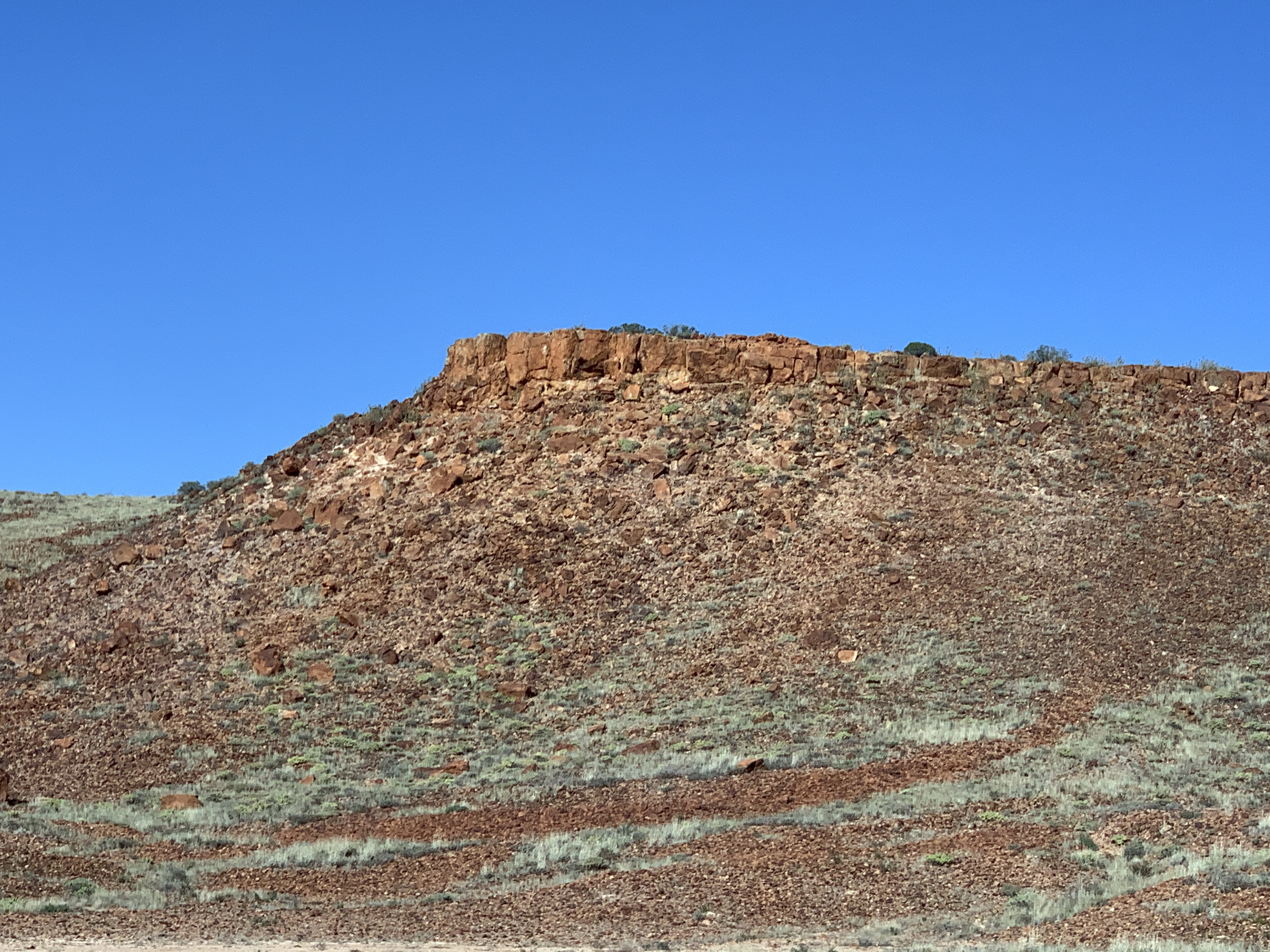
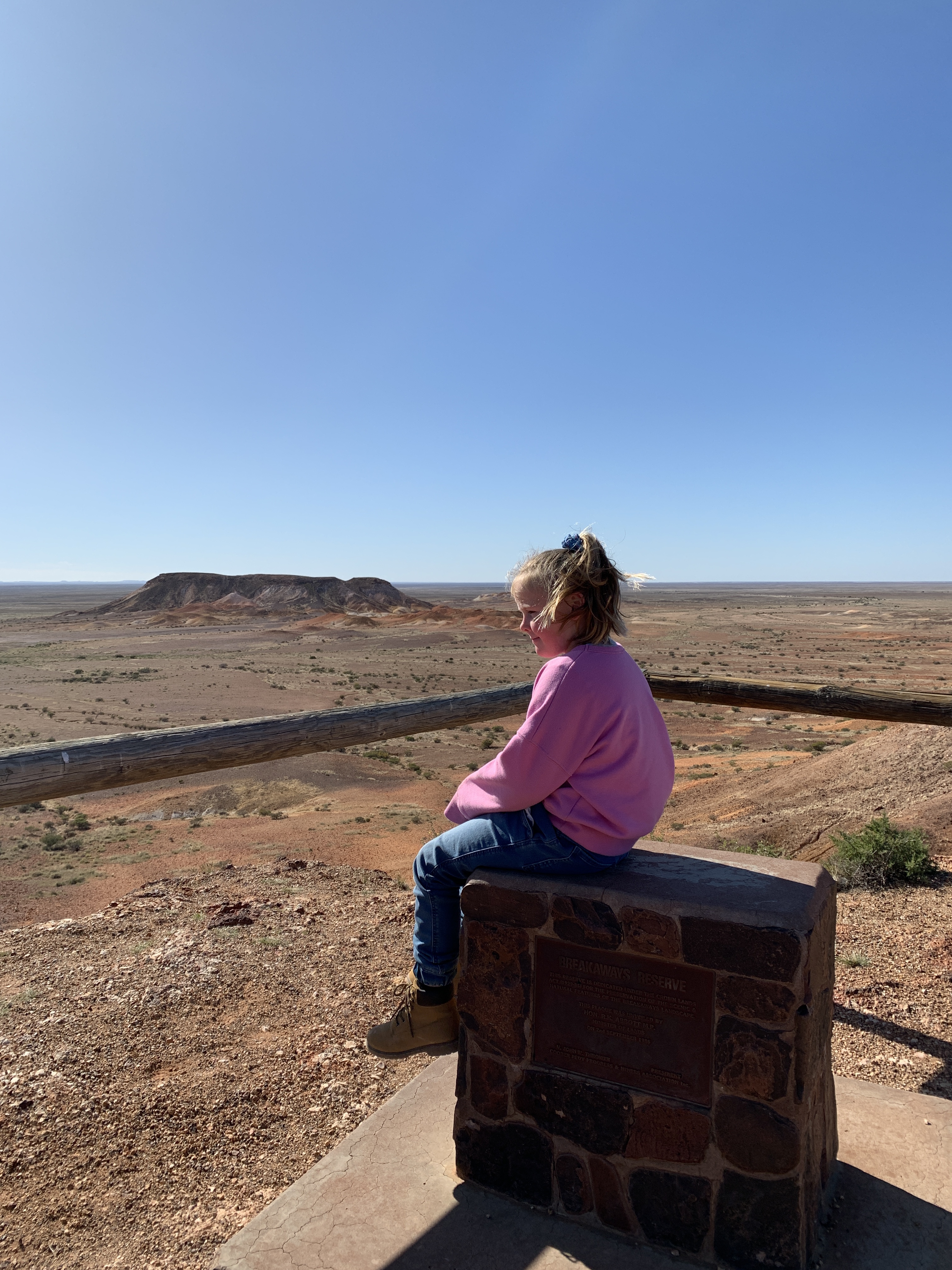
Next we had multiple stops to check out the stunning Breakaways. This series of sandstone ridges is renowned for it’s beautiful colours and we were not disappointed.
The stunning Breakaways
Our tour then took us back to town via the opal fields. The Coober Pedy Opal Fields are the largest opal fields in the world. It is estimated that only 20% of the fields have been mined so there’s probably a lot more opal to find yet. It is the most bizarre looking landscape with all those conical piles of dirt from the shafts. There are 1.5 million to 2 million mine shafts in the opal fields. This is why tourists are not allowed anywhere near the opal fields. It is too dangerous. I loved the signs around town telling people not to walk backwards in Coober Pedy in case they fell down a shaft.
Our tour guide even drove us into the opal fields to show us his own mining claim.
We arrived back where we started and all declared the tour well worth it. We’d all learnt so much and Aaron was a great tour guide. We recommend Noble Tours to anyone visiting Coober Pedy.
After lunch I took Ben and Maddie to the Skate Park just which is not far away on the road into town. They had a great time playing there and on the playground next door. Back at camp I took Riley, Ben & Maddie to the pool. They played a boisterous game of ‘piggy in the middle’ using ‘Oscar’, a little yellow plastic man that Maddie found in my peg bag. I couldn’t understand how they could be in the water. I sat up on one of the deck chairs and I was wearing jeans and four layers on top and a hat to keep warm. The kids assured me the water was warm!
Playing ‘piggy in the middle’
To celebrate Richard’s birthday we had a delicious BBQ dinner of lamb chops served with a potato with coleslaw & cheese, and corn on the cob.
We had a lovely FaceTime chat with our grandchildren, Zara and Henry, and it was so great to see their faces. I love technology.
We’d had a big day so everyone was happy to go to bed early so we could get a good nights sleep before our big driving day the next day. We’ve got 688 km’s to get to Alice Springs so we’d probably camp in the desert along the way before arriving in Alice on Wednesday.




























































































 motorhomemeanders.com