Walking at Kata Tjuta

It was our last day at Yulara before we head off to Kings Canyon and we’d saved Kata Tjuta until last.

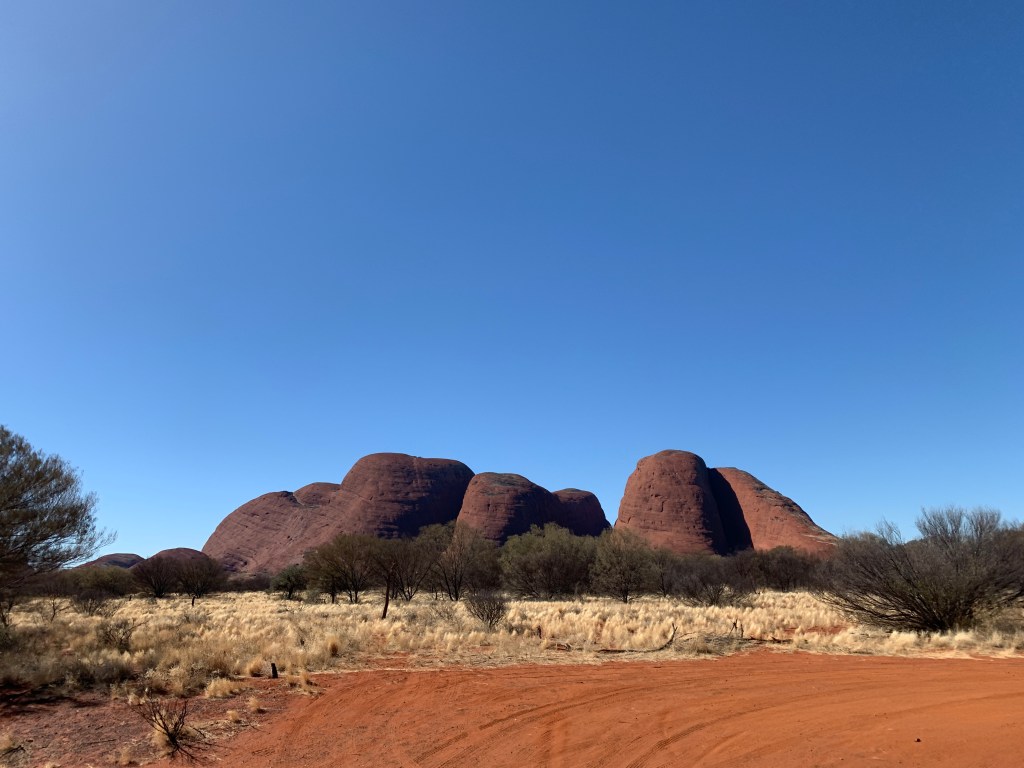
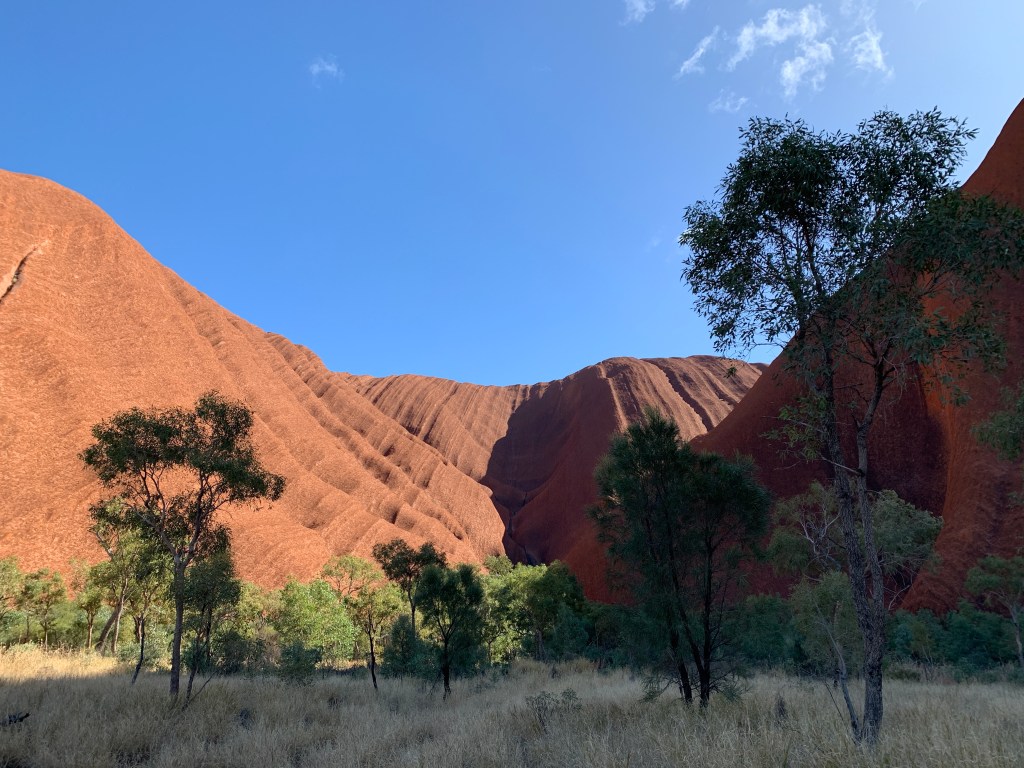
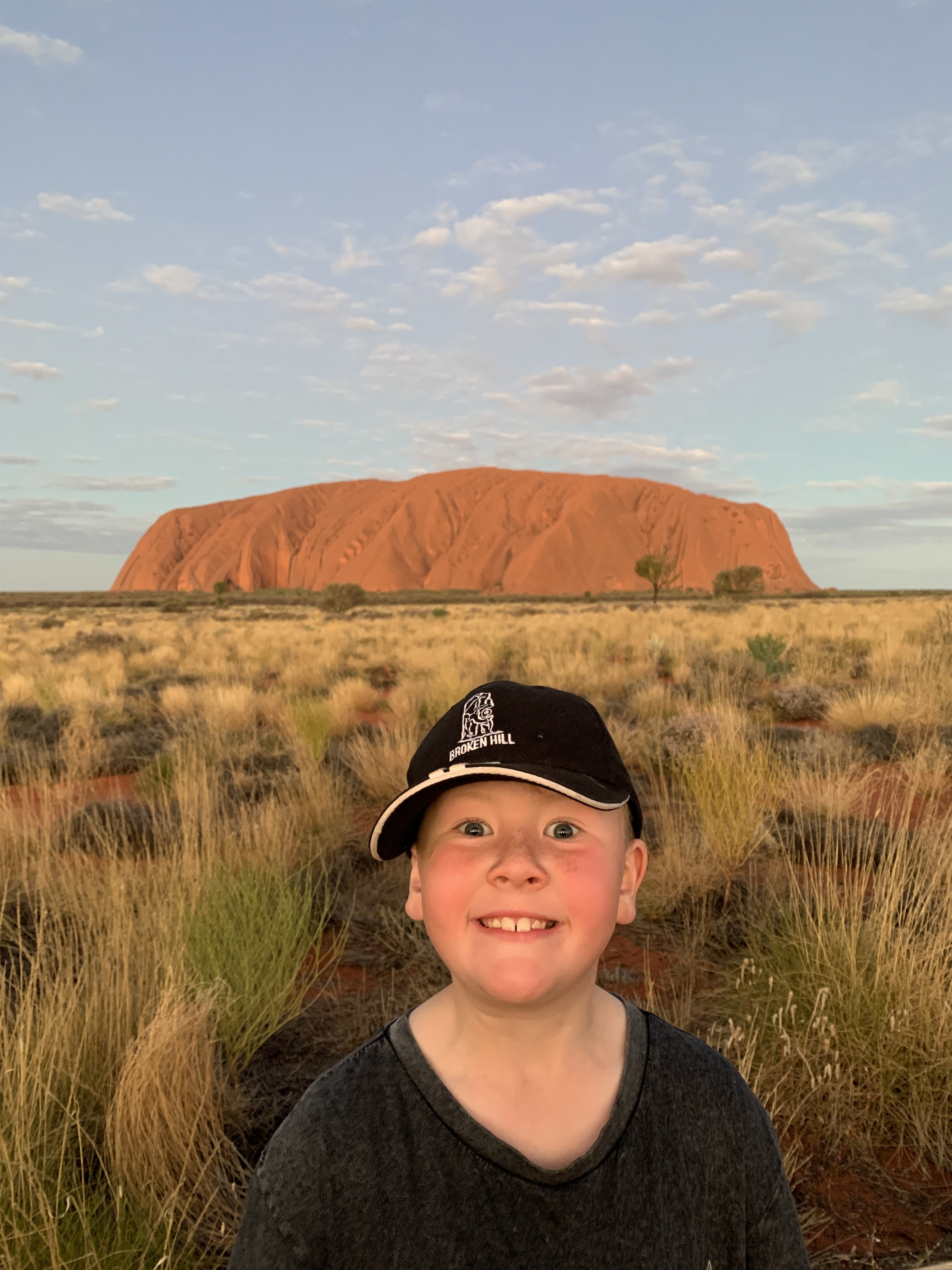
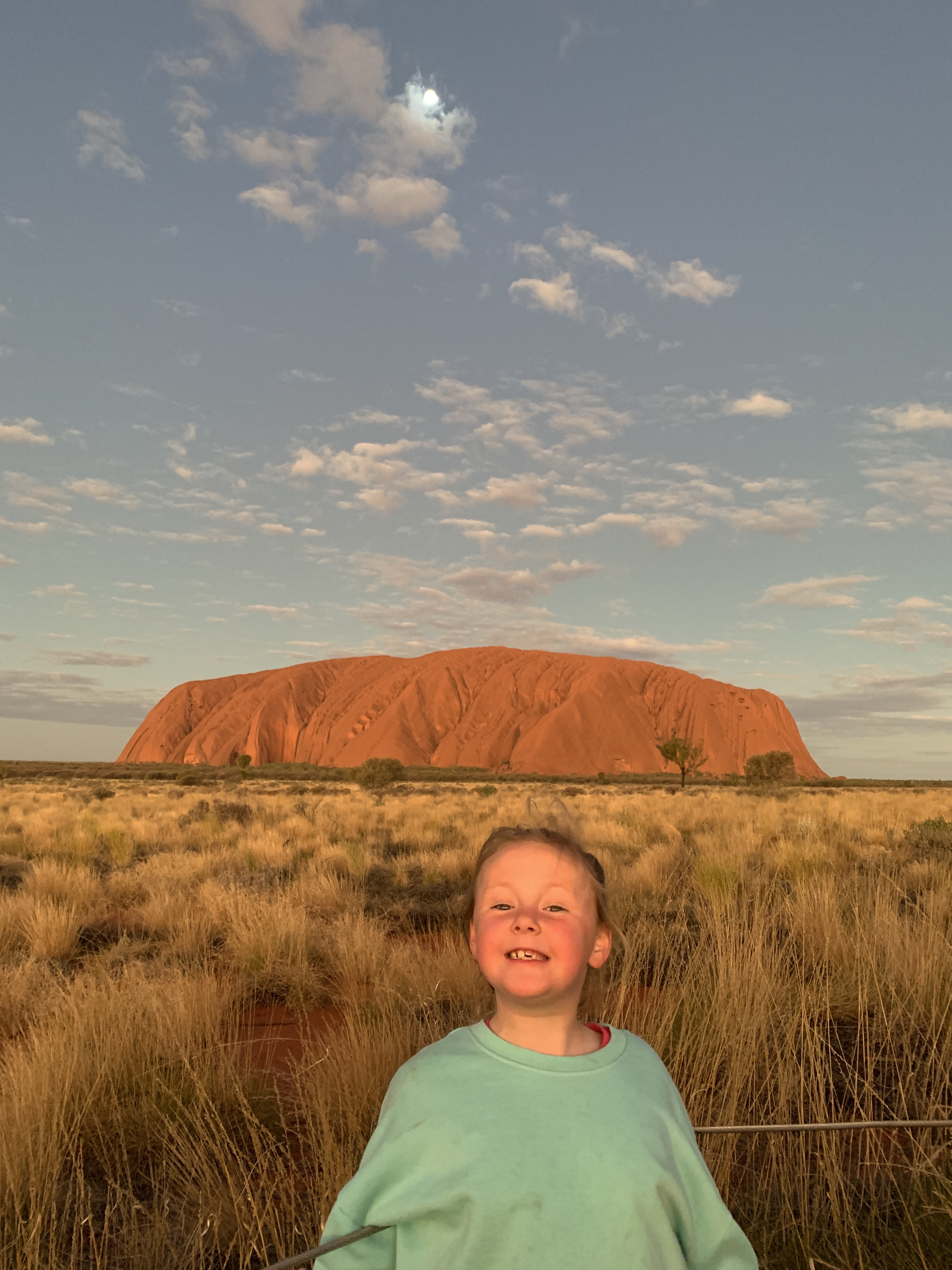
We set off into the National Park once again and this time took a right turn towards Kata Tjuta. Many of you will recall they used to be called The Olgas. Mt Olga is the tallest of the domes at Kata Tjuta and at 1,069m is 206m taller than Uluru.

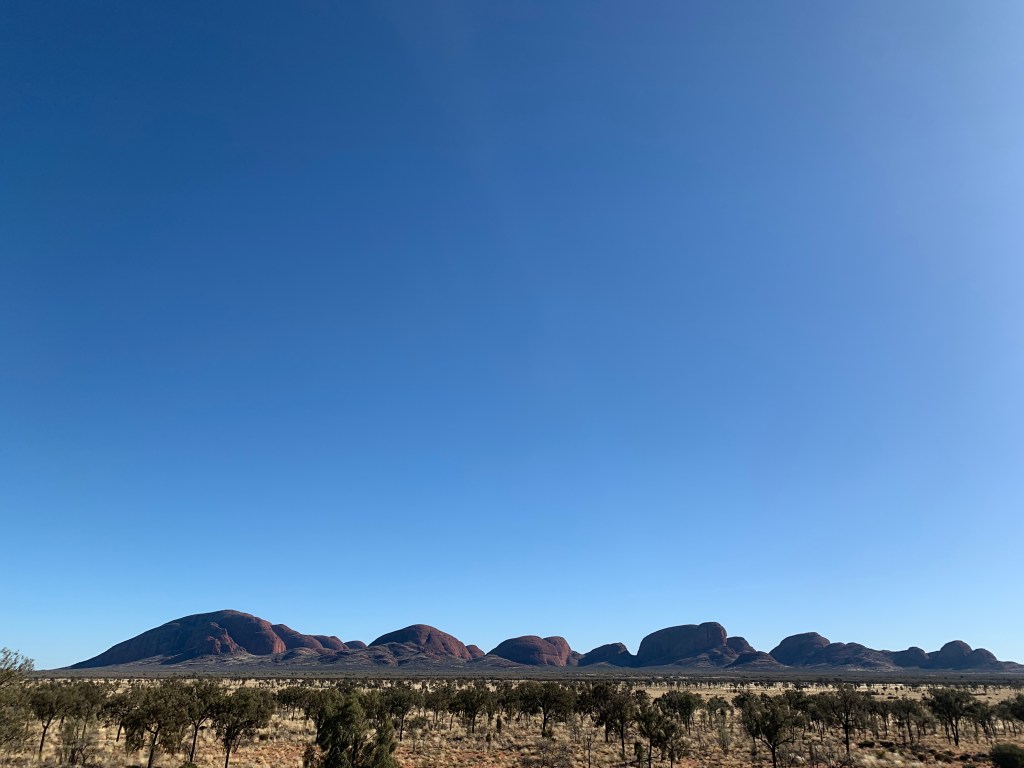
Our first stop was at the Sand Dune Viewing Point. Here there is a car park and a short walk up the sand dune on a metal boardwalk. The boardwalk is to protect the fragile sand dune environment. From the top of the dune you get a fabulous view across to the red domes of Kata Tjuta. There is a large boardwalk platform on the top of the dune with storyboards full of information about the flora and fauna of the sand dunes.
We continued on and passed the turnoff to Kaltukatjara (Docker River) which is the continuation of the Outback Way (The Longest Shortcut) and takes you all the way to WA.

Our second stop was to the Sunset Viewing Car Park. We were way too early for sunset but this is the only place in Kata Tjuta that has toilets.

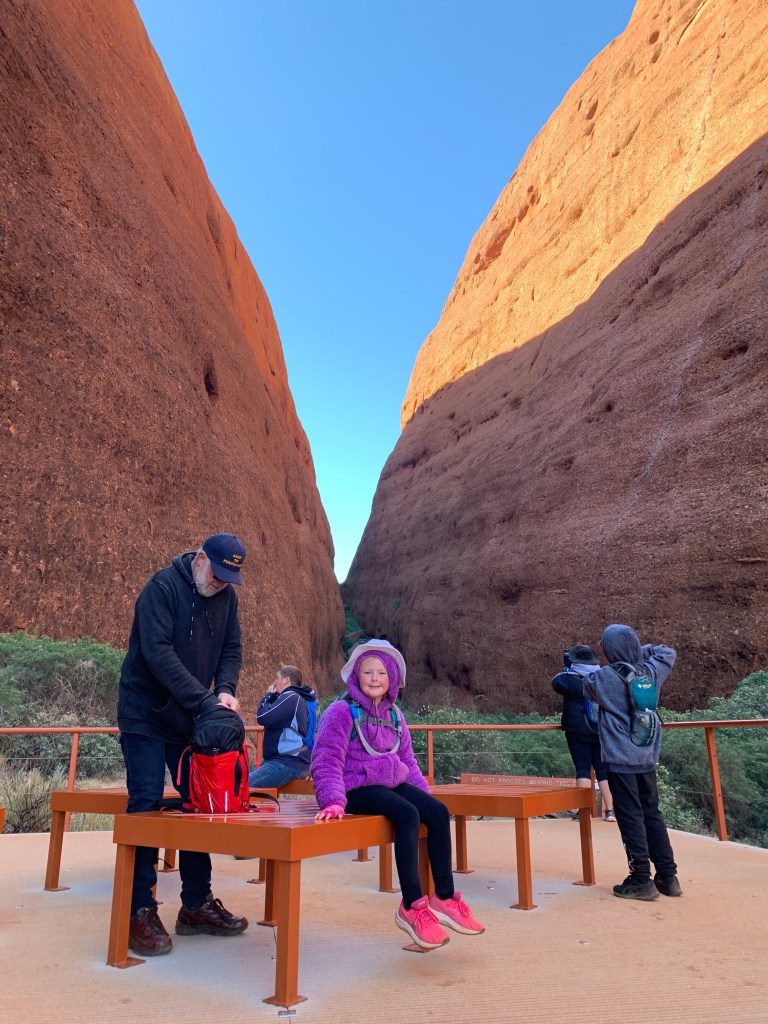
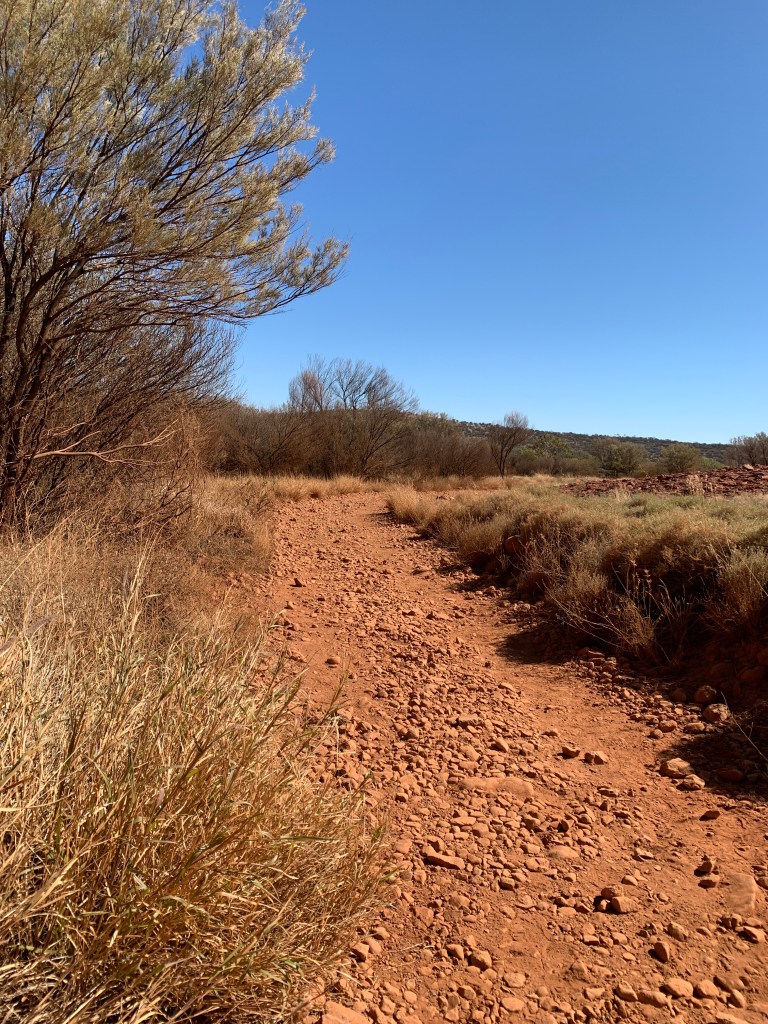
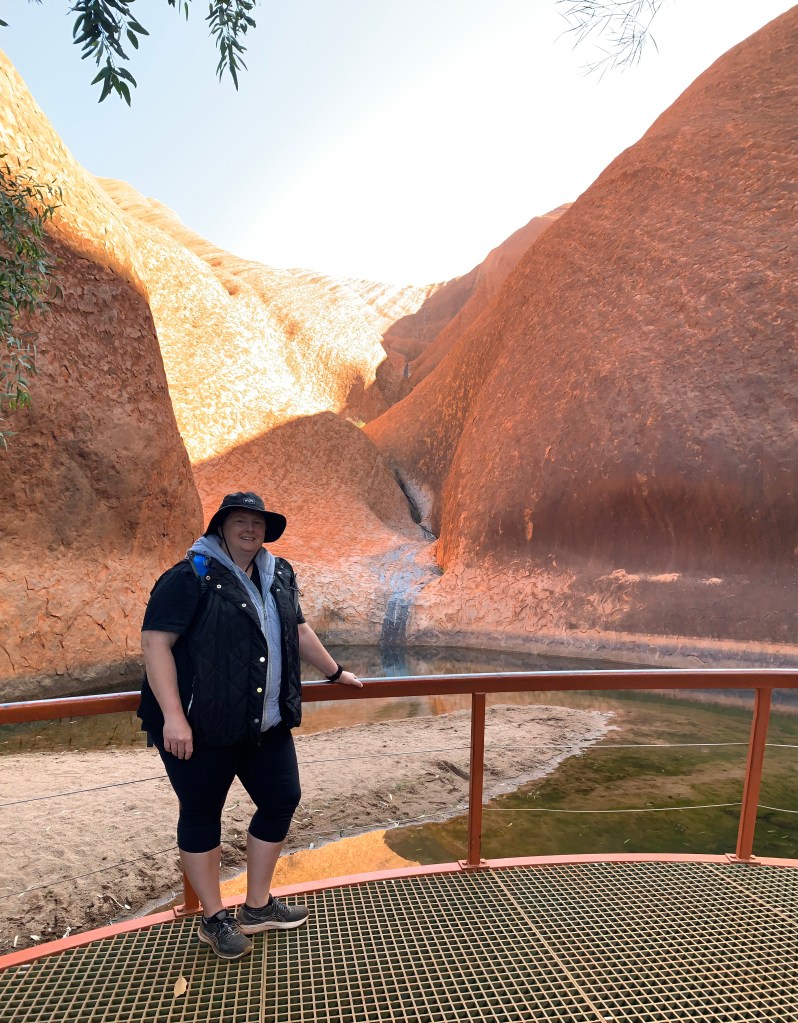
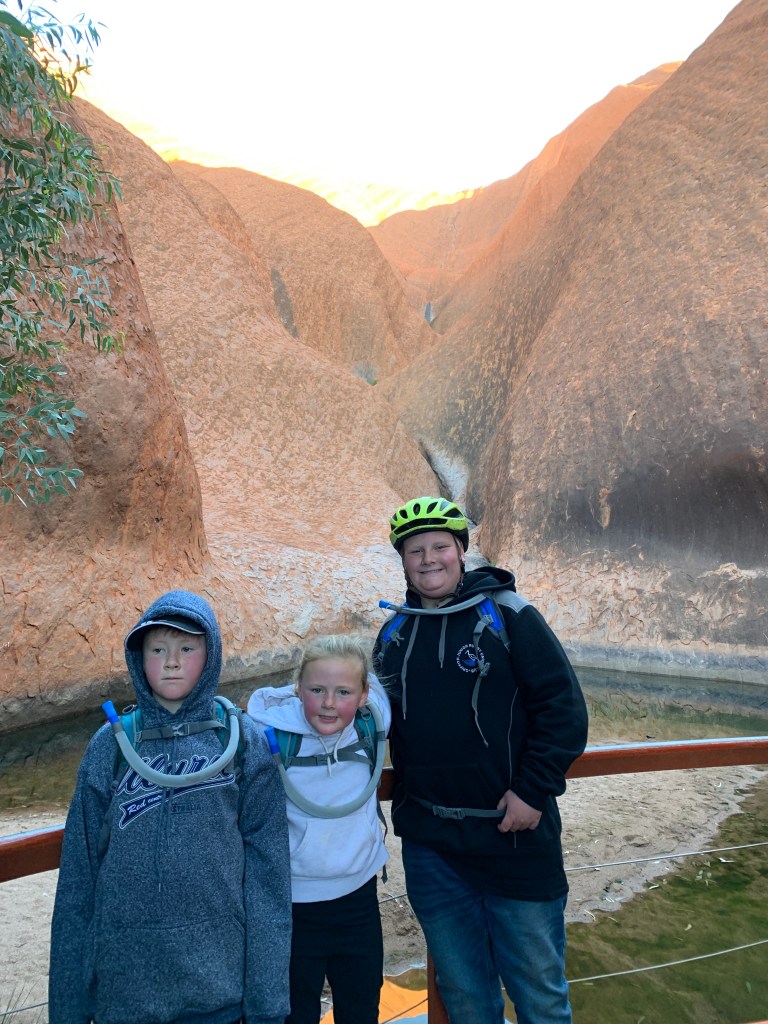
Our third stop was at the car park for the Waḻpa Gorge walk. This walk is a Grade 3 – Moderate walk of 2.6km. It is a very rocky walk and not an easy one. You really do have to watch your step on this track. The wind was howling down through the gorge and it made for very chilly walking. I was wishing I’d worn my beanie as my hat blew off a couple of times and the children had to run after it before it blew too far away. Waḻpa means ‘windy’ in the local language.

There is a sign at the beginning of the track that says that Kata Tjuta is an Aṉangu mens site and is sacred under Tjukuṟpa (traditional law). Visitors are asked to stay on the track and to be respectful of the area. particularly those people who wish to make silly rock cairns. There are signs asking people to please not do that to this sacred place.

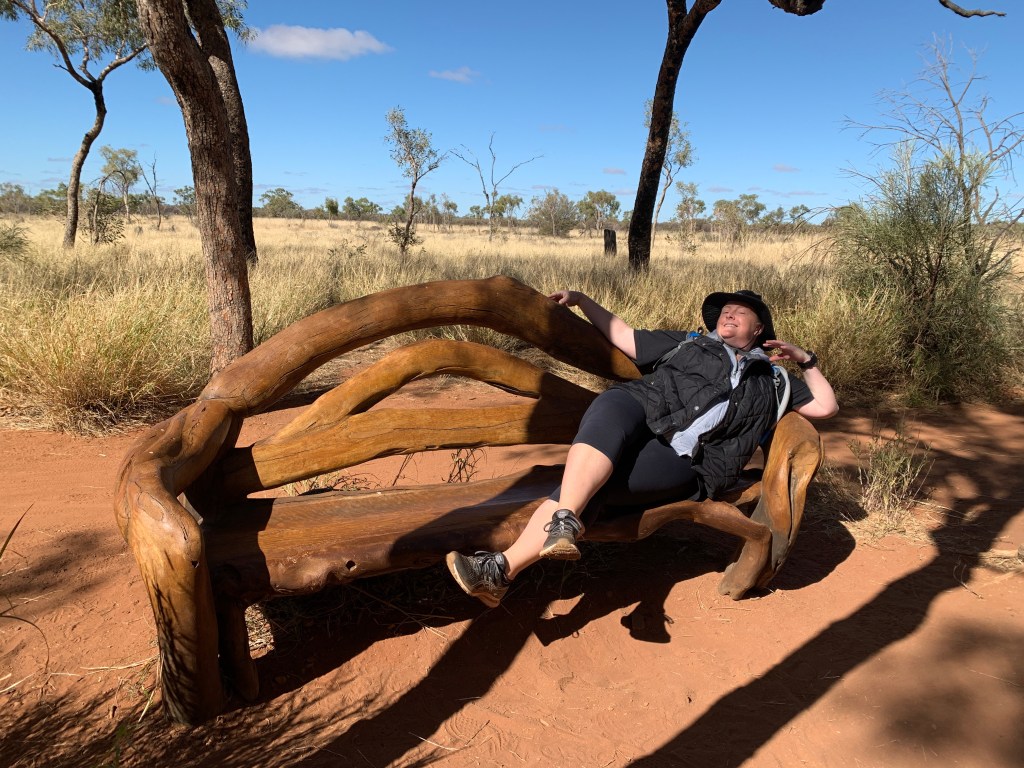
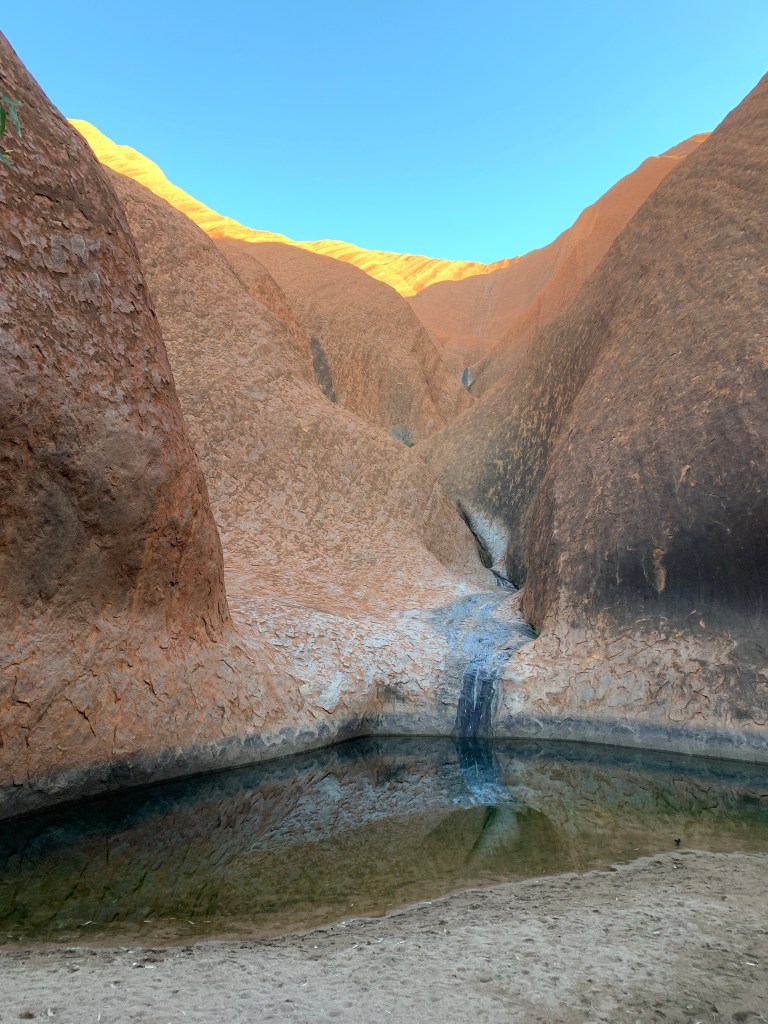
Once at the end of the walk there is a large platform with seats where you can catch your breath and just sit and listen to the sounds of the gorge. It is a beautiful place. Hundreds of tiny birds, we think they were finches, darted all about. There are rare plants that grow in Waḻpa Gorge that grow nowhere else in the world.

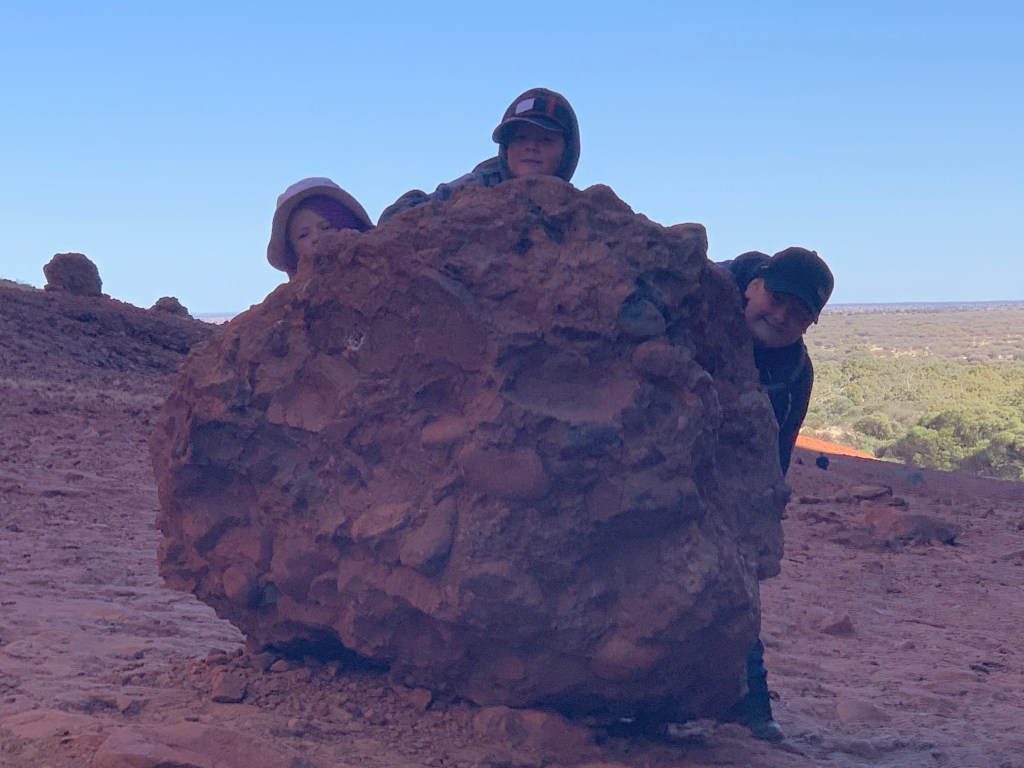
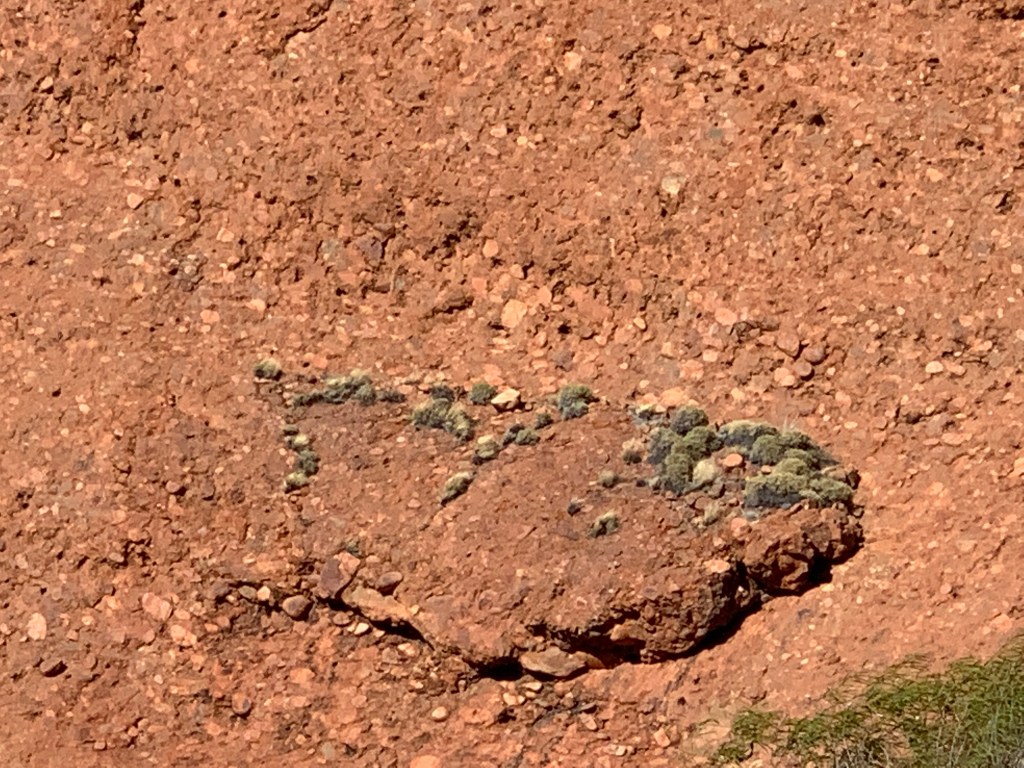
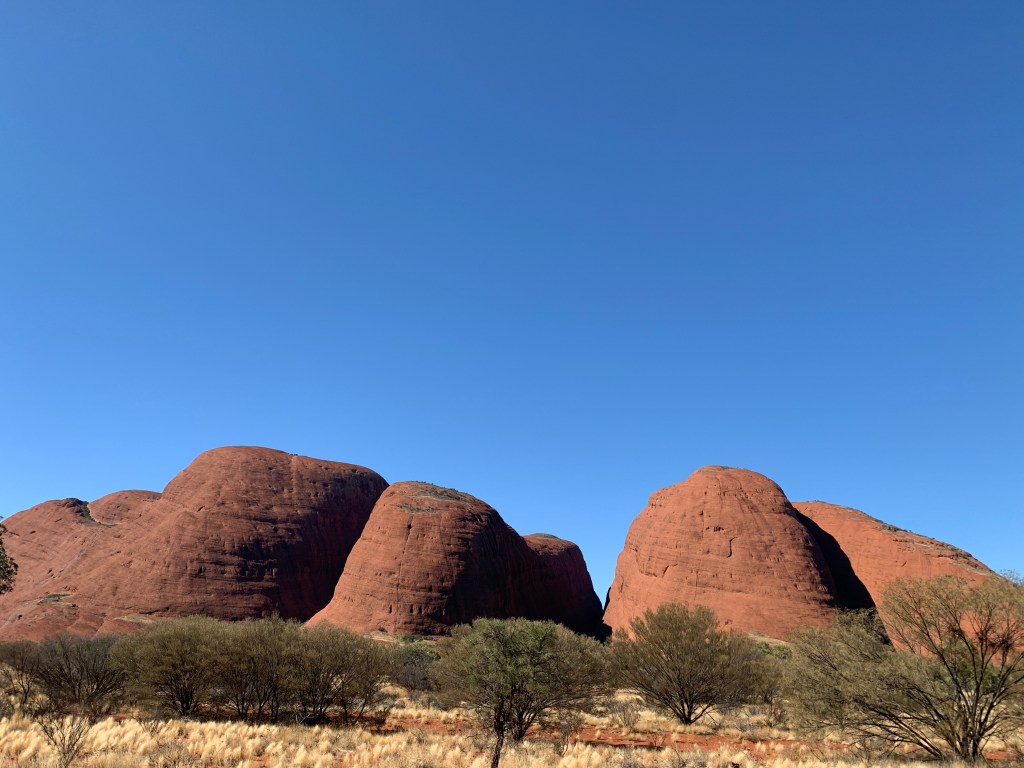
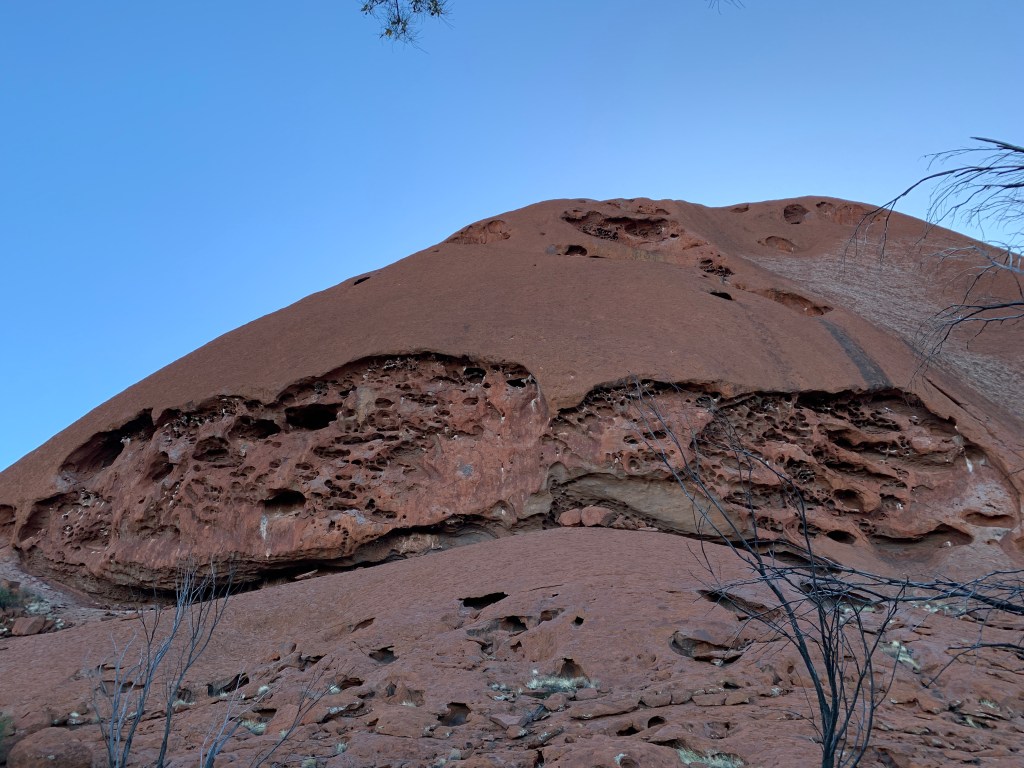
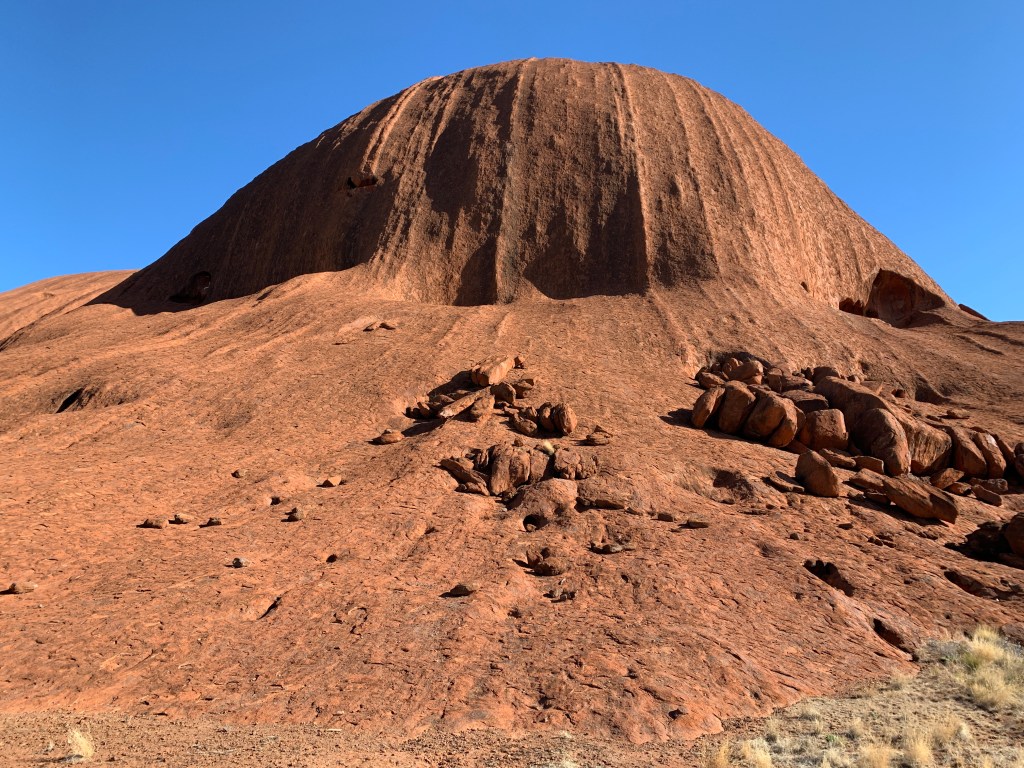
Kata Tjuta differs from Uluru in its composition. Uluru is one great big sandstone rock. The domes of Kata Tjuta are made up of conglomerate rock. Millions of rocks fused together over millenia. They are truly stunning.

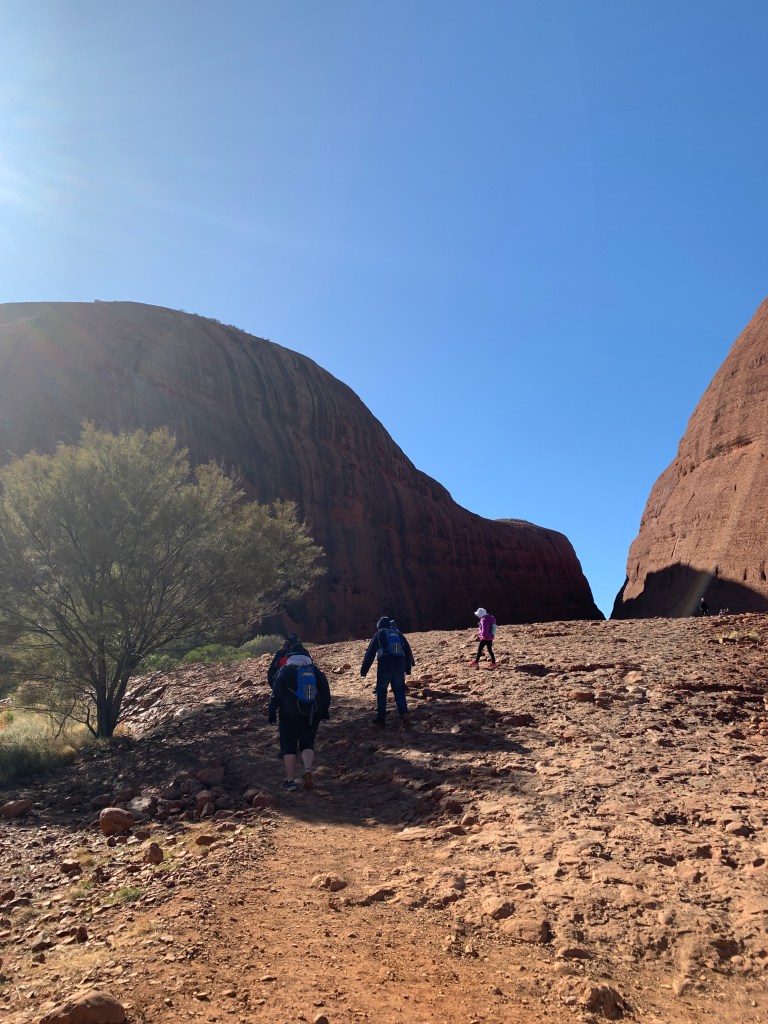
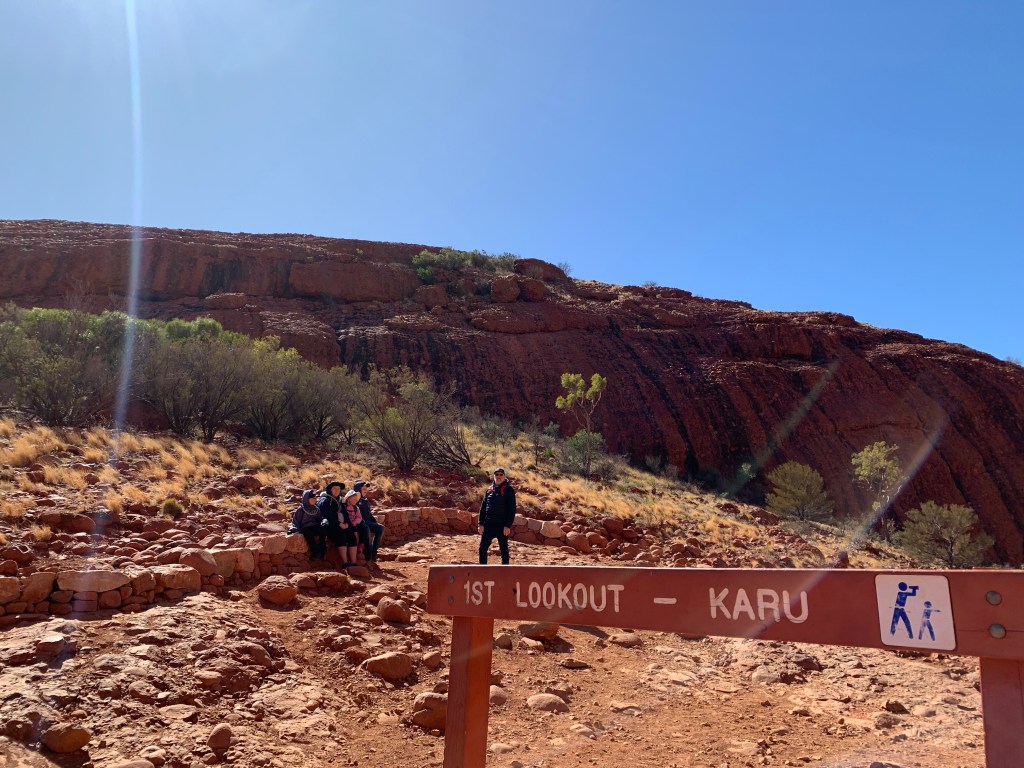
We walked back out of Waḻpa Gorge to the car and drove to our next stop, the car park for the Valley of the Winds walk. The Valley of the Winds walk is in three sections. The first part is to Karu Lookout and this section is a Grade 3 – moderate walk of 1.1km. The next section is to Karingana Lookout and is a Grade 4 – Difficult walk of 2.7km. The Full circuit walk is a Grade 4 – difficult walk of 7.4km and takes about 4 hours.

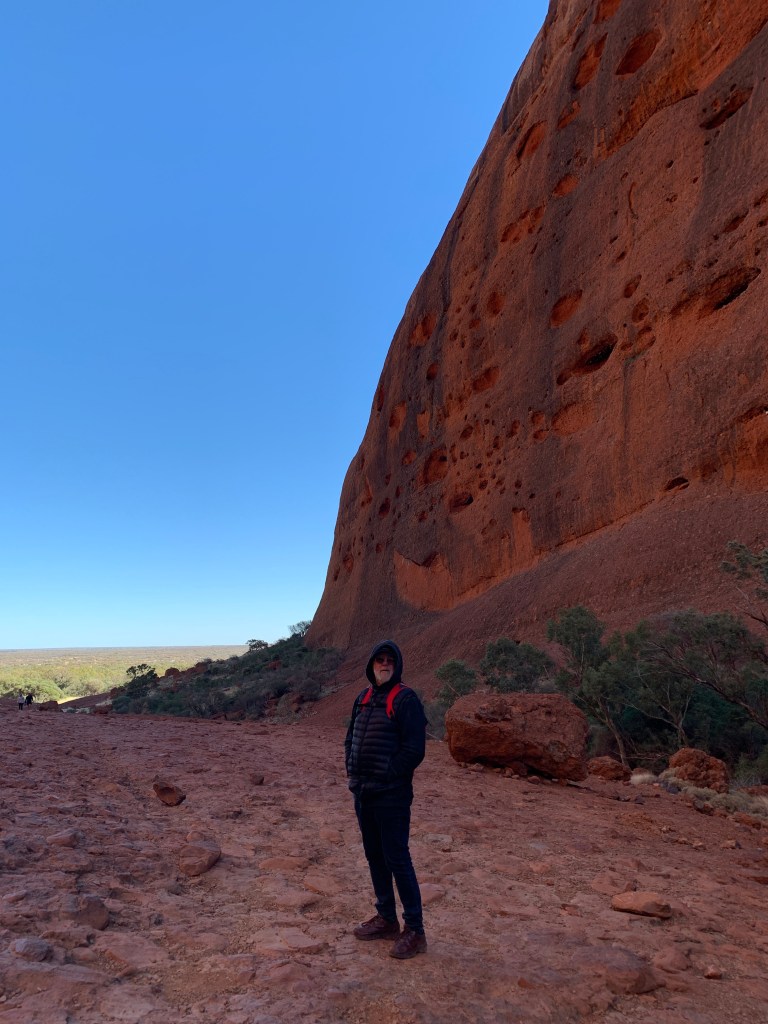
We chose to only do the walk to Karu Lookout and even though this is a moderate walk it was still challenging due to the rocky path. There are lots of loose rocks so you have to mind your step. The view at the end is worth it though. Wow. What an amazing place. It was also very windy
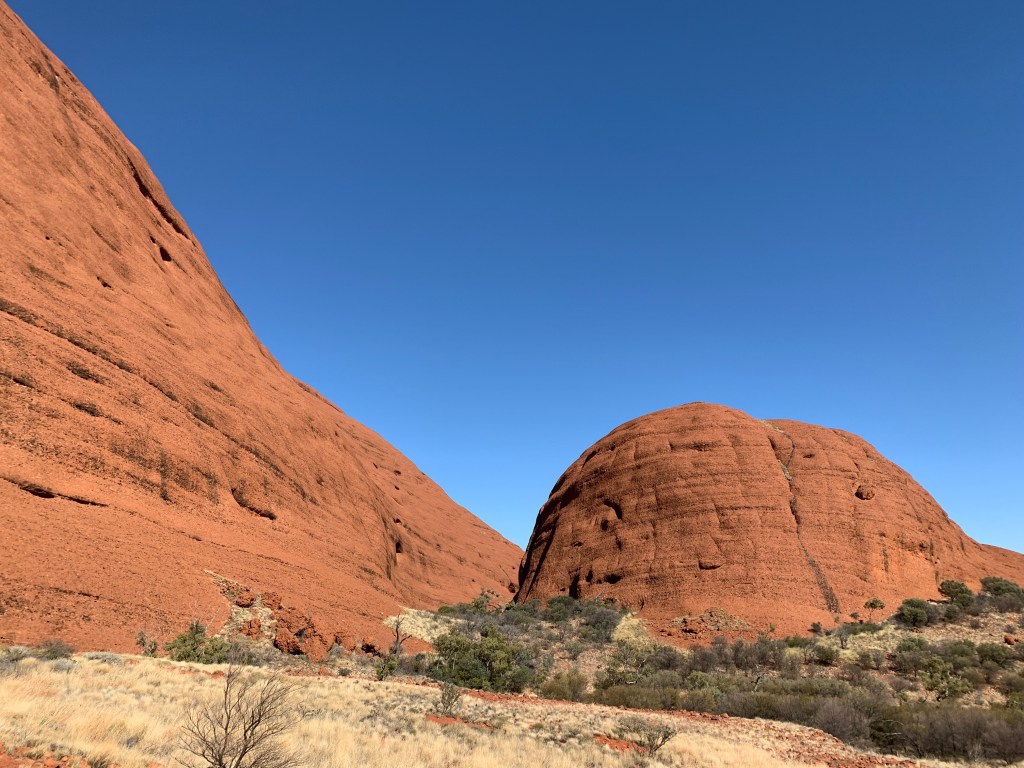
It was a tired group of 5 that headed back to the car and I think we were all relieved to get out of the cold wind. It was lovely to get back in the nice warm car.

Back at camp Katie and I menu planned for the next week and headed off to the IGA to stock up on groceries. We will have 3 days at Kings Canyon then a few nights free camping before we get anywhere near another supermarket.

We were heading back to the car with our trolleys when I looked up and who do I see but someone from our home town of Griffith. Fancy that! They are also staying at the Campground for a few days and were probably in the West MacDonnells when we were. It’s a small world.

Richard and Riley did a dump point run to empty both cassettes before we set off in the morning. I think I’ve already mentioned that the only dump point at Yulara is 5km away from the Campground out near the Water Treatment Plant on the other side of town.

After dinner everyone chipped in to pack up what we could so there is less to do in the morning. We have 305km to travel to get to Kings Canyon Resort where we have powered sites booked for 3 nights.

I think everyone is ready to move on and continue our travels after 6 days spent at Yulara. We have enjoyed it here very much. This is somewhere all Aussies need to visit at least once in their lifetimes and we feel very fortunate to have done this trip together. We are not sure how people only come for two or three days as there is so much to do.
My little blog reaches 10,000 views!

Wow! I received a notification today that my website has reached 10,000 views. I’m a bit stunned. I know that isn’t many for a full time blog however my little blog is really only to record our travels and maybe share some of our adventures with other like-minded travellers.

I started this little blog in March 2016 and I really enjoy writing about our meanders around our fabulous country.

Thank you to all who have been part of that 10,000 views. I hope you enjoy reading my stories as much as I enjoy writing them.

I’m always happy to hear from readers what you would like to hear about. Let me know your thoughts!

Field of Light Dinner

Months ago, when we booked our camp sites at Ayers Rock Campground, we’d also booked for a special night out at The Field of Light Dinner. This combines the Sounds of Silence Dinner with the Field of Light Experience. We were quite excited by the thought of this night out.

Rich and I put on our glad rags and set off to the Campground Bus Stop to wait for our ride. When we arrived at the bus stop there were already a few people waiting for various tours.

Each night, every day of the year, multiple dinners are held out in the desert under the night sky. We found out there is the Field of Light Dinner site, two Sounds of Silence dinner sites and one site for the extra special, top of the range, fine-dining experience called Tali Wiru.

You can also book just to visit the Field of Light and this is what Katie and the kids were doing. They planned to go to the Outback Pioneer Pub for an early dinner before meeting their bus for the ride out to the Field of Light. We hoped we’d catch up with them there.

There were two big coaches that collected all booked for the Field of Light Dinner and we were driven out into the desert, across sand dunes to be dropped off at the base of one dune. A pathway led to the top and along the crest of the dune to a lookout where staff were waiting to serve us drinks and delicious canapés. The canapés included things like a crocodile quiche, small bite-sized pieces of kangaroo served on crusty bread, scrumptious little caramelised onion tartlets, a prawn bite and another tartlet with sweet potato cream. Bubbles, red and white wine were available and soft drink for the no-alcohol guests.

We did have a bit of a laugh when we discovered the wine being served was De Bortoli’s. We travel all this way to be served wine from home.

The staff were very attentive and passed by frequently with platters and to top up your drinks. The flat area had a great view out towards Uluru and we stayed up on top of the dune until the sun set.

We were then led down the hill to our dining site. This was amazing. Large round tables set with white tablecloths under the stars on the red desert sand. Along one side was a large buffet and delicious smells were wafting from there as we sat down for dinner.

We sat a table with a couple from Sydney that we’d met at the top of the dune, three young ladies also from Sydney and a young couple from Italy who were on their honeymoon in Australia. Everyone was great company.

Our lovely waiter introduced himself as Amos and he would be looking after our table all evening. The first course was served to the table and consisted of a native tomato soup. It was spicy and delicious.

Second course was from the buffet and we were invited up table by table. There were 4-5 salads, grilled barramundi, kangaroo in dukkah, a chicken dish and lamb cutlets as well as a couple of vegetable dishes. All dishes had a bush tucker theme using native ingredients.

The variety of food mean there was something for all tastes. I had the barramundi and kangaroo with lots of veggies and it was all very tasty.

Dessert was buffet again and tables were called up in the reverse order to help themselves to a wide selection of desserts. Tea and coffee was also available.

During dinner we had the haunting sound of a didgeroo playing. This really added to the atmosphere of the occasion.

Following dinner the resident star talker discussed the southern night sky. He used his laser to locate the Southern Cross, the signs of the zodiac, the Milky Way, as well as any planets that were visible. Unfortunately for us we had a super moon and the sky was so bight that not many stars were visible. Still, we could easily see Saturn.

I was fascinated to learn the the light from Beta Centauri takes 400 years to reach us on earth. The light you see when you look up at that star left sometime in the 1600’s. Isn’t that amazing!!!

Amos was a most attentive waiter and ensured that our wines and water were topped up regularly.

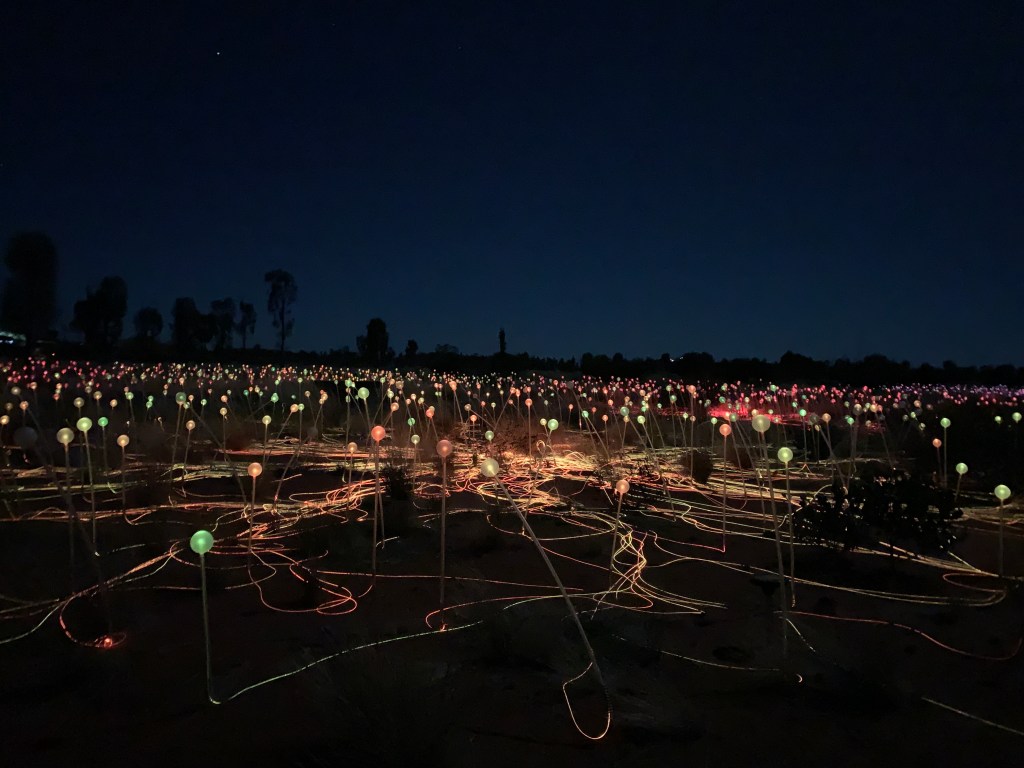
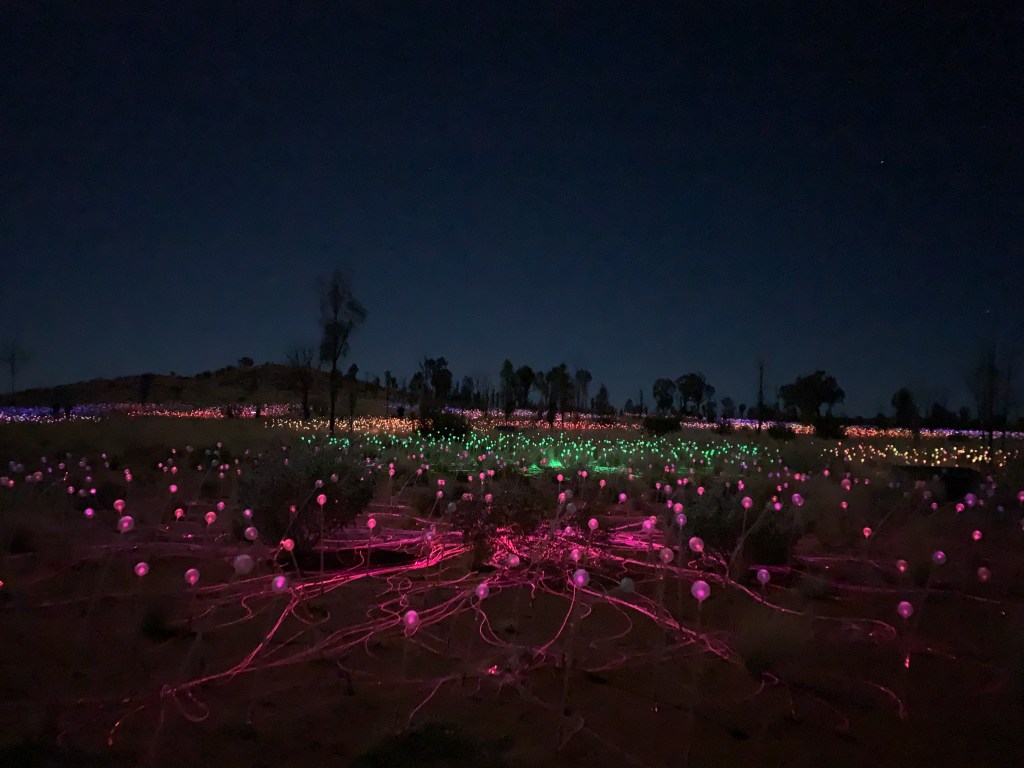
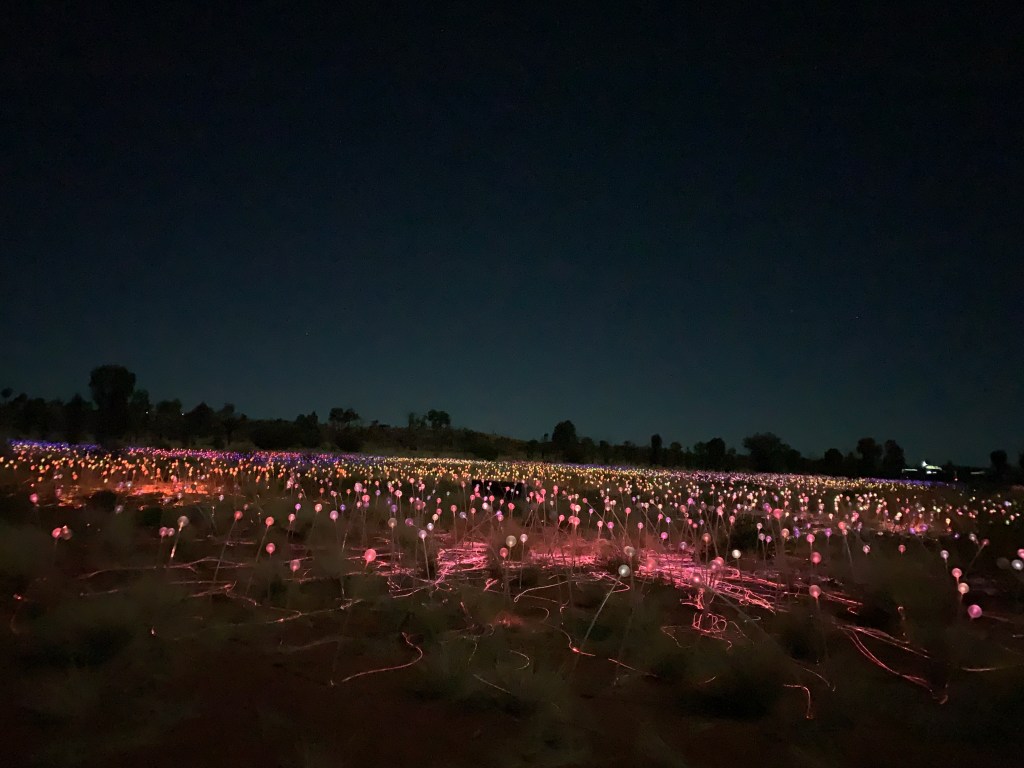
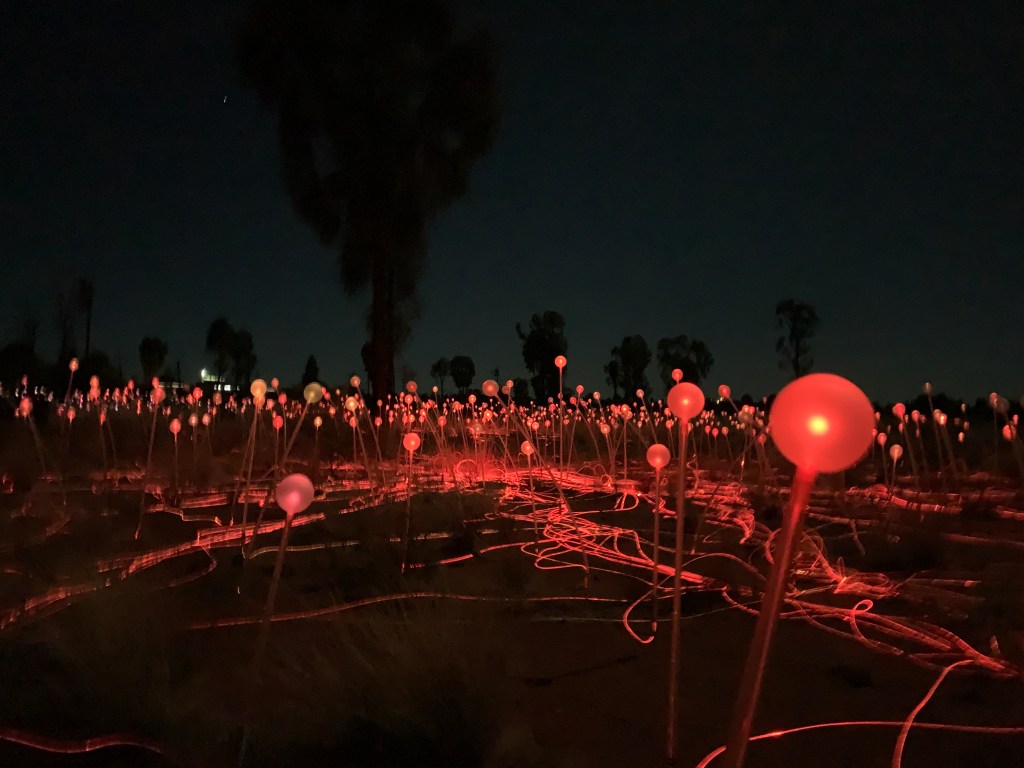
By the time dinner was over it was 9.30pm and we had 45 minutes to set off down the hill to explore the Field of Light art installation. As the sun went down we could see the lights begin to light up and gradually they became brighter and brighter.

The Field of Light is an art installation that was created by British artist Bruce Munro. It was meant to be on display for six months however, due to it’s popularity, it is still going.

There are over 50,000 lights in their frosted glass spheres that sway gently on their stems in the colours of the desert, red, ochre, deep blue and white. The area covers the size of four football fields.

Over 15 tonnes of solar powered lights were transported 19,000 miles via 32 international and domestic flights to the middle of Australia.

The Field of Light has been entrancing visitors since 2016 and will do for some time to come.

45 minutes was just enough time to walk through the magical field of coloured lights.

The evening was definitely a highlight of our visit to Yulara.

We arrived back at camp to find all the lights out next door. They must have all been asleep. We found out the next morning they’d had a lovely dinner at the pub and also enjoyed their walk through the Field of Light.

Cultural day at Yulara

After a slow start to the day Katie, Ben, Maddie and I set off to Ulura to visit the Cultural Centre. Richard had his nose in a book and Riley planned to do the same so we left them behind.

The Cultural Centre is located in the National Park and is only a short drive from the base of Uluru. It really should be your first stop when arriving at the park. We did have a short visit there the other day when we cycled around Uluru however Katie wasn’t with us and she really wanted to have a look at the art gallery.

The Cultural Centre is housed in a free form structure built from locally made mud bricks. You enter from the car park via the Tjukuṟpa Tunnel. Tjukuṟpa (pronounced choor-orr-pa) is the foundation of the Aṉangu culture. It is the creation period, their religious heritage and provides rules for behaviour and living together. It is the law for caring for one another and the land.

Tjukuṟpa refers to the past, present and the future at the same time. The knowledge never changes, it is always the same.

This knowledge is passed on from generation to generation. Some areas of Tjukuṟpa are only passed on to those who inherited the right to the knowledge. And, as with all knowledge, comes responsibility. The Aṉangu people are happy to pass on to visitors some of this knowledge and in return they ask that visitors respect their beliefs and take responsibility for looking after this special place. Visitors are particularly asked not to take photos of sacred sites and these are clearly signposted all the way around Uluru. There are lots of other places to take great photos.

The shape of the Cultural Centre buildings represent the two ancestral snakes, Kunyiya, the woma python woman and Liru, the poisonous snake man. Aṉangu creation stories tell the battles between these two helped create Uluru. Walking through the tunnel are displays that tell the story.

Once through the tunnel you can visit the Information Centre where there are further displays of the history of the National Park and how it came to be a national park, the flora and fauna of the area and a great video presentation about bush tucker, where to find it and what to do with it.

The Aṉangu owned and run Maruku Arts Store is next to that with a large area in front of it with picnic tables and chairs. Opposite is the Ininti Cafe and Souvenir Shop and next to that is the Walkatjara Art Gallery. This fascinating art gallery is also a workshop for local artists and there are often three or four artists at work at any one time. Both times we’ve visited there have been four women artists working.

I am fascinated with the style of painting using the tiny dots. It is painstakingly slow to create the paintings. Each painting tells a story and no two paintings are the same. The artists at work are more than happy to discuss their work with visitors and explain the story behind what they are working on.

There was a real difference between the quality of the art in the two stores at the Cultural Centre. The artworks in the Walkatjara Art Gallery are world class. This is, of course, reflected in the prices with paintings selling for $700-$1000 and anywhere up to $23,000.

Katie met one of the artists, Valerie Brumby, and was very taken with her work. Valerie even agreed to have her photo taken showing of her just completed works. This was quite an honour.

We bought delicious hot pies from the cafe for lunch and ate outside at one of the picnic tables. I had an emu, saltbush and sun-dried tomato pie. It was delicious.

Back in Yulara we stopped off to visit GOCA, the Gallery of Central Australia. This gallery located near the Emu Walk Apartments and Arkani Theatre showcases art from a huge area of central Australia and includes paintings, wooden objects, baskets, and pottery.

A quick visit to the IGA and the Uluru Store and we set off back to the campground. Once we drove in past reception I asked Katie to take a right turn and we drove up through the powered sites section of the park. This area is like a traditional caravan park with streets in rows. Some sites have concrete slabs and all have power and water. There are two amenities blocks and a laundry to service this area.

Between one amenities block and the laundry is a large flat are that is used by bus groups and there were two such groups set up with lots of kids eating their lunches at the many picnic tables. Behind them were rows and rows of little tents that they sleep in.

Back in the section where we are camped there are large lawn areas where people camp in a variety of tents, swags and we even saw a hammock strung up between two trees.

There are also powered sites in this area but not all of them have water. This area is more organic in shape and not in rows like the traditional area. If you drive right through this area you arrive at the overflow area which is just a big oval of red sand where you can camp with no power or water for $46 per night.

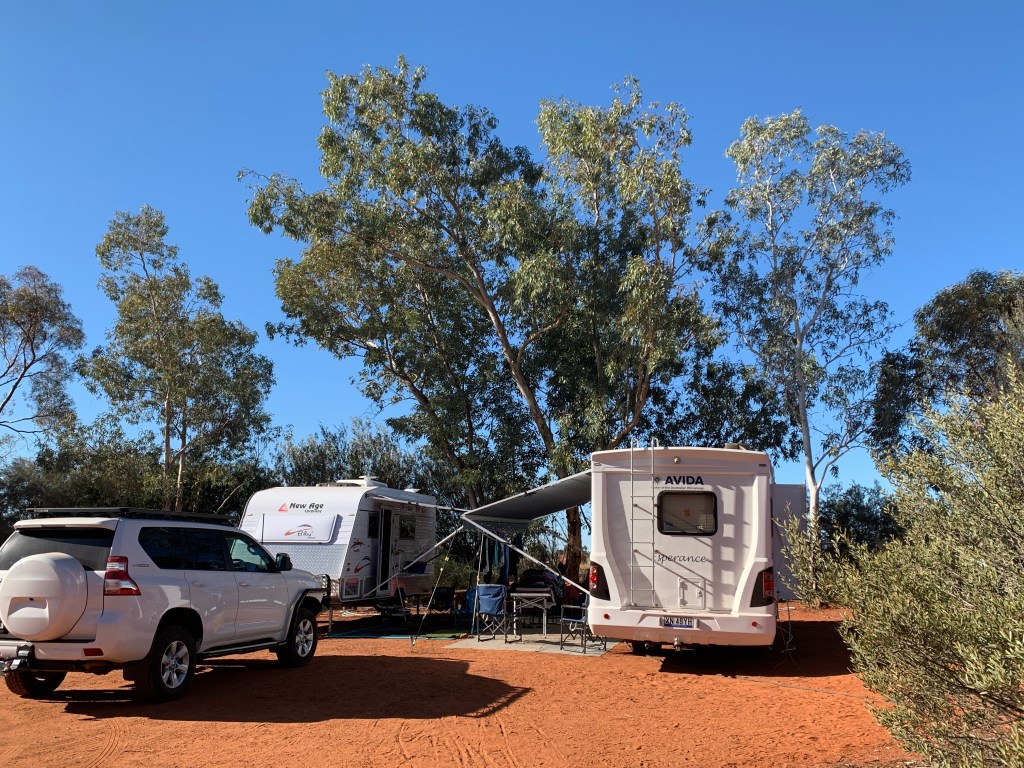
We really like our camp spot. We are tucked in with a big bush on one side so no one can camp on that side and we are backed up to the fence and, beyond that is bush, so no one is behind us either.

There are three amenities blocks in this area and each one has a washer and dryer. There is also a large camp kitchen close to where the tent sites are.

My only suggestions for improvements to the Campgound would be a couple of dump points. There is no dump point at all. The only dump point is 5km away.

The park could also do with a couple of playgrounds for the children. There are none. A bonus would be solar heating for the swimming pool. It would definitely get more use if it was heated.

Another tick – a walk around Uluru & helicopter ride

What another fabulous day in The Red Centre with two big ticks off the bucket list.

The whole family piled into the car to drive out to Uluru. Katie and I were dropped off at Mala Carpark so we could do the Base Walk. Pa took the kids back to Yulara where they went to the supermarket to stock up on supplies and lazed around camp for the morning while Katie and I walked.

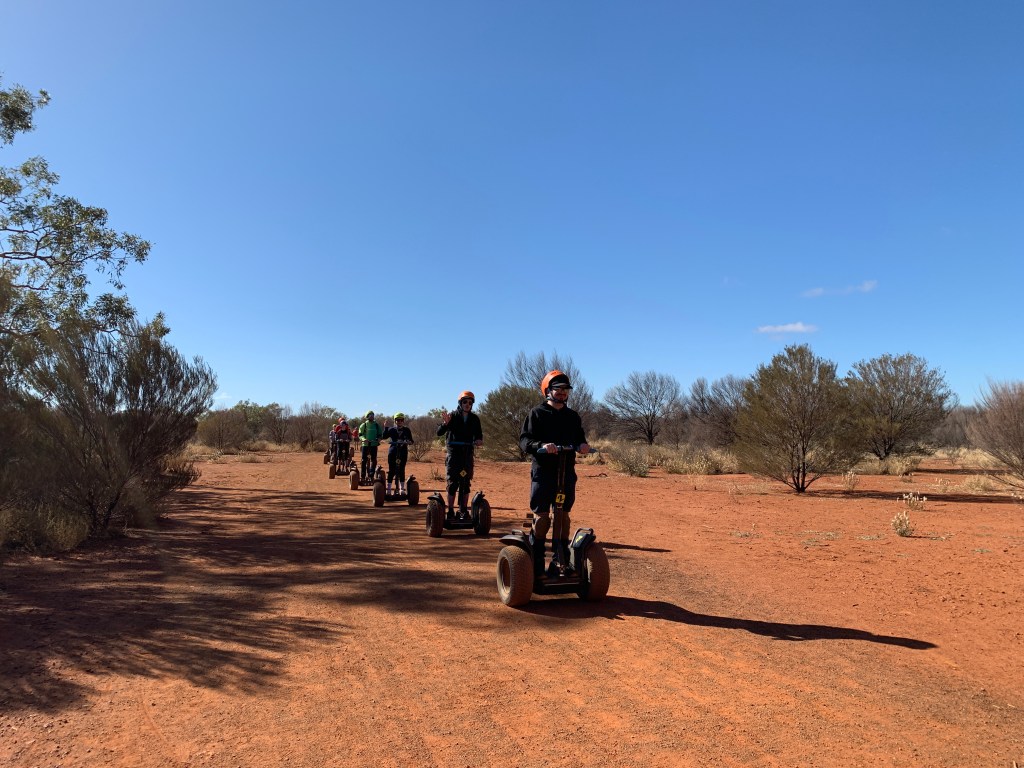
It was a beautiful morning and there were lots of walkers and cyclists. We even passed a Segway tour. We managed to walk the 10.6km all the way around in 2 1/2 hours with a stop half way around for a short rest. We made it back to the Mala Car Park and enjoyed a half hour rest waiting for the family to come and collect us. We ate our packed lunch while we waited and enjoyed just sitting taking it all in.

Walking around the rock was a bucket list item for both of us and we achieved it in good time. It was a most enjoyable walk.

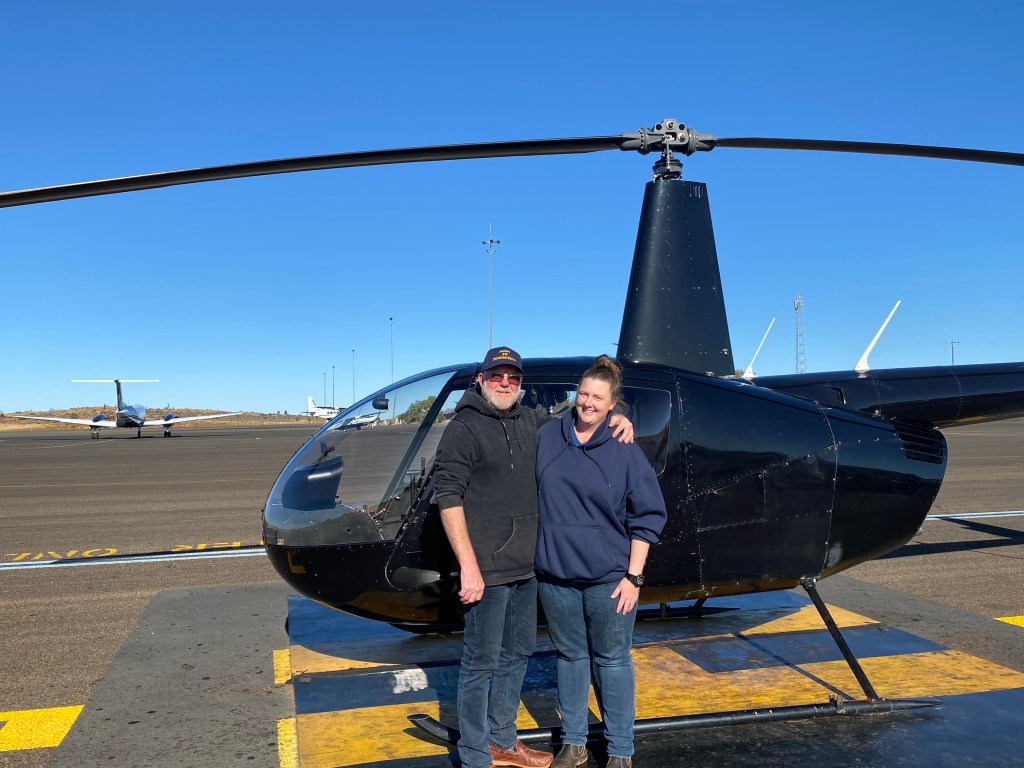
In the afternoon Richard and Katie had a helicopter tour booked and they were picked up from the Campground by pilot Jay. While they were off having an adventure I took Ben and Maddie to the pool. Even though it is not heated they wanted to go anyway. We got to the pool, they stripped off their clothes and Ben approached the edge. Brrr, it looked cold. There was a dad and his little girl on the other side of the pool however she wasnt getting in. I did think it was because it was too cold.

Ben took a flying leap and jumped in. He immediately got out yelling ‘it’s freezing’. Ben and Maddie spent the next hour getting in and out of the very cold pool. The little girl on the other side of the pool, also called Maddi, plucked up the courage to get in up to her thighs but that was it.

Personally, I thought they were all a little mad. You won’t get me in the water unless its hot!

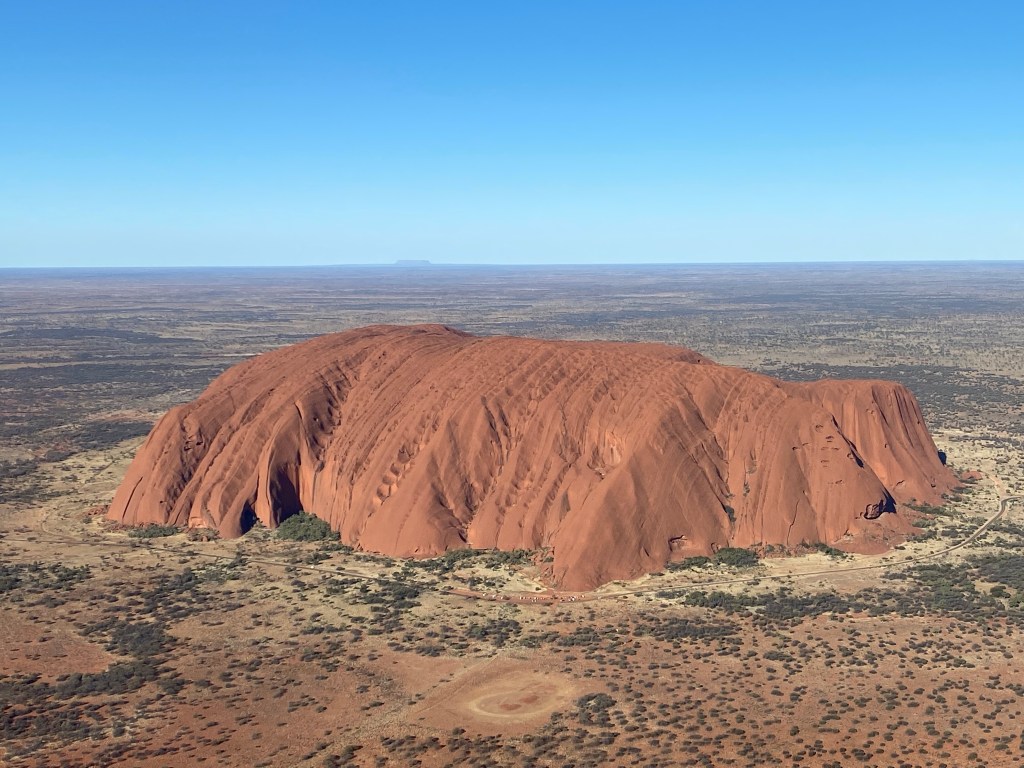
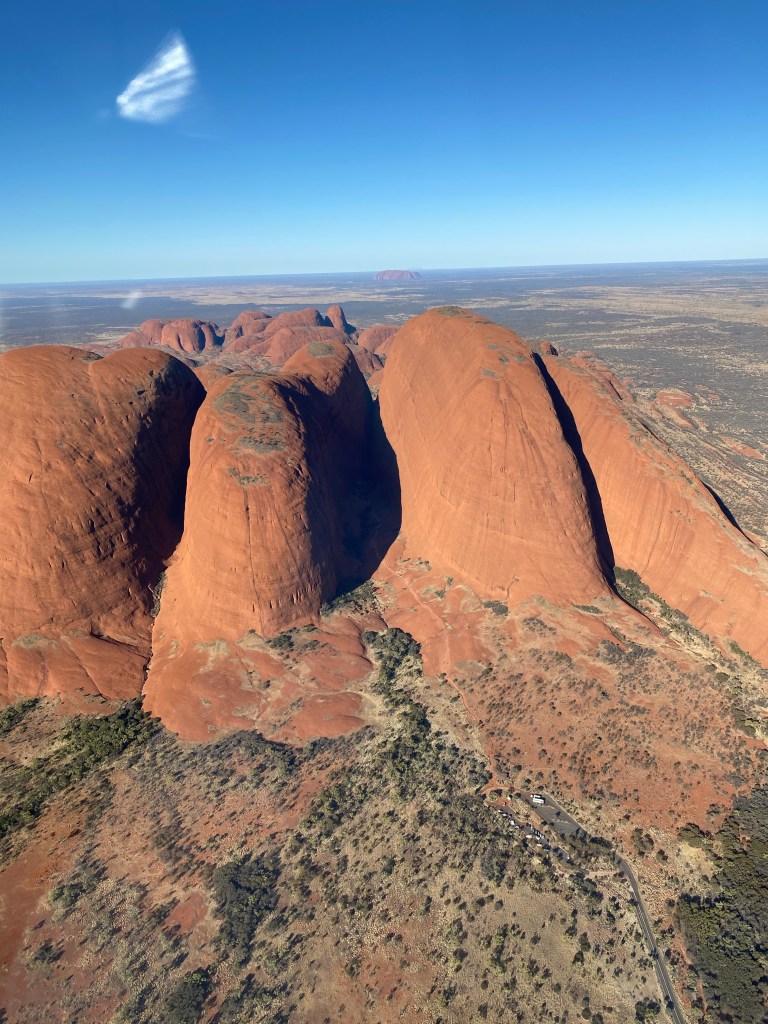
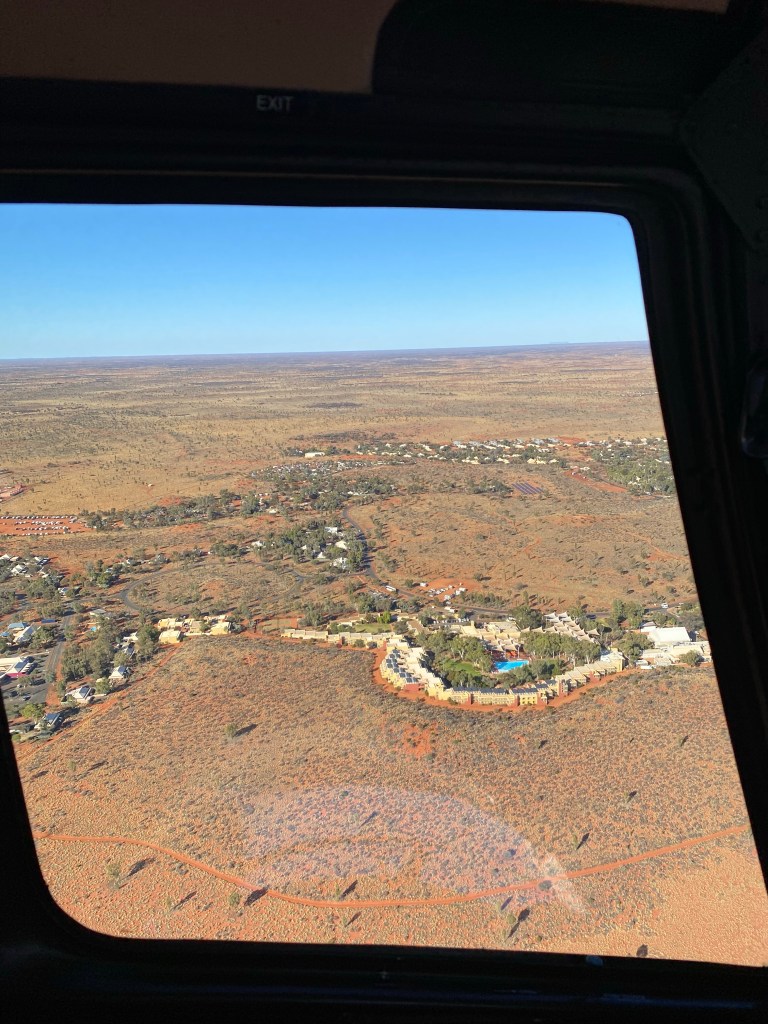
Richard and Katie came back from their helicopter flight over Uluru and Kata Tjuta with big smiles. Jay Crawford was their pilot and they declared he was an excellent pilot with a wealth of knowledge that he was happy to share while they were flying over these amazing places.

Jay was also very caring when one of them suffered from motion sickness and he took the helicopter higher up to smoother air. The whole flight was a memorable experience made even better by the pilot’s great, caring attitude. We gave him a great review on Trip Adviser and Facebook and we recommend Ayers Rock Helicopters.

One thing they learned whilst up in the air was that Kata Tjuta, Uluru and Mt Connor are all in a line, only some 2 degrees off being in a straight line. Uluru itself is 3.5km long and 2.5km wide and the body of the rock goes underground for some 15km. It is HUGE!

Kata Tjuta covers an area some 25km long and is made up of huge sandstone rocks. These are slowly being eroded over time. We will be checking out Kata Tjuta on a day trip tomorrow.

Katie hadn’t been in a helicopter before so it was a big tick off the bucket list for her. Check out the pics!

Wow, just wow. If you look in the distance you can see Mt Connor

Uluru cycling and spectacular sunset

Are we having fun at Yulara? You bet we are!

An early start was needed for our cycling around the rock adventure. We had to be out at the Cultural Centre at Uluru before our booking at 9am. We set off from the campground about 8.15am with our backpacks full of water and snacks. Sadly, we were without Katie though. She had a tummy bug and didn’t feel it would be a good idea to do the ride. We thought we’d ask when we got there if we could change the day for our booking.

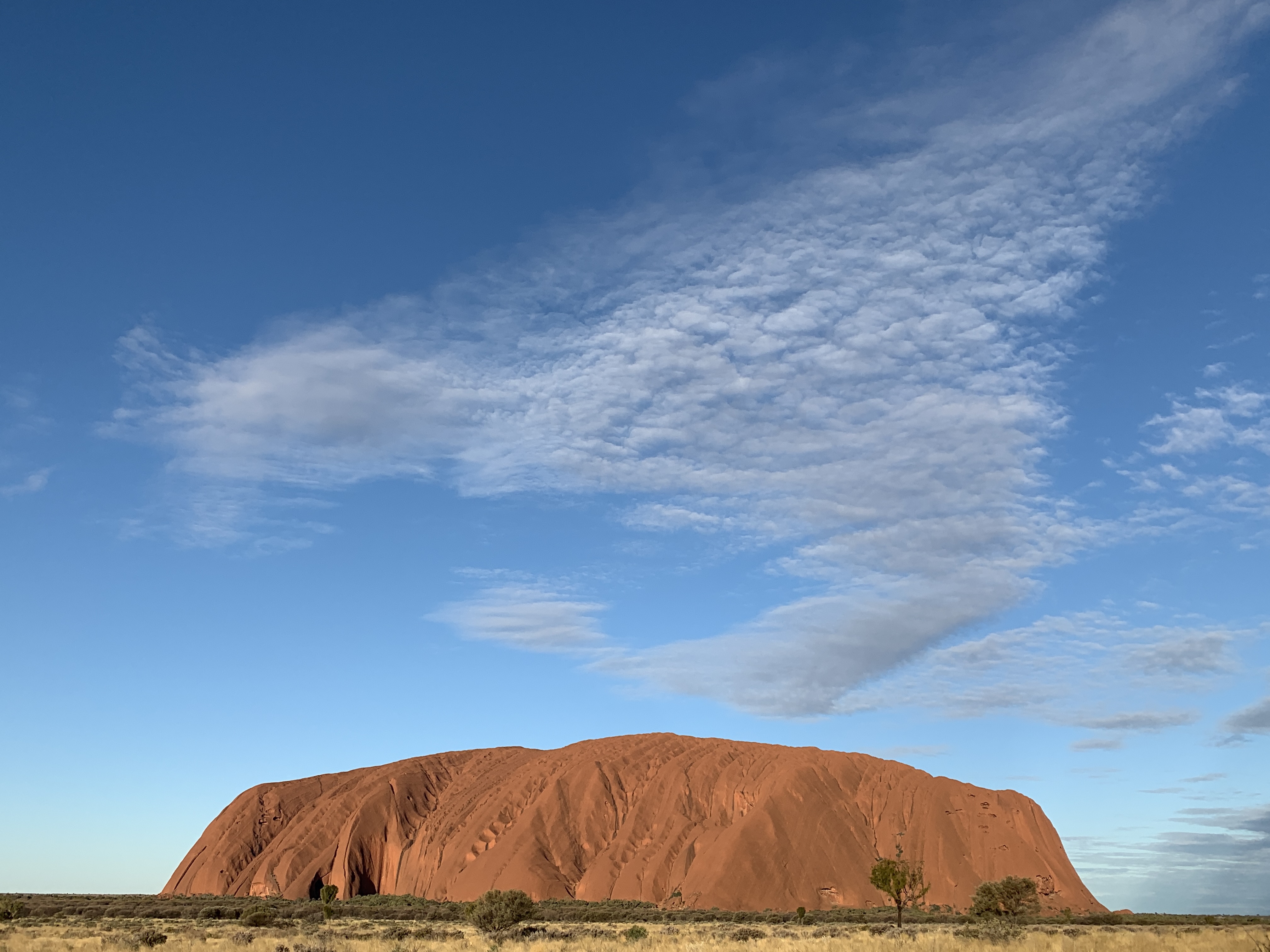
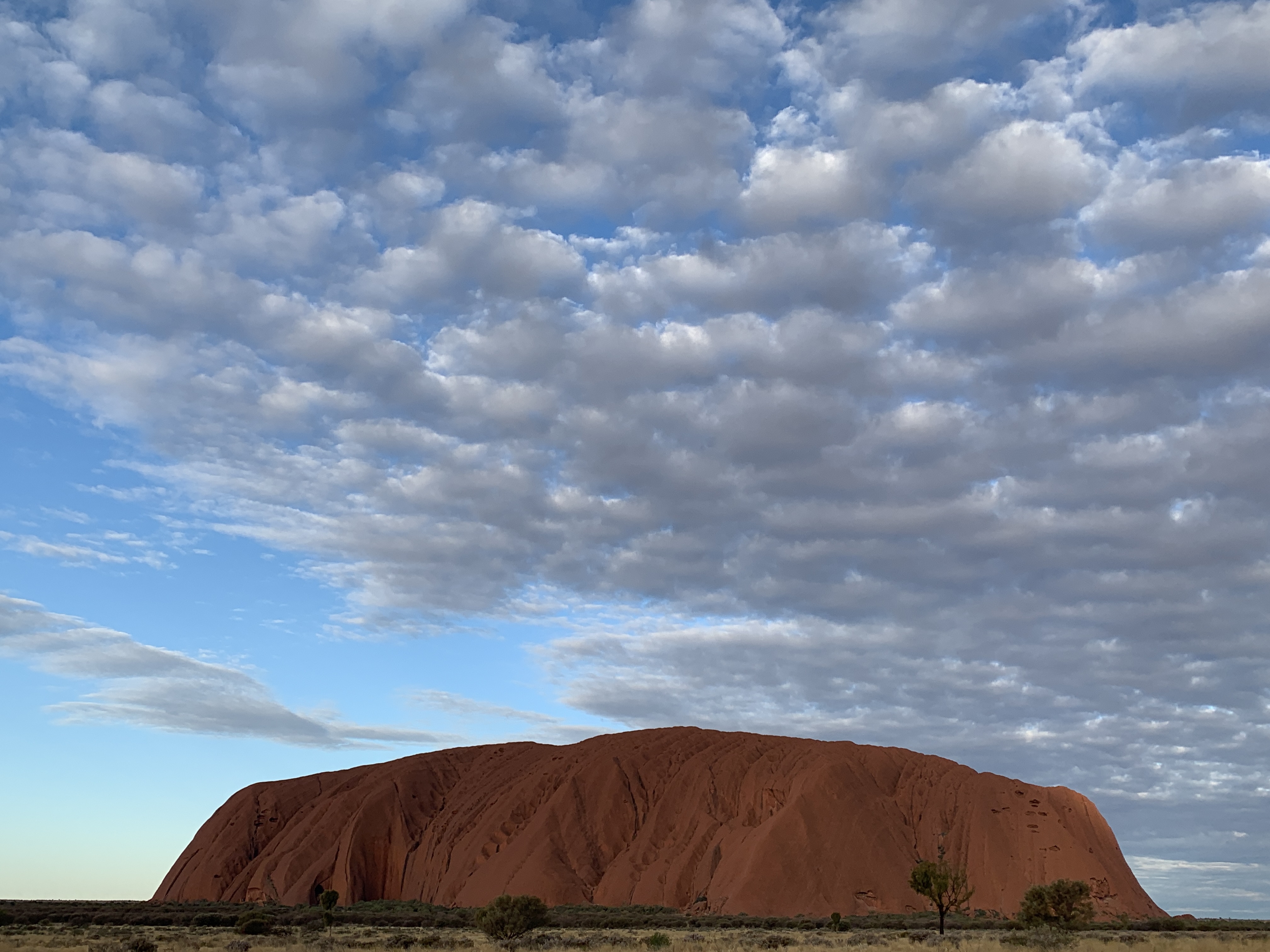
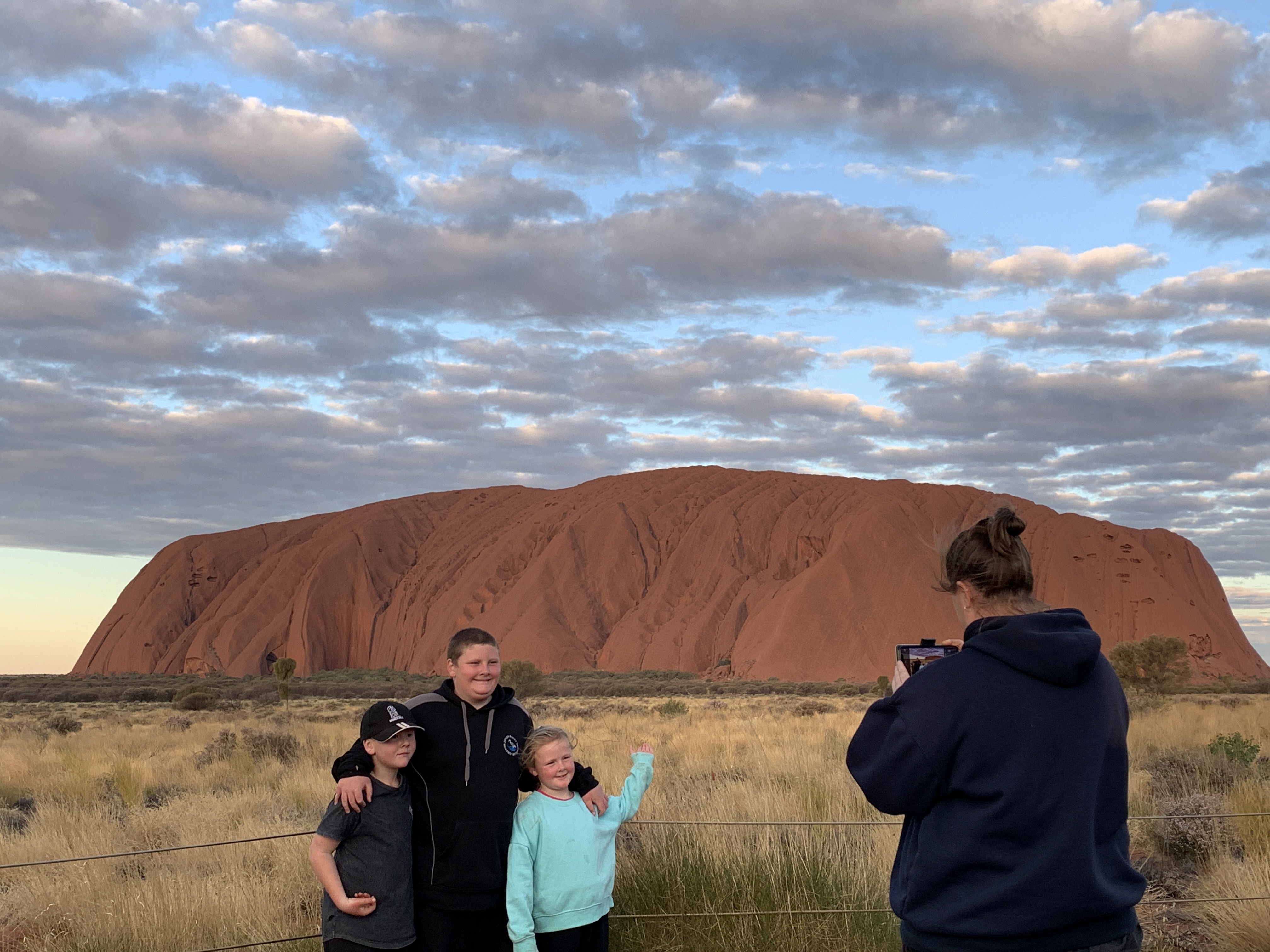
Heading out towards the rock early in the morning and the colour of the rock is very different. It looked really brown in the morning light.

Uluru early in the morning

We arrived in plenty of time and checked in at Cycle Uluru. We did ask if we could change our booking however they had no kids bikes available for any other day so we had to do our ride without Katie. Oh well, c’est la vie!

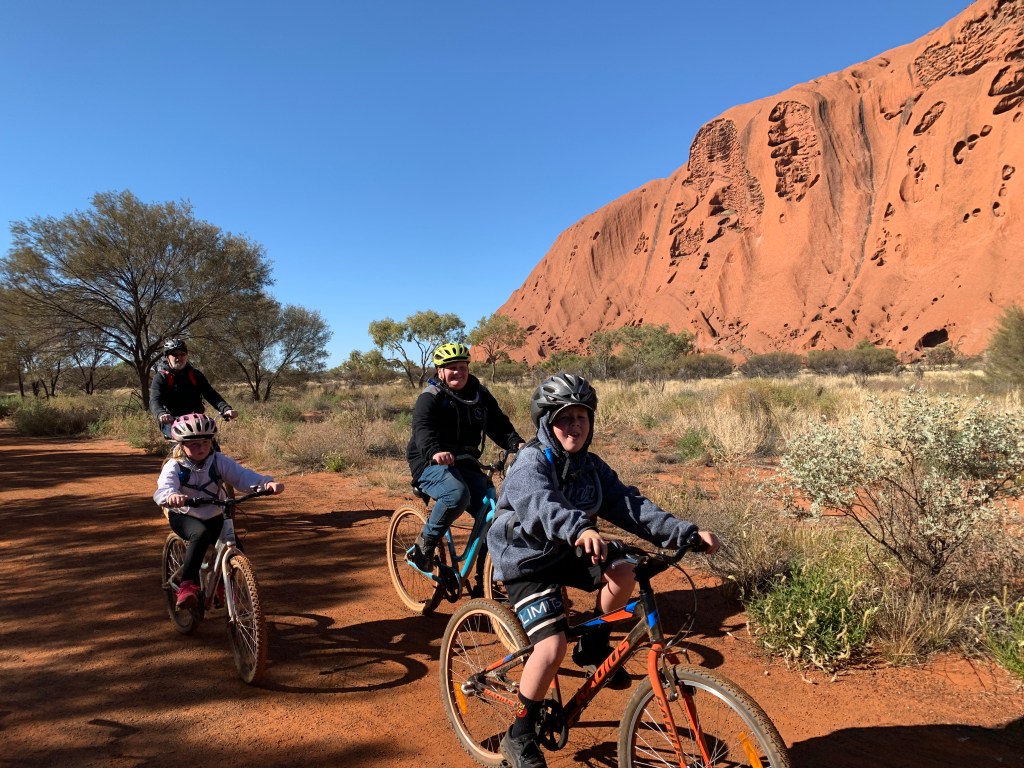
After choosing bike helmets and being allocated our bikes, a guide gave us a quick safety briefing and sent us on our way. Basically the safety briefing was there are two toilet blocks, one at The Cultural Centre and one at the Mala Car Park. Cyclists are to ride to the Mala Car Park then follow the cycling signs so you are going in an anti-clockwise fashion around the rock. All cyclists are to give way to pedestrians. That was about it!

We set off with three young people all very excited to be finally cycling around the rock. We’d talked about doing this for such a long time now we were actually doing it.

It was a chilly morning and the first part of our ride around was in the shade so it was quite cool. The kids were very excited when we arrived at a part where you could touch the rock. Actually touch it!

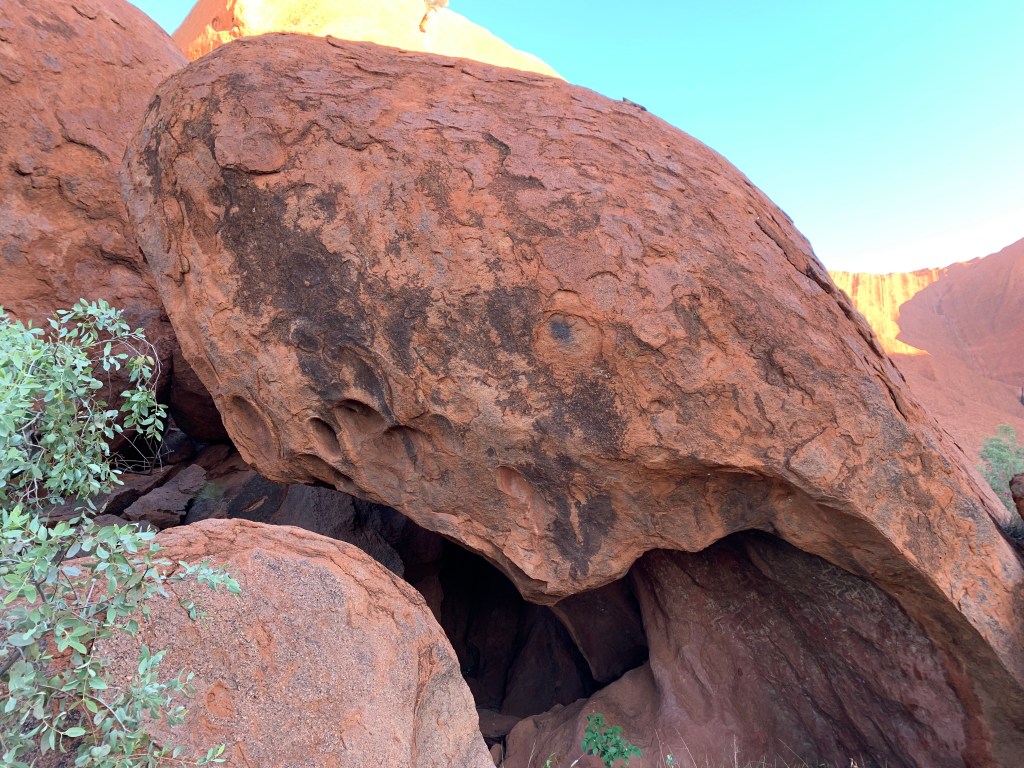
We stopped along the way to check out Muṯitjulu Waterhole, one of the most reliable waterholes around the rock. There are small caves there where Aboriginal men would have hidden while they kept their eye out for game that came to the waterhole to drink.

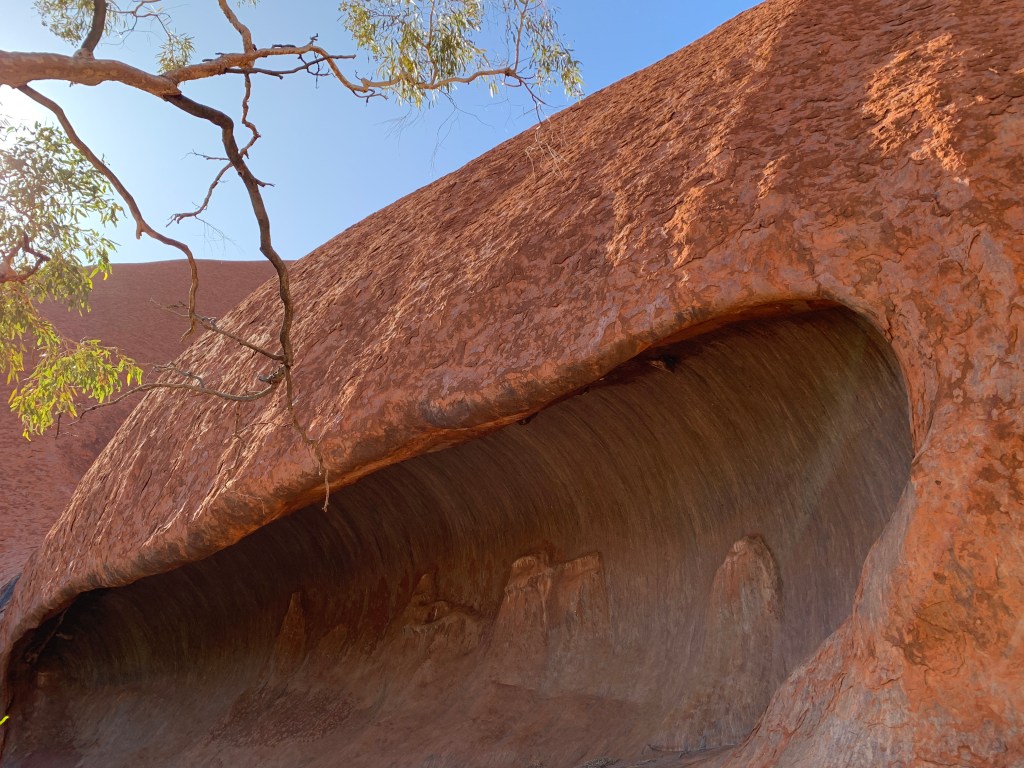
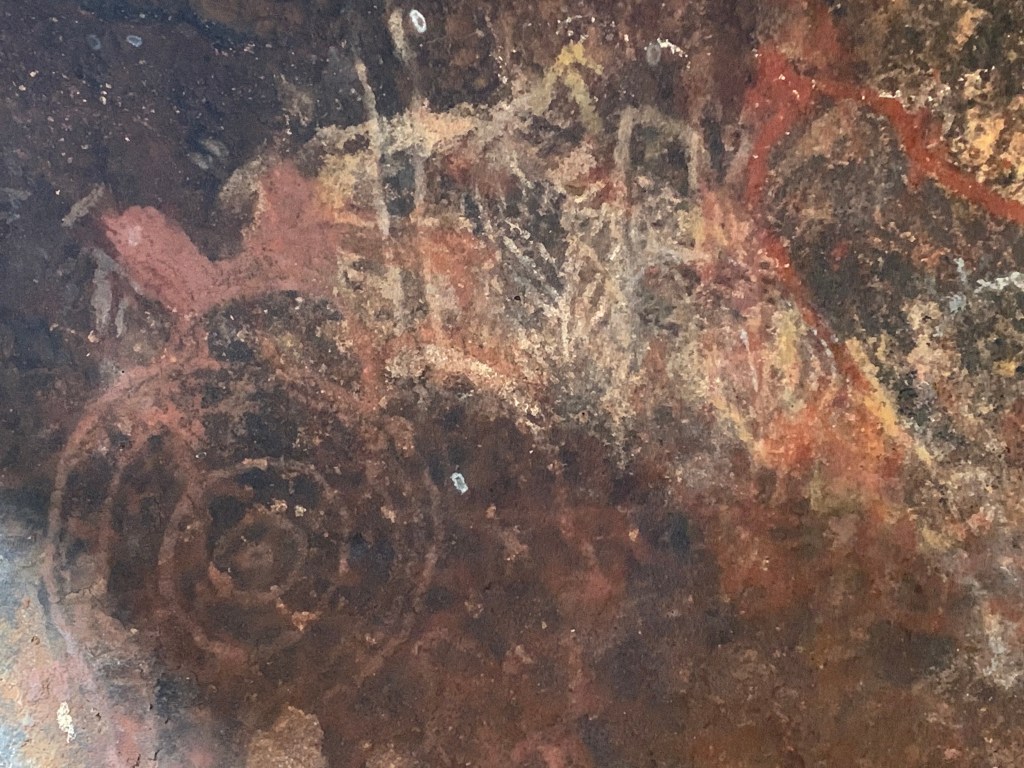
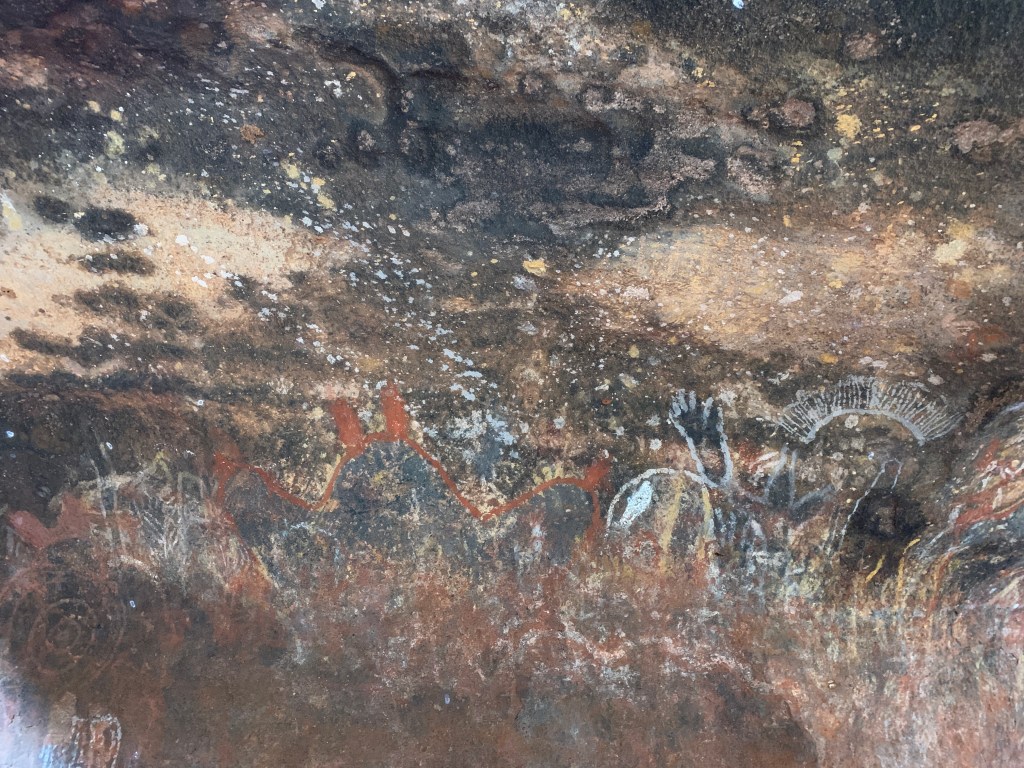
Further on we came to Mutitjulu Cave and checked out the old rock paintings. This would have been a place where people camped and used the rock paintings to tell stories. These stories are still being taught to young people to this day.

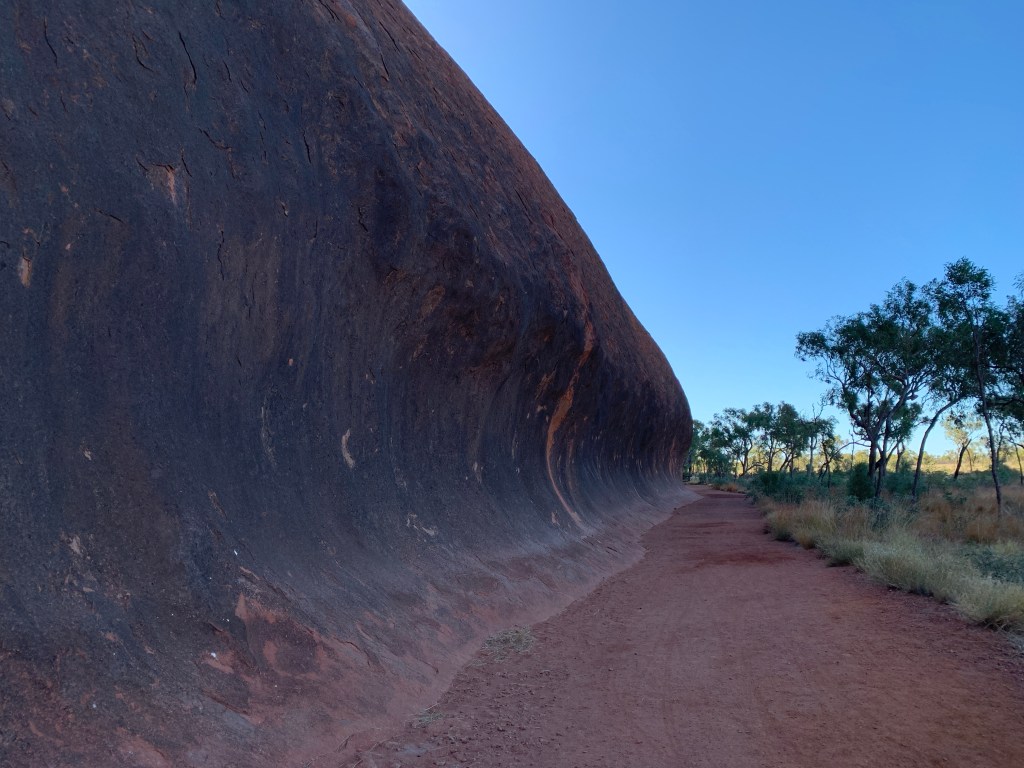
We stopped again at ‘wave rock’ and it’s a bit hard to tell from the photos just how big the ‘wave’ is.

The winding red gravel path is mostly wide enough for two people to walk side by side and follows around the edge of the rock for most of the way. By about half way around we finally came out into the sun and this helped to warm us up a bit.

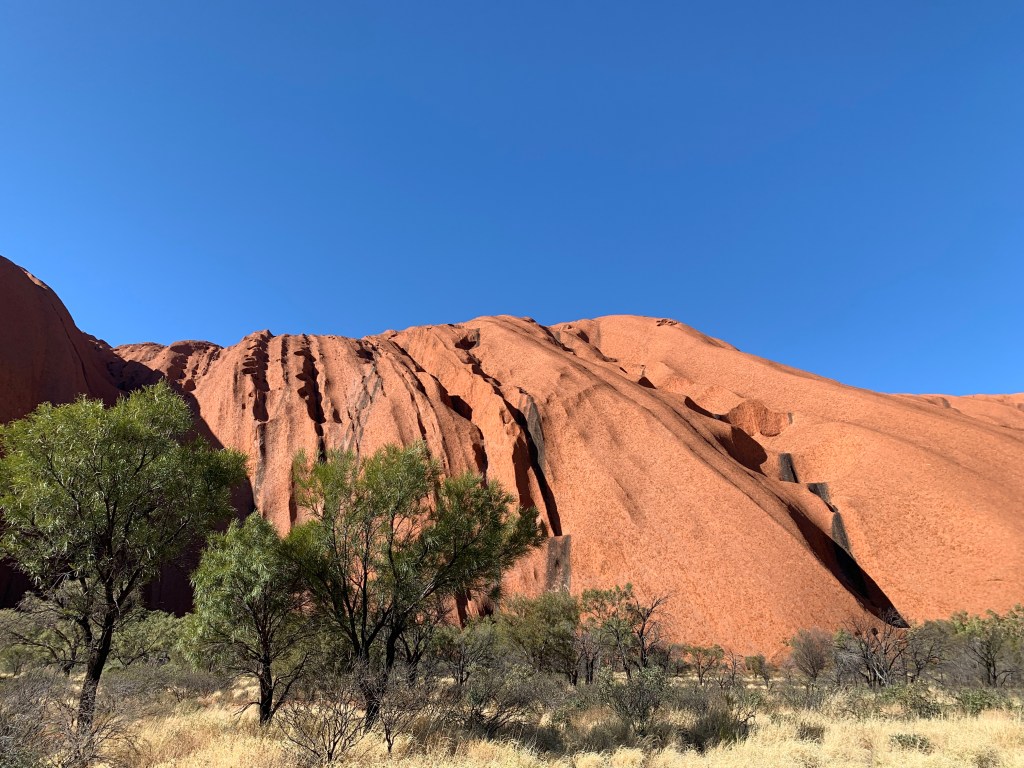
It’s very hard to describe how huge the rock is. At one point I stopped to take photos and the whole rock wouldn’t fit in. I tried doing a panorma but I’m not very good at those!

The Base Walk is 10.6km all the way around and we had three tired little people by the time we made it back to the Mala Car park. We’d done it! We’d cycled around the rock. It had taken us 2 hours. Not speedy I know, but we did stop a lot. You just have to stop to look at the rock and take it all in.

We made it!

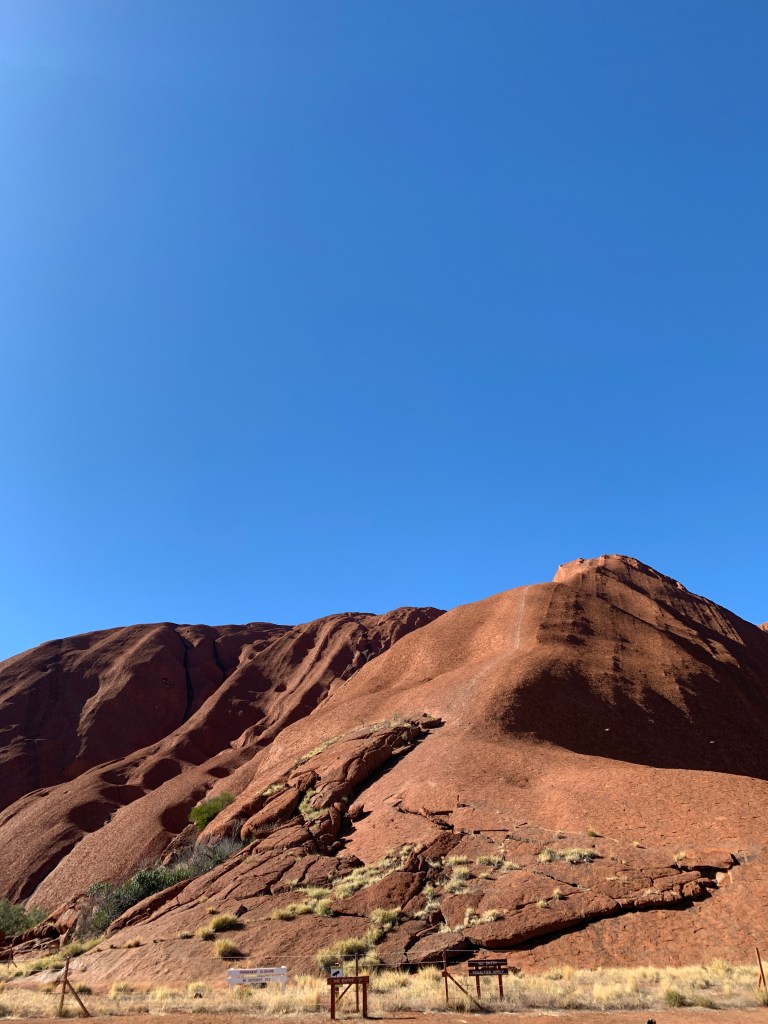
We enjoyed a well-earned 15 minute break at Mala Car park where there are lots of benches to sit on. Mala Car Park is the spot where people used to start their climb of the rock when it was allowed. Looking up at the track up the rock I really don’t see the attraction of climbing. It is very steep and looks so dangerous.

You can make out the faint trail where people used to climb the rock

We set off back to the Cultural Centre to deliver our bikes back to Cycling Uluru as our booking finished at 12noon. We made it with half and hour to spare. Our whole ride had taken us 2 1/2 hours and we’d done 15km in total.

It was a quick process to deliver our bikes and helmets back and then we headed in to check out the Cultural Centre. The Cultural Centre houses a souvenir shop, a cafe, an Indigenous Art store and an Art Gallery. Rich bought the kids all an ice cream and while they sat and ate those I checked out the art. The Indigenous Art Store has lots of paintings and wooden artefacts for sale, all made by local artists.

The Art Gallery is well worth a look as it houses superb examples of the famous dot paintings. Four lady artists were working on paintings and they are amazing to watch. The attention to detail is incredible. Those large dot paintings are so time consuming to paint dot by dot. No wonder the prices in the gallery ranged from $3,000 to $23,000. I didn’t buy one!

The kids were all keen to have a look at the artists at work so we carefully walked into the gallery so they could watch. They were all very impressed by the workmanship involved.

Our tired little group piled back into the car and I think a couple of them nodded off on the way back to camp. We arrived back to a spotless camp. Katie had been cleaning! Fortunately she was feeling a bit better.

We spent the afternoon napping, watching movies, people watching (we’ve got new neighbours) and blogging. Not sure about one of our new neighbours. You should see how they’ve parked their van. It’s on such an angle I don’t know how they’ll be able to sleep in it.

Around 4.30pm we loaded our chairs, table and picnic rug into the car along with some drinks and nibbles and set off back out to the National Park to watch sunset on the rock. To enter the National Park all adults must buy a ticket. You can purchase them online. It costs $38 for a three day pass or you can purchase an Annual Pass for $50. Children are free. As we were going in and out for 6 days we purchased Annual Passes for Rich, Katie and myself. When you reach the park boundary there is a ranger station. If you have a pre-purchased pass you can enter via the left lane and here you scan your pass and the boom gate opens. Those without passes have to enter the queue in the other lane and purchase tickets from the ranger before they can enter.

The Sunset Viewing car park is in the perfect spot to get the best views of the rock as the sun sets and it pays to get there early as the spots fill up quickly. We found a great spot with room in front of the car for our chairs and table. We had a lovely man and his two girls from Sydney on one side and another lovely man and his two girls also from Sydney on the other side.

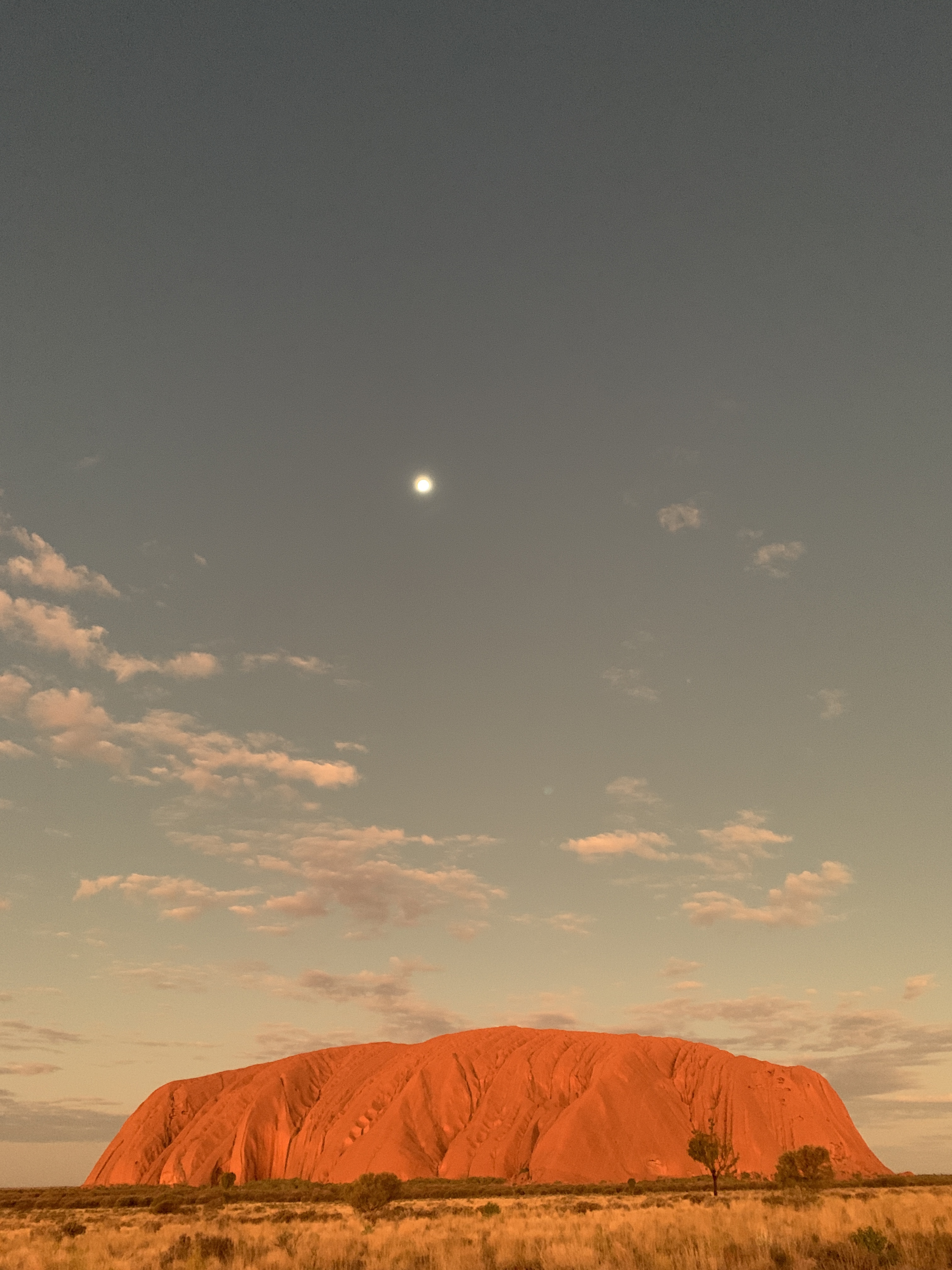
Watching the sun set on the rock is incredible, amazing and very moving. I took so many photos. Here’s a few.

We all had such a great time and stayed out there until we were almost the last car to leave. What a fabulous evening and one I’m sure we will all remember for a very long time.

Exploring Yulara and we ride camels

Yulara is an interesting place. It is basically a big resort with multiple hotels and apartments as well as the Campground. The resort caters to all budgets from the top end at Sails in the Desert to basic tent camping for bus groups. Visitors can fly directly to Yulara as there is an airport or you can fly to Alice, pick up a hire car, camper or motorhome and drive to Yulara. This seems to be a very popular option as we’ve seen many rental campers and motorhomes since we left Alice.

The resort has a Town Square and it is here that you find the shops, Post Office and IGA Supermarket. I was surprised at the supermarket. It holds quite an extensive stock of supplies including meat, fresh vegetables and bread. We would be able to stock up again before we left to go to Kings Canyon.

We spent an hour or so wandering around the shops and then settled in the square to listen to the Didgeridoo Workshop. Ben was chosen to be a didge player along with a few other men and boys. Maddie put her hand up to have a go but was told politely that, culturally, only men and boys play the didgeridoo.

We spent the next hour watching the men and boys learning to play and listening to the didgeridoo. It is a fabulous sounding instrument and we learnt that didge players are really singers and use their body in the same way that singers do to produce the sounds. A really good didge player has to practice often and keep their vocal chords in good shape just as singers do.

We also learnt that didgeridoos can be in a certain key and they are basically an amplifier for the voice of the player.

Ben and his didge

We bought a couple of hot chooks and salad from the supermarket and headed back to camp to have lunch and prepare for our afternoon camel ride.

We had to be at the Campground Bus Stop by 1.44pm to be collected by the Uluru Camel Tours bus. We were ready and waiting when the bus pulled up.

Waiting at the bus stop

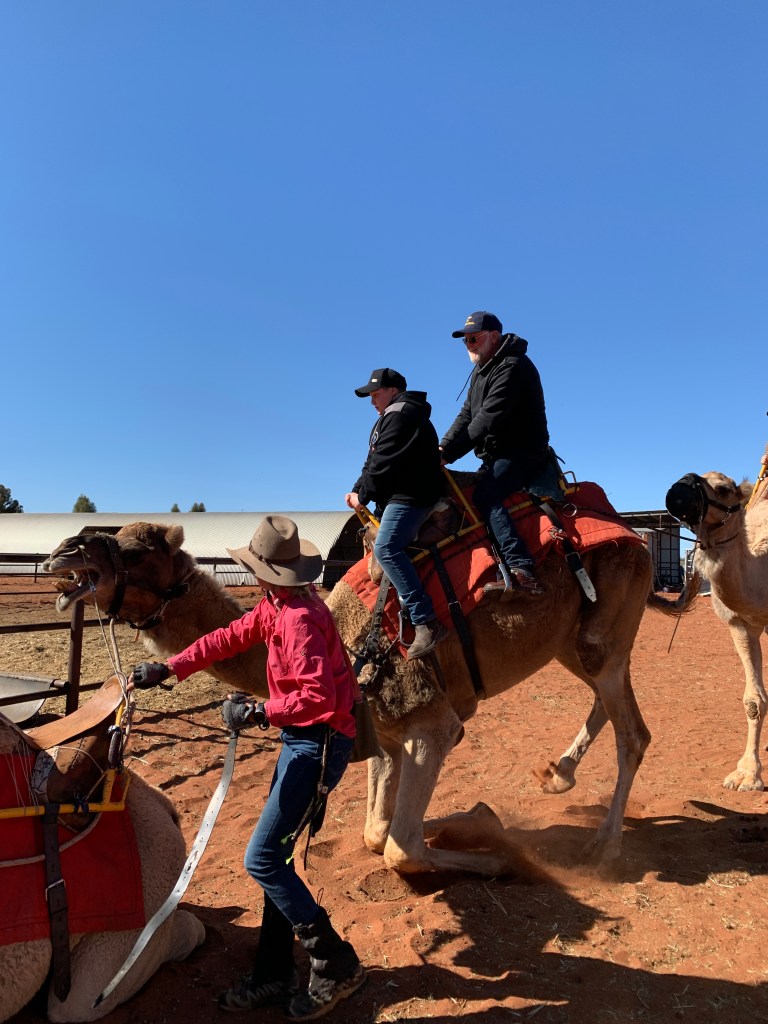
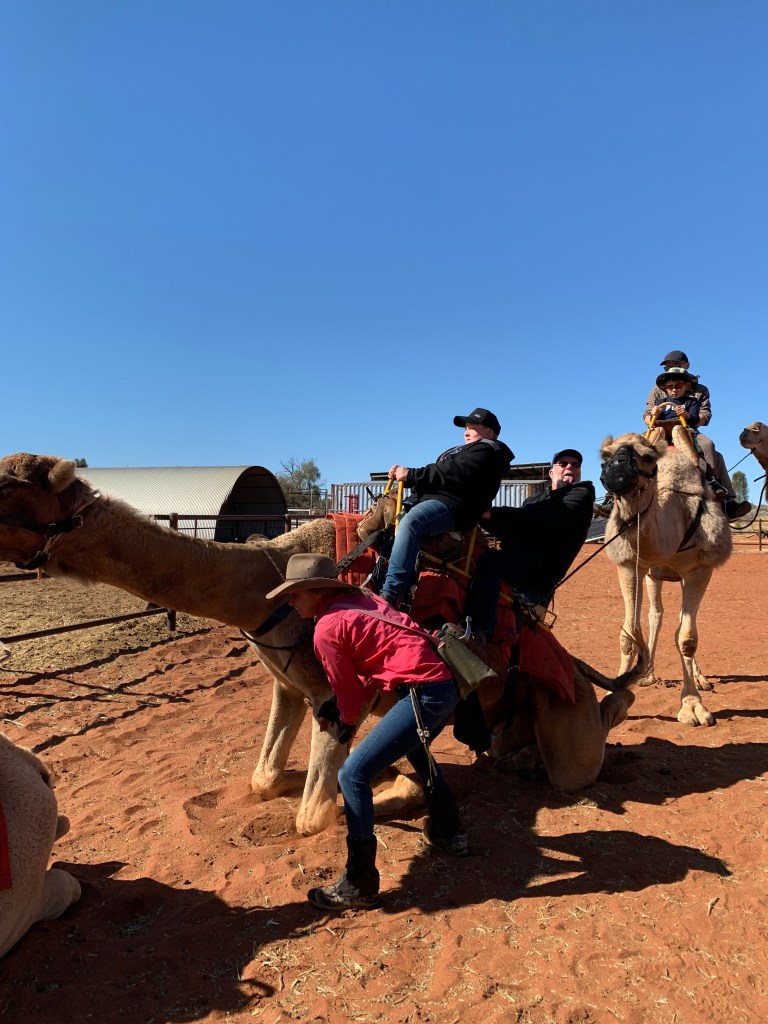
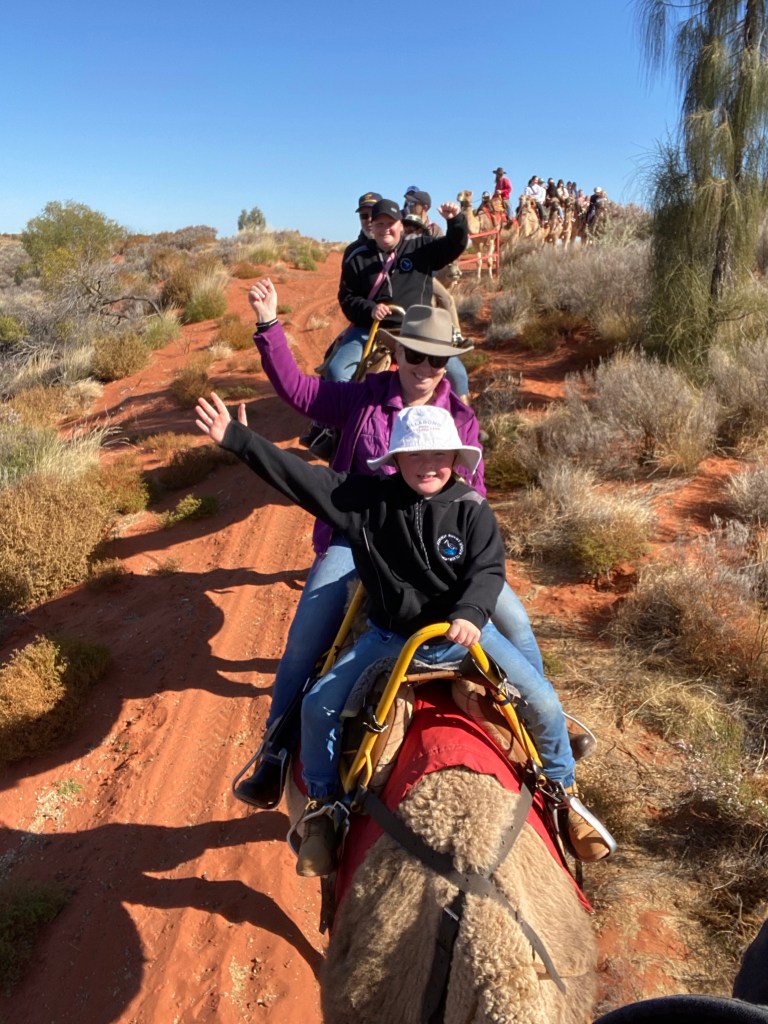
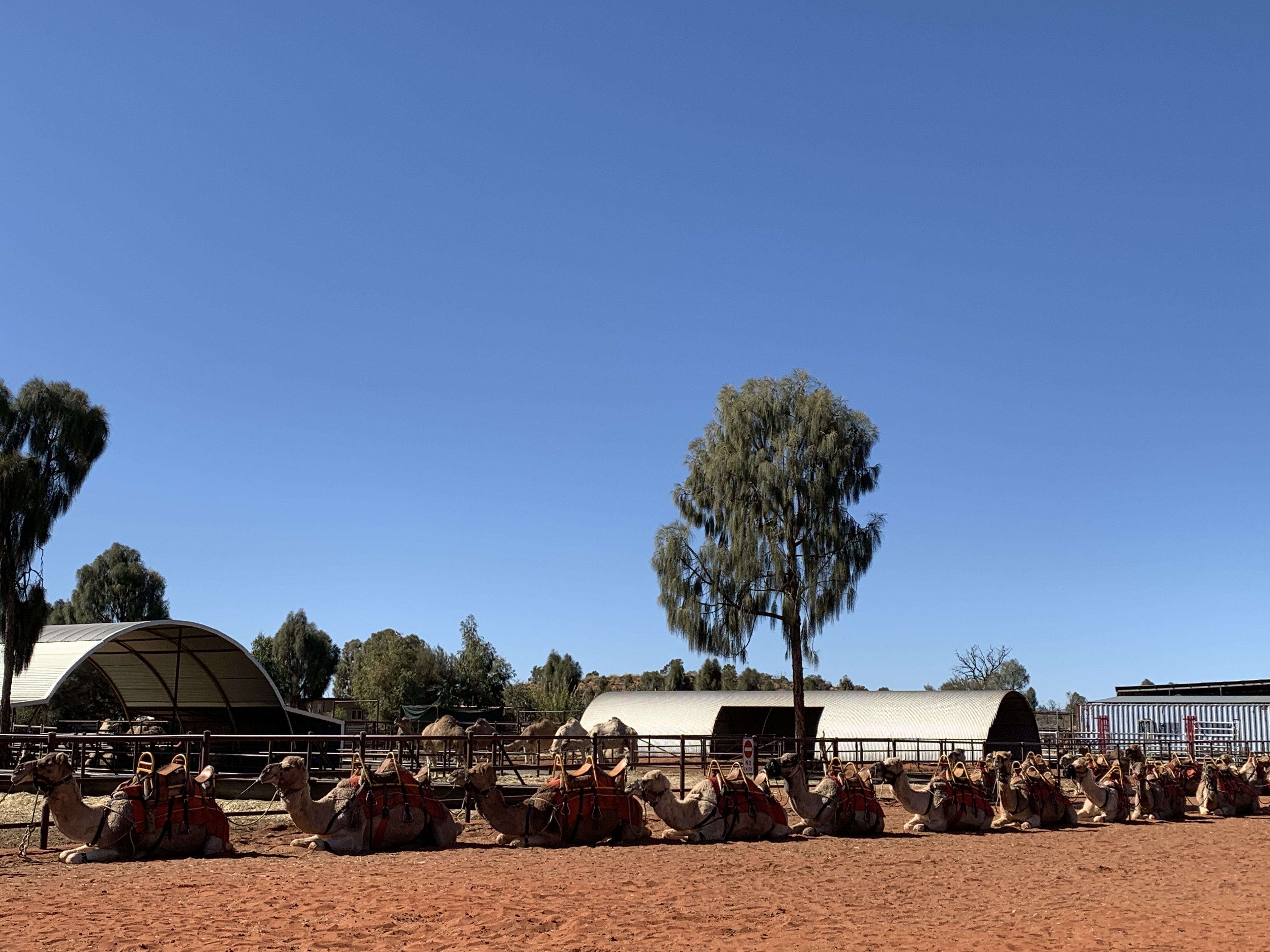
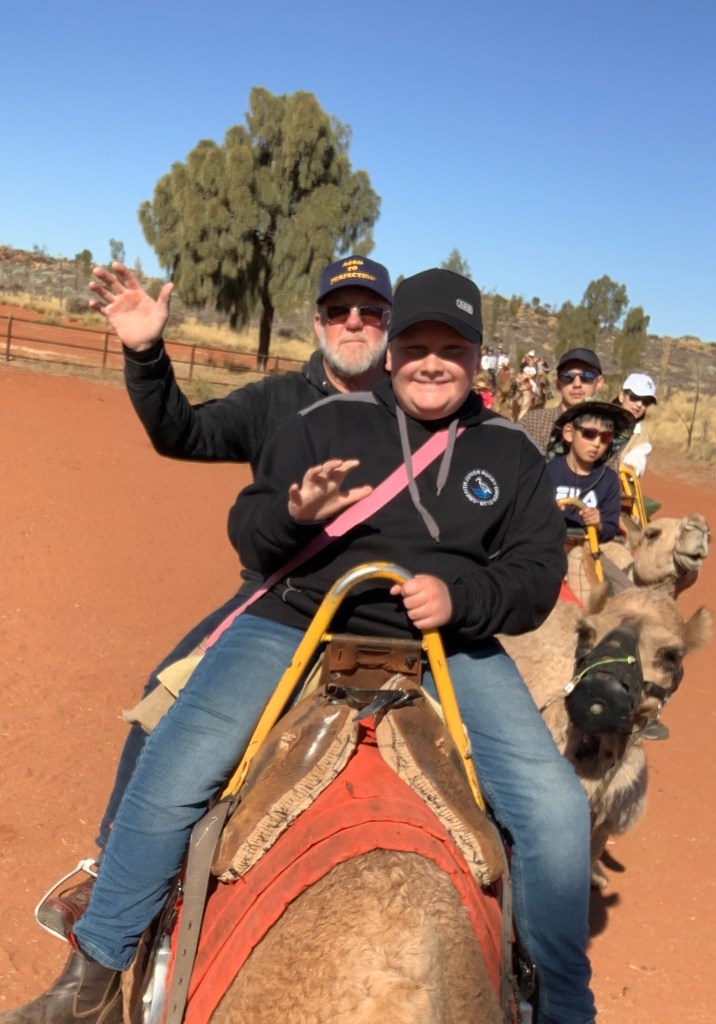
It was a short drive out to the camel farm and here we were given a safety briefing and told a little bit about what to expect on our ride. Then we were led out to where our saddled camels were waiting. They were all sitting on the ground and didn’t look so big. The saddles are all for two people so Maddie rode with me, Ben rode with Katie and Riley rode with Pa.

We had another family of three with our little group and they all managed to get on and their camels stood up with no problems.

Riley and Pa were next and were helped onto their camel, Archer, with Pa on the back and Riley at the front. The look on Riley’s face as the camel stood up was priceless. He looked absolutely terrified but once Archer was standing he relaxed.

Maddie and I were next and we managed to get on with no trouble but then our camel, Curly, started to stand up and Maddie lost it. She was scared, sobbing and shaking. I managed to calm her down and held on to her until she got used to be up so high. And it is up very high off the ground! It didn’t take long before she relaxed and enjoyed the ride.

Katie and Ben were next and they managed to get on and their camel, Jed, very calmly rose up to standing with both Katie and Ben hanging on tight.

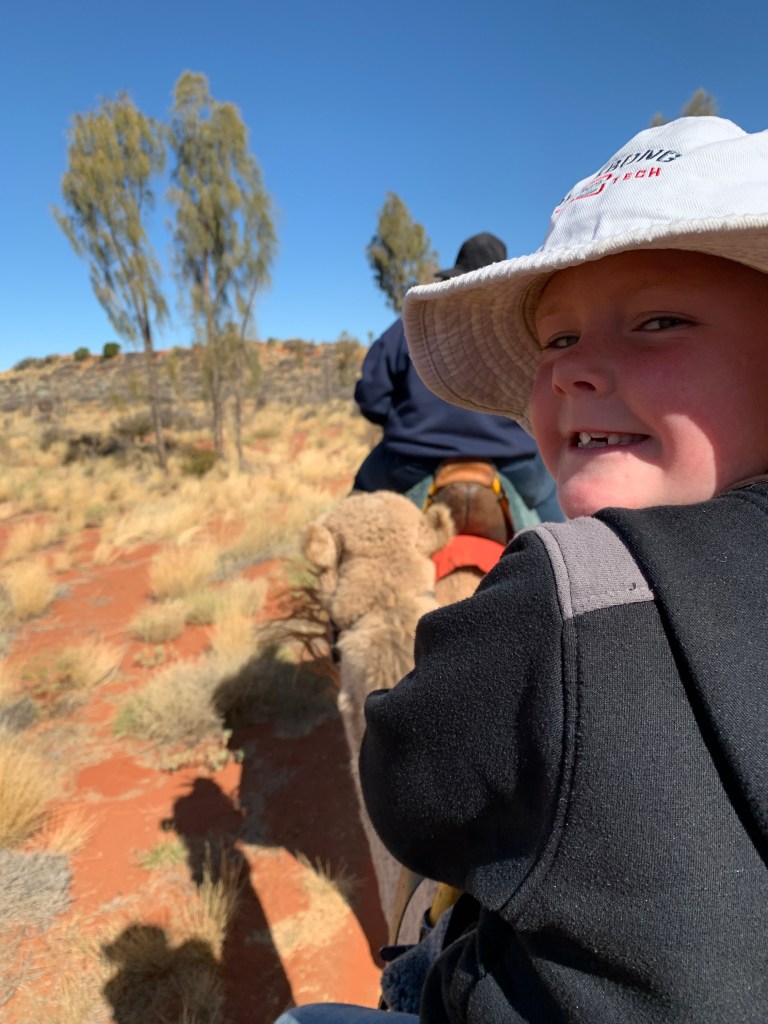
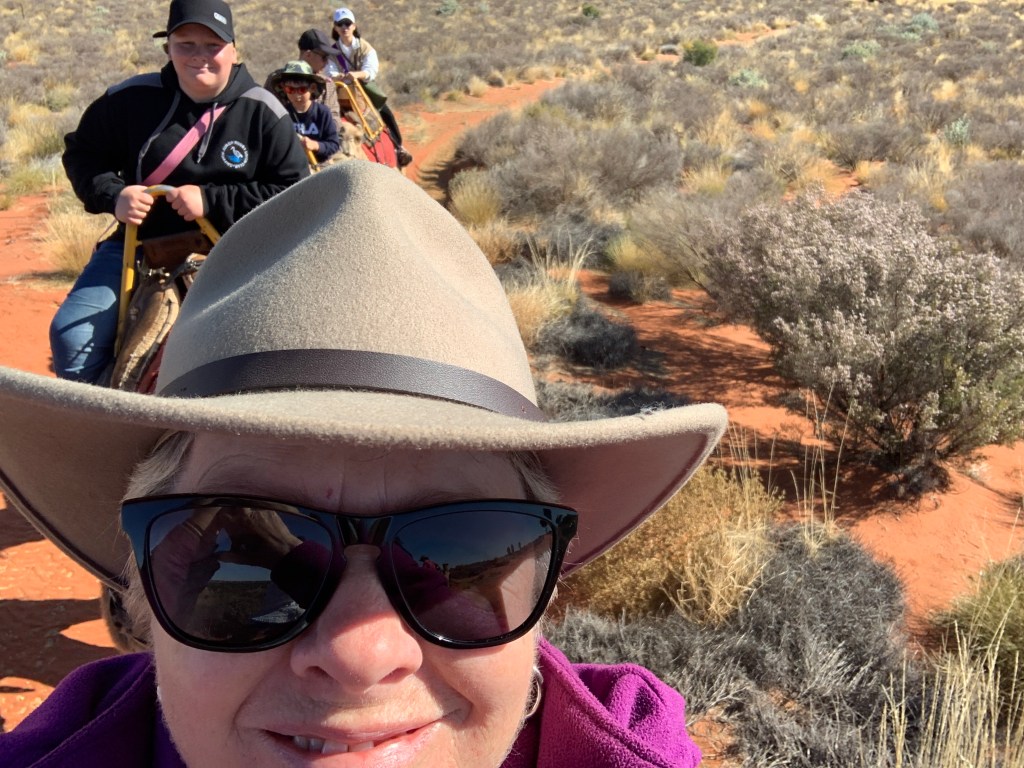
Our guide, Tracey, rode the lead camel, Jonny, and once she was sure we were all ready we set off. It is NOT like riding a horse. The gait of a camel is completely different to any horse I’ve ever been on however, if you’ve ridden a horse, you soon get used to the movement of the camel.

Tracey led us out into the desert towards Uluru telling us lots of information along the way about camels and how they came to be in Australia, how they’ve been used as transport and cargo carriers, and fun facts about the camel.

The camels we were riding were one humped (Dromedaries) camels. The ones with two humps are called Bactrian camels. The hump is actually a big lump of fatty tissue that the camel uses to regulate its body temperature. It stores heat in it during the day and releases it at night when it’s cold. They also have very large veins running down their powerful back legs and, to keep cool, they urinate on their legs. As it dries this helps to keep them cool.

Camels have three stomachs and they can digest almost all the plant life we could see around us in the desert as we walked along. They chew their cud just like cows do. A camel burp is the most unpleasant smell because it comes from food being digested for days. Ewwww!

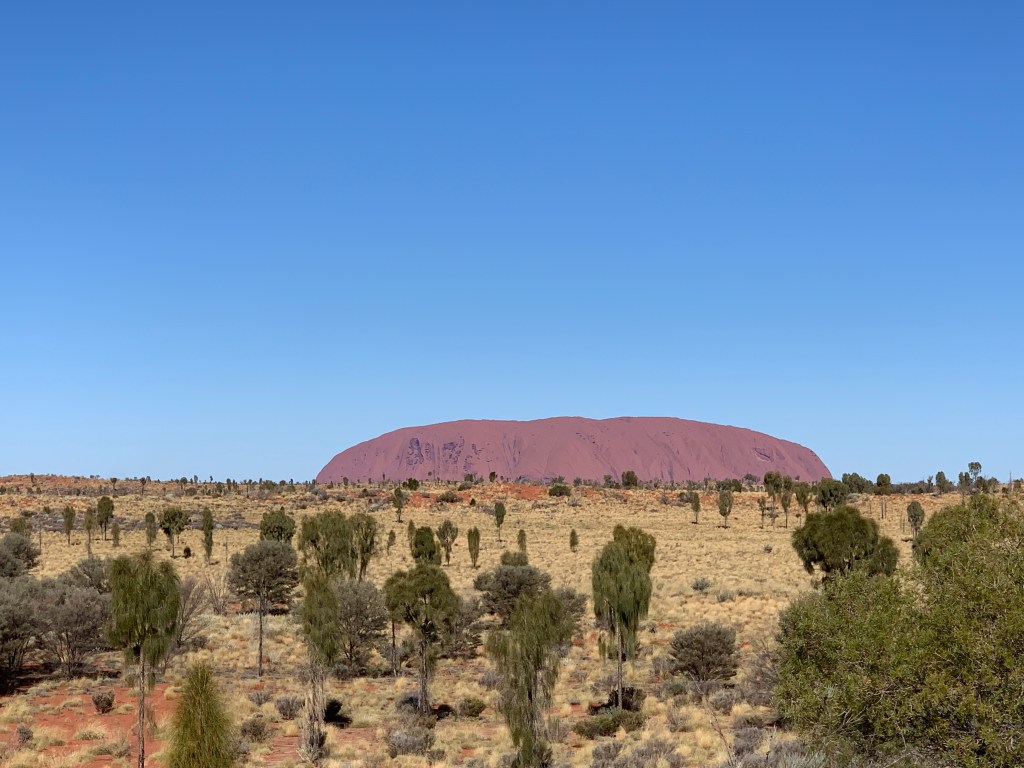
As our little group went over a sand dune we had a great view of the big red rock. Tracy stopped us all there so we could get great photos of us all on our camels with the rock in the background.

All our kids asked lots of great questions of Tracy and she was more than happy to answer them. We learned that camels can drink 150-200 litres of water in one go. Full grown male camels weigh between 800kg to over 1 tonne and they can carry up to 50% of their body weight. So a one tonne camel like Archer can carry up to 500kg. That’s incredible. Not wonder they were used in the outback for so long as beasts of burden.

All the camels used by Uluru Camel Tours are castrated males that have been caught in the wild and trained to take tourists for rides. These camels can do this all day without getting tired. The owner and his crew recently did a camel roundup on a nearby property and caught 270 camels. Wild camel numbers in Australia are an estimate only and it is reckoned there are over 1 million of them roaming the deserts of the inland.

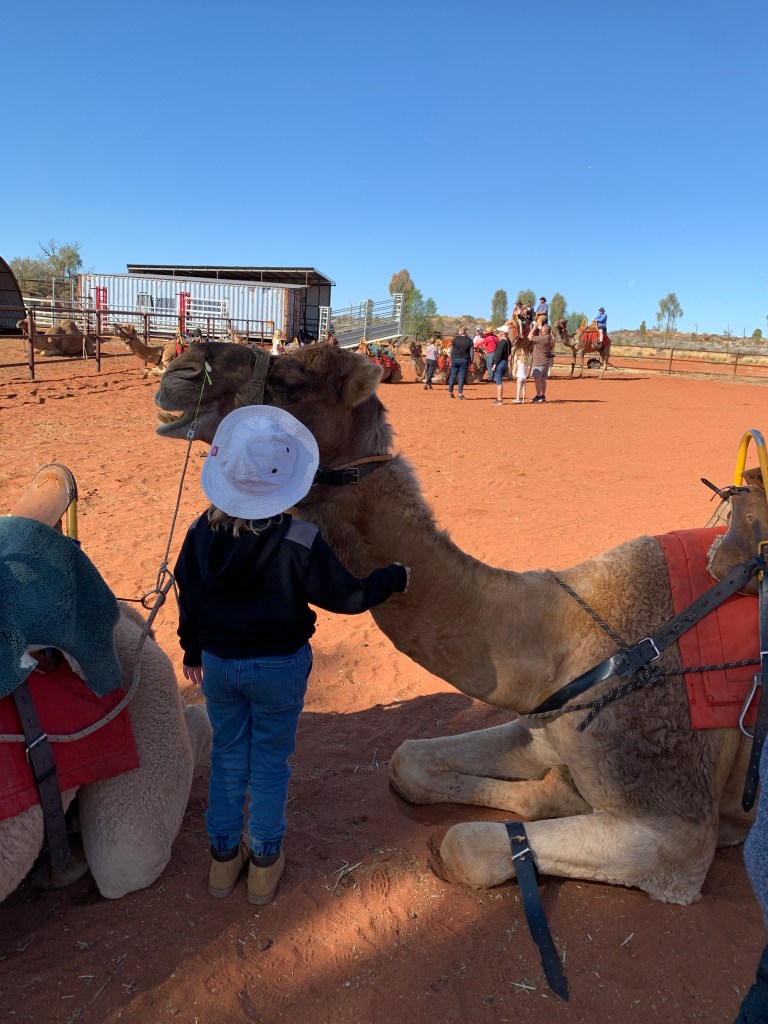
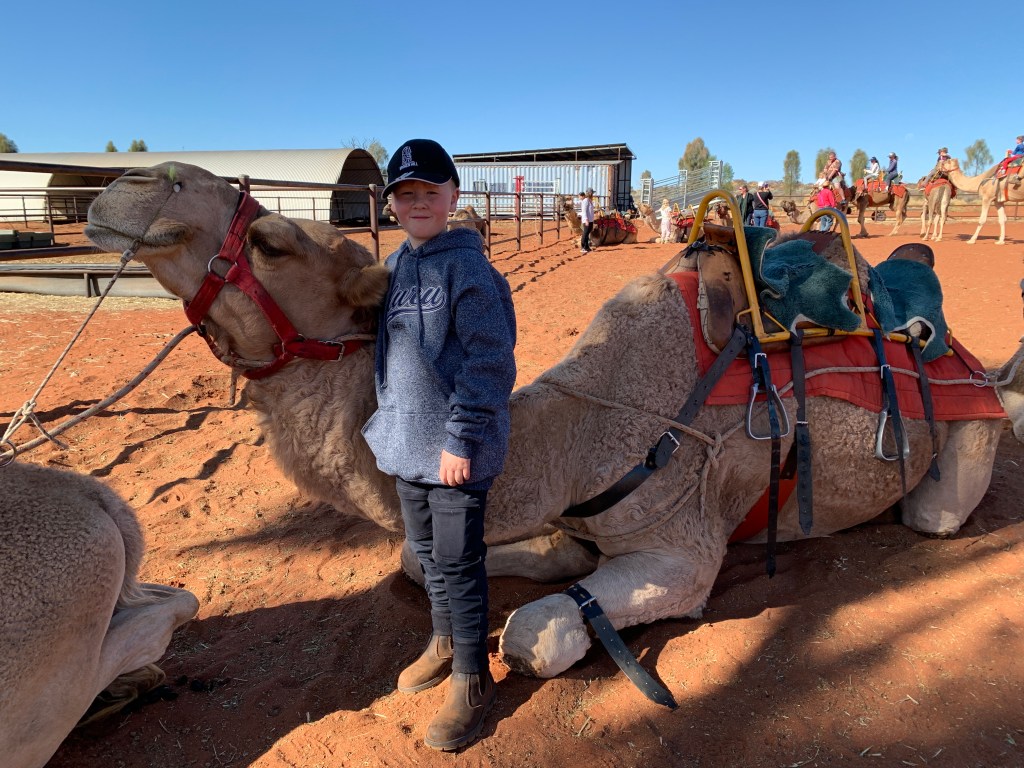
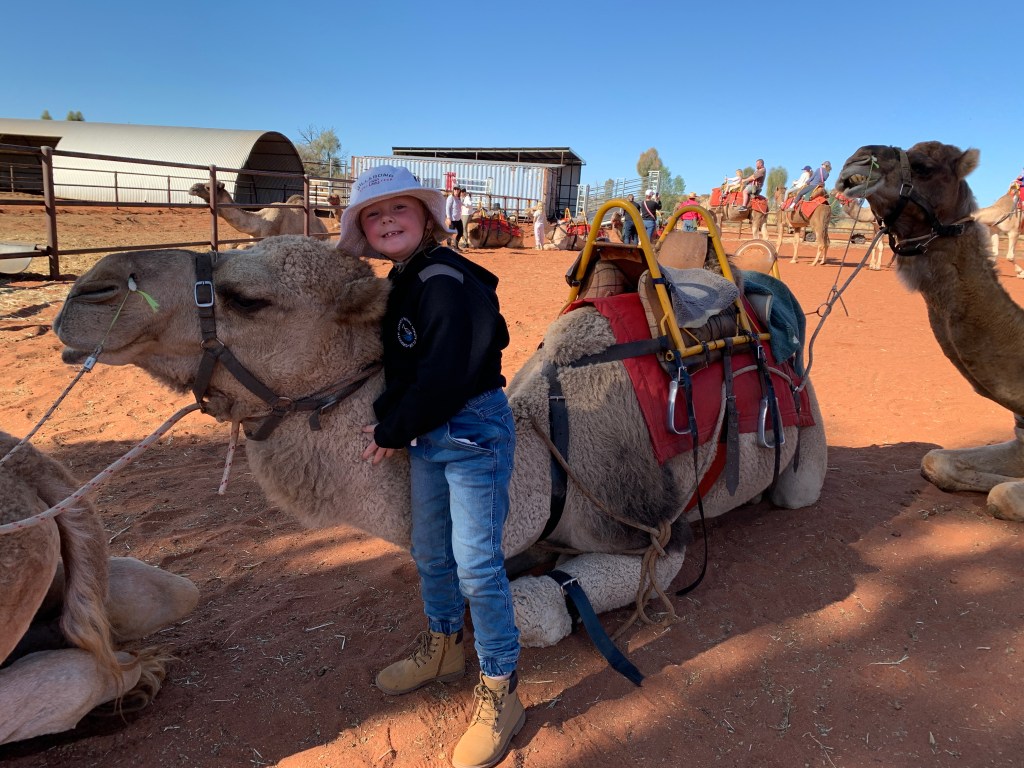
Our 45 minute camel ride was over in no time and we’d all thoroughly enjoyed the experience. Maddie declared it was great fun and the camel getting down was much better than when it got up. Our camels all obediently got down so we could all dismount easily. The camels were happy for us to give them all a pat and even seemed to enjoy a scratch on the ears. They are truly amazing animals.

What a fabulous experience and one I’m sure we’ll all remember for a very long time. We definitely recommend this one to families. Such a fun thing to do.

The camel farm has a petting zoo with farm animals and the kids were keen to have a look. Our bus driver was happy to take the other guests back and come back for us to give us extra time.

Eventually we had to say farewell to the camel farm and our happy bus driver, Dan, took us back to the Campgound on the little bus.

It was my turn to cook and I did a lamb roast in the Weber and my little oven. It was delicious.

Everyone was off to bed early as we had to be up early the next morning to do our cycle around Uluru.

Happy campers after a lamb roast

We arrive at Yulara

A lovely sleep-in was had at our overnight free camp at Petermann Rest Area. I cooked up scrambled eggs and bacon for everyone and, judging by the way no one talked during breakfast, they were enjoyed by all.

After packing up we set off on our final leg to Uluru 120km away. We passed Curtin Springs, a one million acre cattle property that has really embraced tourism. They have a roadhouse, camp ground, do tours to Mt Connor and even have a paper making factory where paper is made from the local grasses. The camping area looked very busy and the vans were parked quite close together. I think we chose our overnight camp really well. We were the only ones there to start with however a couple of motorhomes came in and then three vans and a couple of campers. There was plenty of room for everyone to spread out.

We all chuckled in the morning as they had all left before we all got up!

Not long after passing Curtin Springs you get your first glimpse of Uluru in the distance. OMG it is HUGE. There was lots of excited chatter over our UHF’s with everyone thrilled we were finally nearing the famous Aussie icon.

As we approached Yulara I checked the map of the area and discovered there is only one dump point in Yulara and it is out of town near the water treatment plant so we decided we’d better head there first before going to the campground. Here we came across our first queue. Luckily there were only two in front of us.

After that necessary business was complete we headed into Yulara. Yulara is the name of the town/resort that is the closest to Uluru (Ayers Rock) and Kata Tjuta (The Olgas).

We made it to Yulara

We pulled into the Service Station to fuel up prior to camping and Katie drove into the Campground to get in the queue. After fuelling up we were able to pull in behind Katie in the queue. I think I counted 5 vans plus us in the queue so not too bad.

Entering reception we found a long queue of people most of whom were checking in like us. We felt sorry for one guy as he was waiting only to get some $1 coins for the dryers.

It wasn’t a very long wait. The three staff seemed to be doing their best. We were allocated our powered sites and given a map of the park. We were also given a Campground Pass that you have to carry with you if you wish to enter a licensed premises at Yulara. Only genuine guests at the resort may be served alcohol.

How disappointed we were when we arrived at our allocated sites. They were right out the back on red sand and there were bollards on both sides of both sites which meant we wouldn’t be able to put our slide out and awnings out. There was also no water tap. There was power however this would not do for 6 days. We’d booked sites so long ago with power and water.

It’s hard to express how disappointed we all felt. We’d been planning the trip for so long and we were so looking forward to getting to Uluru. What to do?

We set off to walk back through the campground passing by other sites and I made note of which ones were free and would suit us. Back at Reception and the queue was just as long as before. I noticed that the lady that served us before was free and I quickly walked over to her and explained that the sites were too small for us AND they had no water. That would be OK for a couple of nights but not for 6. Katie said I did get some glares from people waiting in the queue. The assistant was very helpful and tried her best to find another site for us. Eventually her senior came over to see what the problem was and when we explained she was also helpful and said it might take a while to juggle around other bookings but she would try her best.

Yay! she was able to give us the vacant sites we’d seen on our walk to reception. We were very happy with that! What a great outcome. It pays to be nice and friendly. I explained to the kids on the way back ‘You catch more flies with honey’. By being nice and friendly we achieved the outcome we wanted. The original small sites would be more suitable to a camper trailer.

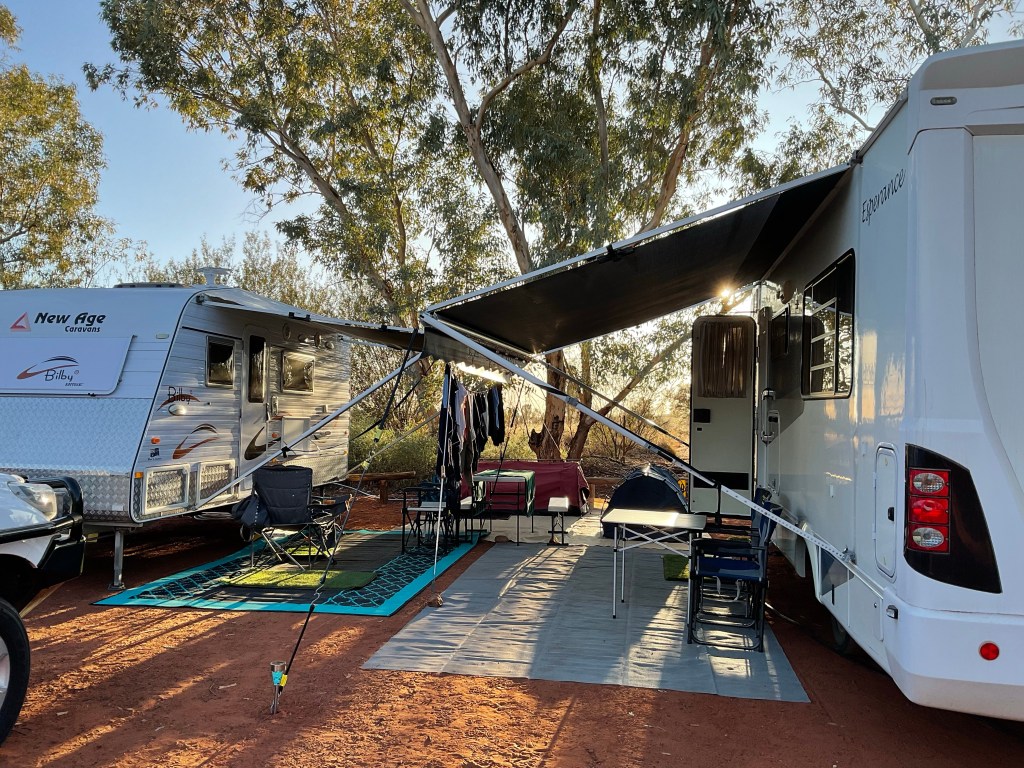
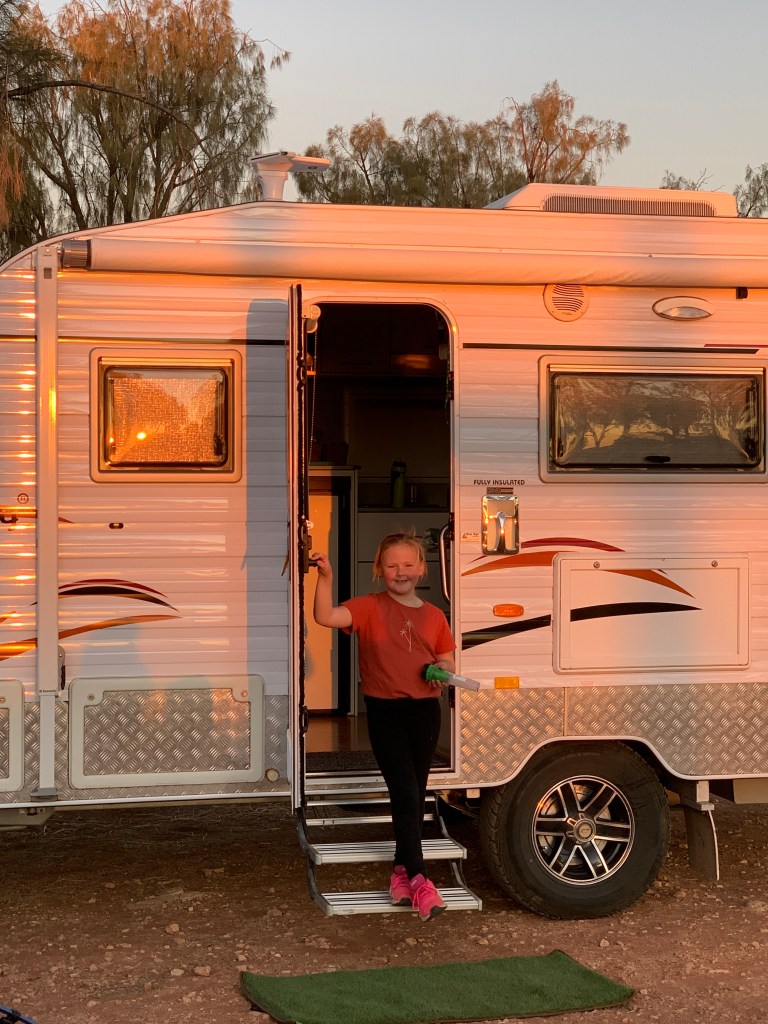
We quickly walked back and moved onto our new sites. We were able to back the van in and drive the motorhome in forwards so our doors and awnings face each other. The kids were so helpful setting up camp. They are old hands at it now.

It took a while to set up camp as we were staying for 6 nights in the one place. I even put up our solar party lights. They would light up when it got dark.

We were all extremely happy with our camp sites.

It was an excited group that set off in the car in the late afternoon to drive out to see the rock. Uluru is about 20km from the campground. Wow. As we got closer we were all amazed. It is so huge that it’s a bit hard to take it all in. We stopped at the sunset viewing point and cars were already staring to park up for the sunset view. We checked out that carpark and decided we’d come back one evening with drinks and nibbles and our camp chairs so we too could sit and wait for the sunset.

We continued on and drove all the way around Uluru with another short stop at the Mala Walk. This is the place that people used to start their journey when you were allowed to climb the rock. Climbing the rock was very dangerous and also offensive to the local Aboriginal people who consider the rock a sacred place. Not a place for tourists to troop all over. I looked at the spot where people used to climb and I’m glad its closed. I’m looking forward to our cycle around it instead.

Back at camp it was Katie’s turn to do dinner and tonight’s was nachos. Delicious and filling. At the dinner table we all talked about what we were grateful for and it was a universal thing. We were all grateful to be on this trip and be finally at Uluru. We all felt very fortunate.

Tomorrow we will explore the village/resort and in the afternoon we will be going on a camel ride. How exciting! I’ve never been on a camel!

Off to The Rock

As Katie had some school and uni work to do Rich and I took her car and set off with Maddie in search of some wood for our campfires. We left the boys behind to get their swags packed up. Katie was able to use our RV wifi and logon to do her work.

There’s a Mitre10 in Alice so we headed there first. They usually have wood. We were able to get a bag of firewood and a bag of kindling. All set for our free camp that night.

Next stop was the chemist and we found one just near the Coles Supermarket. The shopping centre in the Alice CBD is quite good with all the usual shops you would expect in a town of that size. There’s a Woolworths and Coles Supermarkets and a large Kmart as well as most of the chain stores.

We arrived back at the park to find Katie had finished her school and uni work and was ready to pack up and hit the road. We set off just before 10am. We like the Discovery Park at Alice Springs and recommend it, especially to families as they cater very well for children with lots to do. There’s a couple of playgrounds, two jumping pillows, the swimming pools with water slide, free shows in the evening and you can even hire pedal go-karts. The amenities blocks are large and cater well for the large park. The camp kitchen near us was quite large with lots of room for many families.
There was quite a bit of excitement in the vehicles as we set off south. We were finally on our way to Uluru. Our original plan was to visit Uluru first, then Kings Canyon then Alice and the West MacDonnells however that had to be changed simply because the campground at Ayers Rock was completely booked out for two weeks. So our plan became Alice Springs and the West MacDonnells, then Uluru, then Kings Canyon then home again. So this day we were finally on our way to the big red rock.

It’s 475km from Alice to Yulara (the township nearest Uluru) so we thought we’d free camp somewhere along the way and arrive at Yulara the next day.

We had an uneventful trip to Erldunda, which claims to be the Centre of the Centre, where we pulled over to have a lunch break. We did pull into the road house however they had renovations going on at the pumps and it was a bit chaotic. The queue for the one working petrol pump was some 12 caravans long and as we didn’t really need fuel we continued on around the corner and pulled off the road where two vans were already pulled in. We’d turned the corner so we’d left the Stuart Highway and were now on the Lassiter Highway heading west.

The Lassiter Highway forms part of the Outback Way, otherwise known as Australia’s Longest Shortcut. This route goes from Winton in outback Queensland to Alice then to Yulara and across the desert to Laverton in WA. It is 2,700km long and has a current project happening to eventually tar the entire length. That will be amazing. We met a couple at Glen Helen who had driven across from WA. They said it took them 2 days to get to Yulara from Laverton and was much quicker for them than going all the way around across the Nullarbor. And that was with most of the way still being dirt.

We drove through Mt Ebenezer and it was a bit sad. The roadhouse and other buildings were all boarded up and derelict. It obviously was a thriving roadhouse once.

The countryside on the way to Yulara is vast woodland plains with low scrubby trees and shrubs. We hadn’t seen any sign of life though apart from the occasional bird of prey and the humans in vehicles. Hadn’t even seen a lizard on the road.

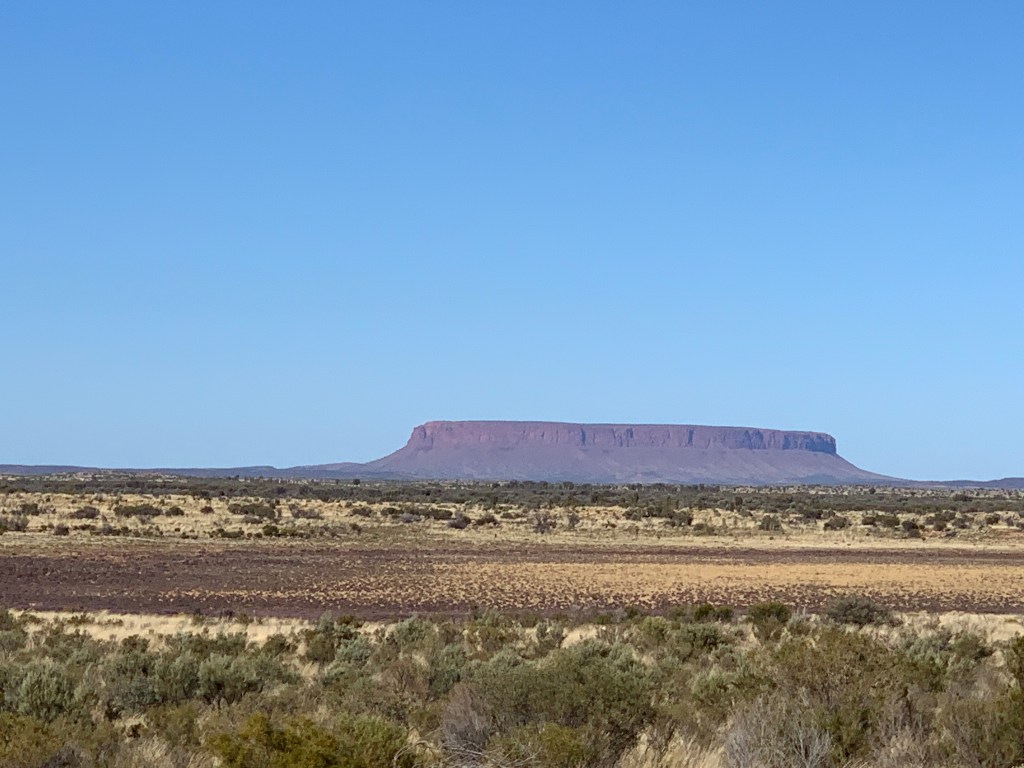
As we approached our camp spot for the night at Petermann Rest Stop (Curtin Springs East) we got our first glimpse of Mt Connor.

Wow wow wow. If Uluru is bigger then I’m going to be gobsmacked!

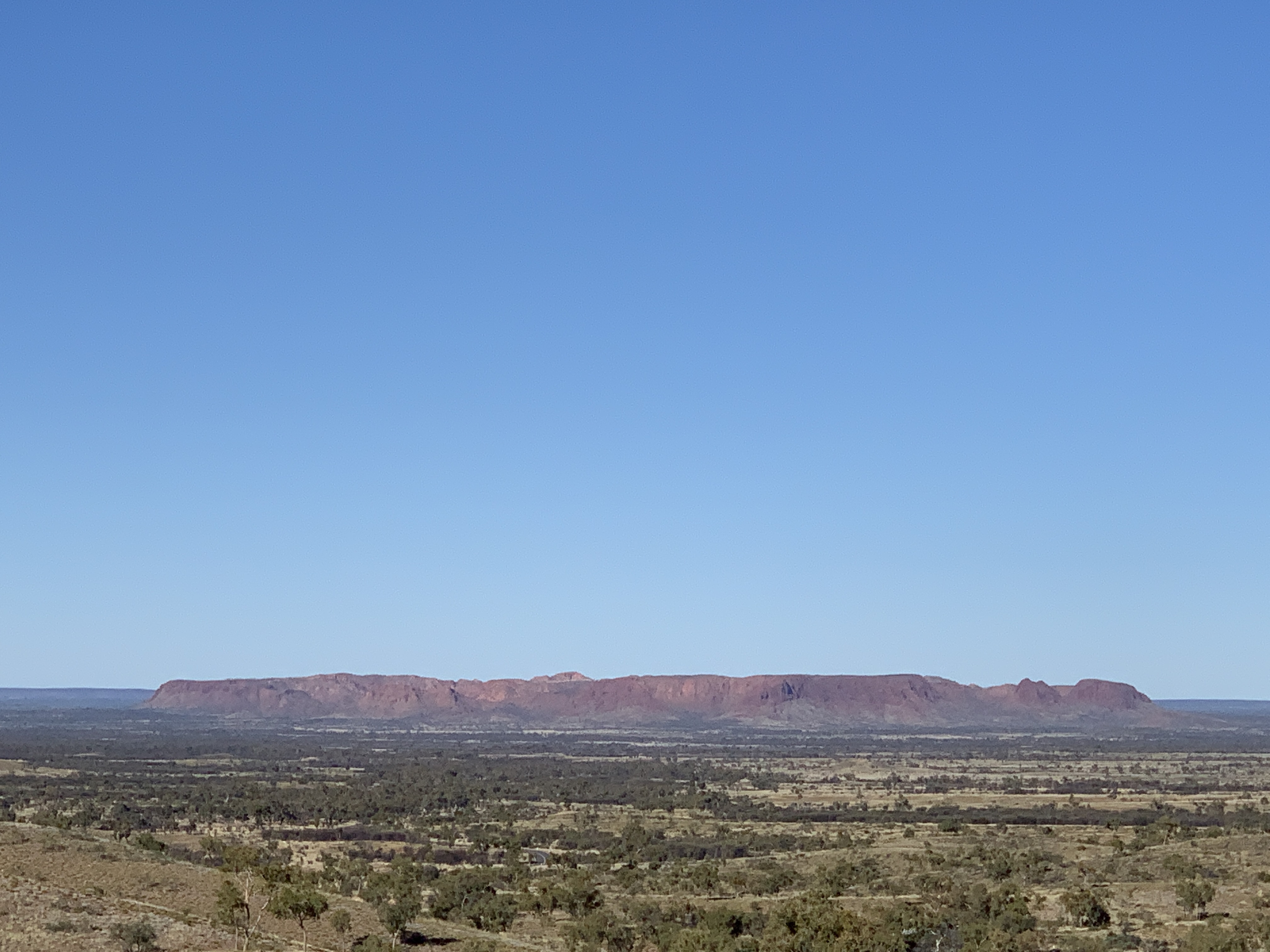
Mt Connor is a flat topped mesa that rises out of the desert to a height of 859m. It was glowing pink in the afternoon sun. People traveling to Uluru often mistake Mt Connor for Uluru so it is also known as Foolaru.

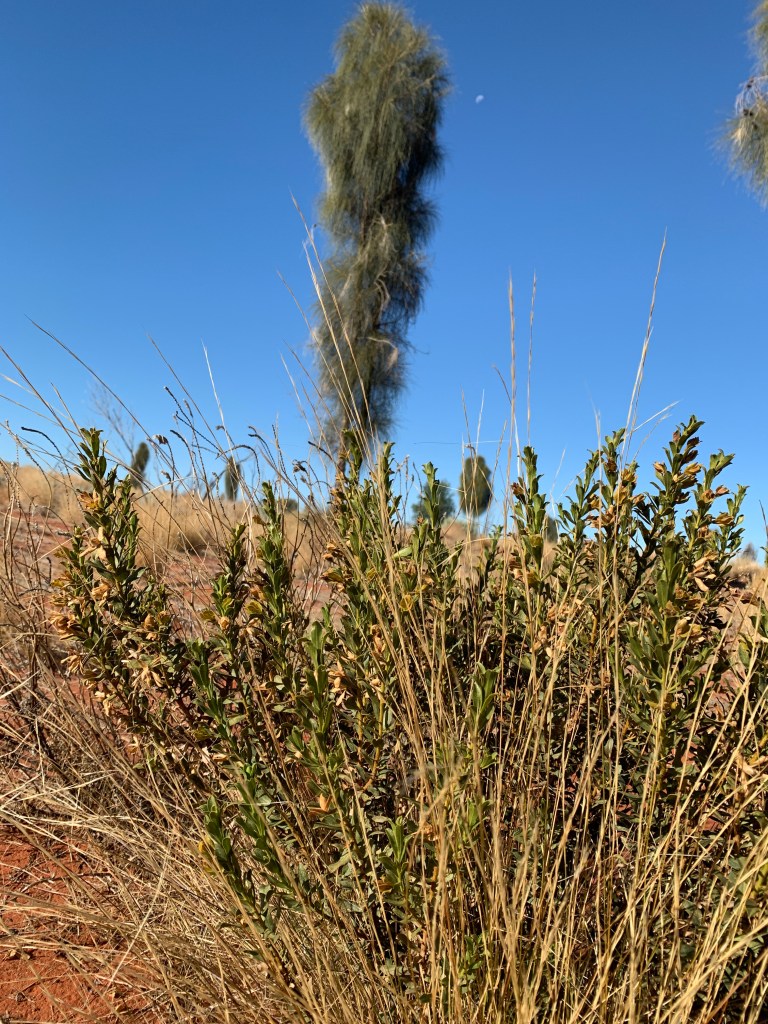
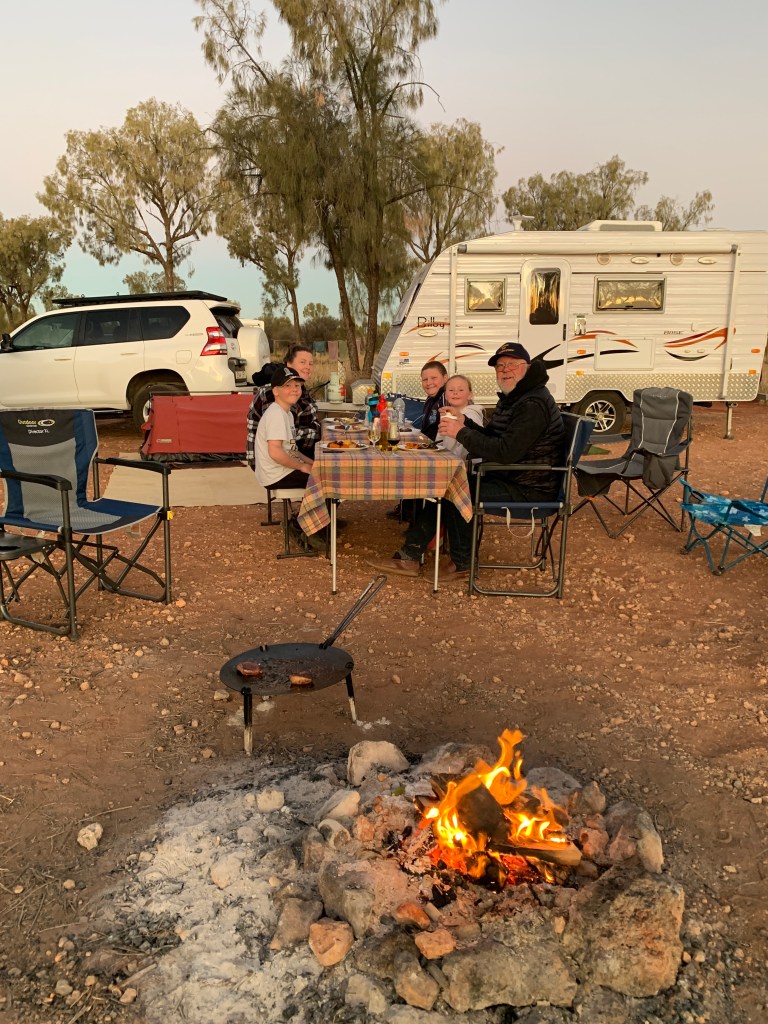
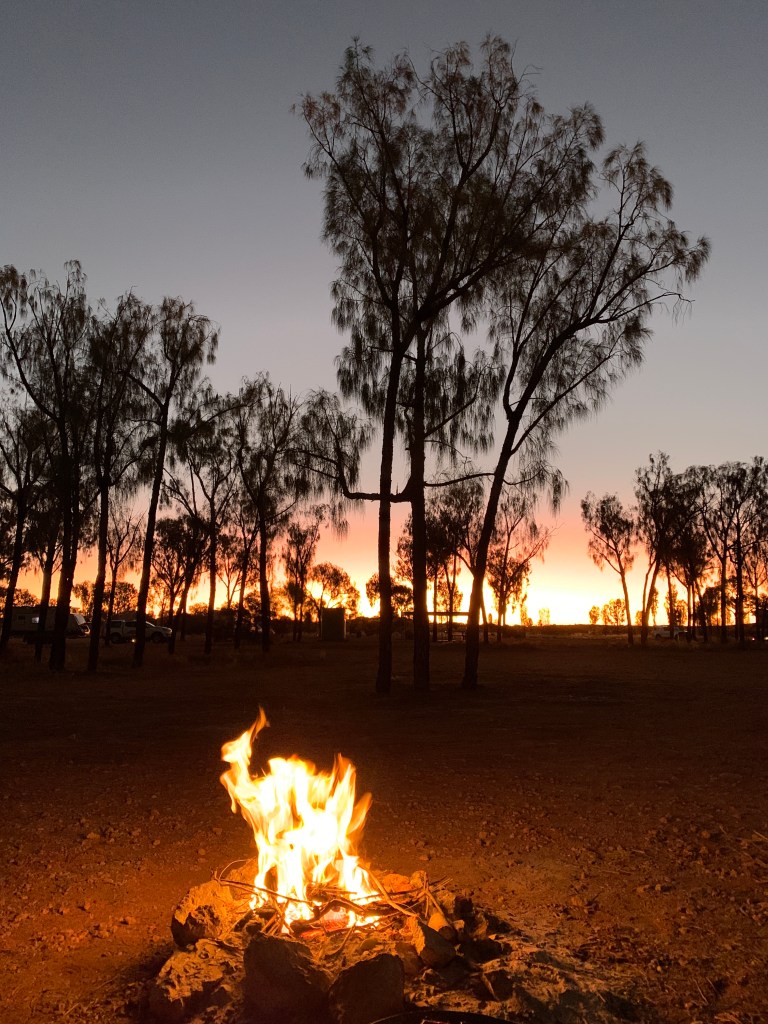
We chose our camp spot well. We pulled into the Petermann Rest Area and we were the only ones there. We were able to get well back from the road and set up around a little fire pit with our vehicles blocking the prevailing wind. We are surrounded by fabulous Desert Oak trees. We love these strange looking trees. The kids think they look like The Lorax from Dr Seuss.

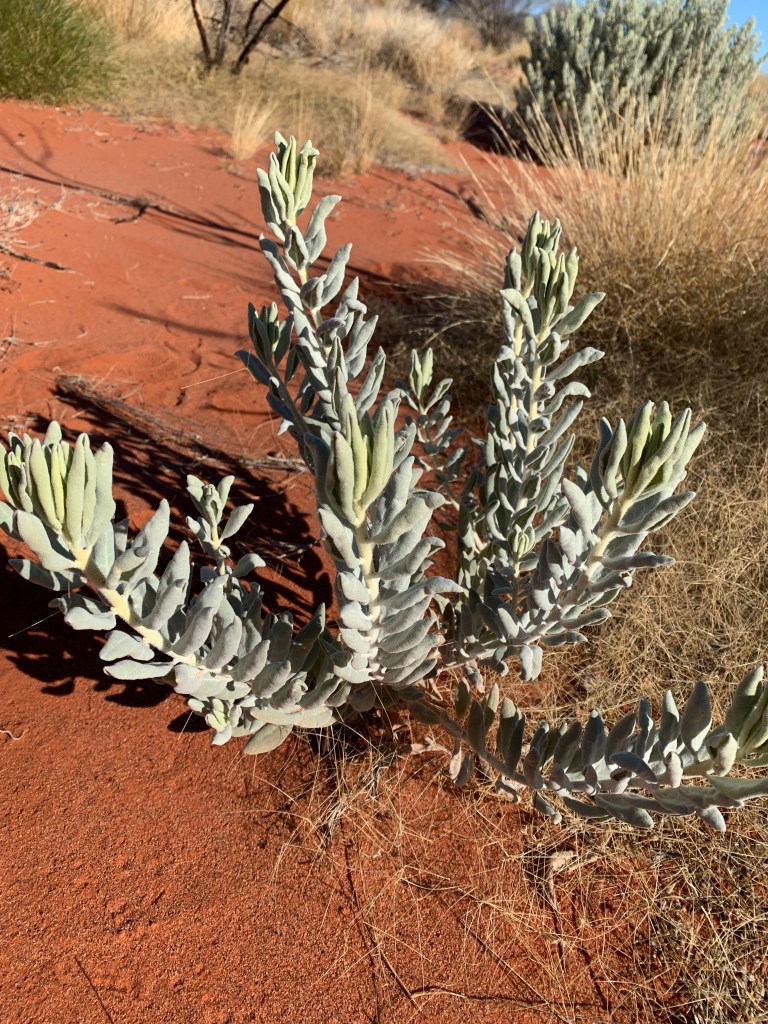
While Richard got the wood ready for our fire the rest of us went for a walk over the sand dunes to get a good look at Mt Connor. Wow, just wow. I love all the different plants you find in the desert. Lots of red sand and there are these fabulous plants.

Riley and Pa cooked our steaks on the Biji-BBQ. Riley is becoming quite the BBQ cook. Our steaks were accompanied by baked potato and pumpkin and a rocket, beetroot, feta & walnut salad. Scrumptious!

After dinner we sat around our lovely little camp fire and played a silly word game. This game involves each person saying only two words then the next person says two words and adds to the story. Our story ended up being about an ugly princess who had warts and hairy armpits. She had a sister who had a boyfriend who fought unicorns. It was hilarious. There was lots of giggles to see who could say the next silliest thing. What a funny evening.

As we only had 120km to go to arrive at Yulara the next day we decided to have a sleep-in morning and aim to set off by 10. The night wasn’t as cold as the recent ones in the West MacDonnells.

Back to Alice Springs via Hermannsburg

We packed up and left Glen Helen before 9am and headed further west. The plan was to follow the road around in a big loop to Hermannsburg then back to Alice.

Looking towards Mt Sondor

We had a few laughs the last few days at the Winding Road signs. We came across them on the way to Redbank Gorge and further on. What passes for a winding road in the NT is really just a few bends. They didn’t seem like winding roads to us at all.

Now going to the Snowy Mountains there are winding roads!

We pulled in to check out Tylors Pass Lookout. From there you get a fantastic view across to Gosse Bluff. About 140 million years ago a space object, thought to be a comet about 600m across, crashed to earth on that spot. The shock waves shattered the rocks and stood them on them on end. Over time the rocks have eroded away and the formation is now about 5km in diameter. You can visit Gosse Bluff and camp there however the road in is 4WD only so not for us. It’s still pretty impressive even from the lookout.

We passed the Mereenie Loop Road intersection. This is the way to Kings Canyon if you don’t mind going on the dirt. You also need a permit to travel on that road.

We noticed signs for horses in the area and there was plenty of evidence left by them on the road. Katie and the kids saw a horse on the side of the road. It appeared to be struggling to get up. Maybe it was hit by a car or maybe it was having a foal or maybe it was just sick. We kept our eyes peeled but didn’t see any more horses.

We did see a mob of about 20 donkeys. That was a bit of a surprise!

One of the most famous Aboriginal painters, Albert Namatjira lived at Hermannsburg. He was a Western Arrernte man and became the first commercially and internationally acclaimed Aboriginal artist with his works being displayed and sold all around the world.

The Historic Precinct of Hermannsburg is 130kms west of Alice Springs and 107km from Glen Helen. It is a sealed road all the way. Hermannsburg was established in 1877 by Lutheran missionaries from Hermannsburg, Germany. The missionaries at Hermannsburg saw from the beginning the importance of learning and recording the written form of the local Aranda language. The mission children were educated in both English and Aranda. The Christian message was still at the heart of the mission philosophy. The missionaries forged a strong relationship with the Aranda people that continues to this day.

The land was returned to the Aranda people in 1982 and the buildings at Hermannsburg fell into disrepair. Local Aranda leader, Kasper Gus Ntjalka Williams, helped have the site declared a National Heritage Place in 2006. This has enabled funding to assist with improvements and signage for the many visitors to the area.

We arrived back in Alice around lunchtime and first stop was for fuel and gas bottles. We checked in to the Discovery Parks – Alice Springs where we were just a few days ago. While Richard and the boys stayed behind, Katie, Maddie and I set off to get the groceries.
OMG what on earth was going on in Alice? The supermarket was packed with people. There was hardly any bread left, all the long life milk was gone, there was hardly any toilet paper, the checkout queues were 4-5 deep. It was like Christmas shopping!! No one batted an eyelid though and the checkout lady said this was normal.
Back at camp it was time to get washing done. The inside of the motorhome looks like a laundry with clothes hanging everywhere to dry.

We head off towards Uluru in the morning and I think everyone is a bit excited about that.